
Welcome to Hyperion Records, a British classical label devoted to presenting high-quality recordings of music of all styles and from all periods from the twelfth century to the twenty-first.
Hyperion offers both CDs, and downloads in a number of formats. The site is also available in several languages.
Please use the dropdown buttons to set your preferred options, or use the checkbox to accept the defaults.

 RECORDING PERFORMANCE
from notes by Peter Phillips © 2007
extrait des notes rédigées par Peter Phillips © 2007
Français: Gimell
aus dem Begleittext von Peter Phillips © 2007
Deutsch: Renate Wendel
 Byrd: Sacred Works Byrd: Sacred WorksSIGCD7762CDs Download only  This fine set offers an opportunity to experience the rich liturgy of Saint Thomas Fifth Avenue, a showcase for the music of William Byrd, and the welcome unearthing of a pioneering recording of The Great Service from 1981 and not previously avail ...» More |
 Byrd: Playing Elizabeth's Tune Byrd: Playing Elizabeth's TuneStudio Master: CDGIM992Download onlyStudio Master FLAC & ALAC downloads available  Peter Phillips directs The Tallis Scholars in sacred music by William Byrd, recorded while filming for the BBC in Tewkesbury Abbey.» More |
 Byrd: The Tallis Scholars sing William Byrd Byrd: The Tallis Scholars sing William ByrdCDGIM2082CDs for the price of 1 — Download only "England has never produced a greater composer than William Byrd. His music for the Anglican Church has been sung without interruption since the 16th century. In stark contrast his Catholic music was not heard for over 300 years. This specially pr ...» More |
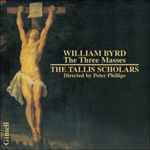 Byrd: The three Masses Byrd: The three MassesCDGIM345Download only The original release on CD of this classic recording of the three Masses by William Byrd.» More |
 Renaissance Giants Renaissance GiantsCDGIM2072CDs for the price of 1 — Download only "The Renaissance is well known for its cultural giants. Leonardo da Vinci, Raphael, and above all Michelangelo epitomize a period when the human spirit seemed to grow and gain in confidence. This collection of complete works celebrates the musical ...» More |
 A choral tapestry A choral tapestryStudio Master: SIGCD283Download onlyStudio Master FLAC & ALAC downloads available A Choral Tapestry' explores the rich vocal timbres of sacred vocal music spanning five centuries. Interweaving genres create an ethereal sonic tapestry that centres around the haunting beauty of William Byrd's Mass for Four Voices. The programme i ...» More |
 Naked Byrd, Vol. 2 Naked Byrd, Vol. 2SIGCD235Download only Tavener, Purcell, Barber and Byrd, were 3 composers who wore their hearts on their sleeves, and whose art saw their emotions laid bare, in an atmospheric concert with the Armonico Consort, where magical musical moments are intertwined with sublime ...» More |
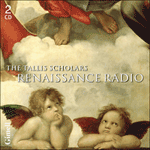 Renaissance Radio Renaissance RadioCDGIM2122CDs for the price of 1 — Download only Sacred Music from the Renaissance Era for Celestial and Secular Radio. When Peter Phillips founded The Tallis Scholars in 1973 sacred vocal music from the Renaissance Era was seldom heard on radio. Now it is firmly established as one of the great ...» More |
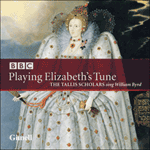 Byrd: Playing Elizabeth's Tune Byrd: Playing Elizabeth's TuneGIMDN902SOLD OUT!This album is not available for download NTSC FORMAT DVD. Filmed performances of sacred music by William Byrd together with a documentary on the troubled times that produced some of the most intimate and passionate sacred music ever written.» More |
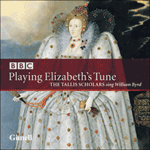 Byrd: Playing Elizabeth's Tune Byrd: Playing Elizabeth's TuneGIMDP901SOLD OUT!This album is not available for download PAL FORMAT DVD. Filmed performances of sacred music by William Byrd together with a documentary on the troubled times that produced some of the most intimate and passionate sacred music ever written.» More |
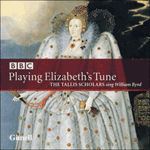 Byrd: Playing Elizabeth's Tune Byrd: Playing Elizabeth's TuneGIMSA592SOLD OUT!This album is not available for download SACD. Peter Phillips directs The Tallis Scholars in sacred music by William Byrd, recorded while filming for the BBC in Tewkesbury Abbey.» More |