
Welcome to Hyperion Records, a British classical label devoted to presenting high-quality recordings of music of all styles and from all periods from the twelfth century to the twenty-first.
Hyperion offers both CDs, and downloads in a number of formats. The site is also available in several languages.
Please use the dropdown buttons to set your preferred options, or use the checkbox to accept the defaults.

| Andrew Kennedy (tenor), Dante Quartet, Simon Crawford-Phillips (piano)» More |
| Adrian Thompson (tenor), Delmé Quartet, Iain Burnside (piano)» More |
| John Mark Ainsley (tenor), The Nash Ensemble, Leo Phillips (violin), Elizabeth Wexler (violin), Roger Chase (viola), Paul Watkins (cello), Ian Brown (piano)» More |
 PERFORMANCE RECORDING
The vocal style of On Wenlock Edge is predominantly syllabic (one syllable per note), with only very occasional melismas (groupings of successive notes within a single vowel sound) deployed to highlight effects such as the fitful gusts of wind in the swirling first movement. The second movement’s opening clearly emanates from the same general inspiration as that of the Tallis Fantasia. The emotional core of the cycle lies in its third and fifth movements, which are separated by only the most fleeting of burlesques: a well-judged respite between two passages of sustained intensity.
‘Is my team ploughing?’ displays a new psychological insight, delineating the drama played out between the living and the departed by alternating muted strings for the voice from below ground with repeated piano chords for the no less unquiet spirit above it. In other contexts the resulting climax could have conveyed spiritual or sensual exultation; but this is short-lived and soon replaced by final disconsolate murmurings from the grave. ‘Bredon Hill’ retains the muted strings, initially balancing them with subdued piano chords to embody what the poet Matthew Arnold captured as ‘All the live murmur of a summer’s day’—a line later set by RVW in An Oxford Elegy (1949). From the stillness progressively emerge distant steeple bells, which rise to a contented tumult before receding again. What follows is a master stroke of simple transformation, as the song’s opening chord is recognizably reprised in altered harmonic form. The expressionist exterior landscape becomes a midwinter of the spirit and a world numbed by loss. Listening to the tolling of the funeral bell (conjured by both plucked and bowed violins doubling the piano), it is easy to imagine the further influence of Ravel, who greatly admired this work by his pupil; but one thinks also of that more macabre bell that permeates ‘Le gibet’, the central tone poem in Ravel’s piano triptych Gaspard de la nuit. Ravel was working on this during 1908, almost immediately after his sessions with RVW—but, as previously noted, parts of On Wenlock Edge already existed in 1906. If there was a line of influence, in which direction did it run? Recurring as if to lend point to this question, Shropshire’s church bells now turn oppressive, their tumult mocking the condition of the speaker’s bereft spirit. After the brokenness of the final, resigned ‘I will come’, the focus recedes and the observation becomes more distant in ‘Clun’, where the fleeting smallness of human life is reflected by a widening vista: the peace of rural Shropshire; the distant bustle of London; an unnamed world beyond this one. The ‘doomsday’ that ‘may thunder and lighten’ at the last seems to be a conflation of the individual’s day of reckoning with ‘Domesday’, that feudal record of Norman England which ‘spared no man, but judged all men indifferently’ (William Lambarde, A perambulation of Kent, 1570).
RVW pragmatically envisaged performances of On Wenlock Edge with only a piano available, and the score contains many alternative deployments for the pianist to adopt in the absence of strings. The work was first performed, with full complement, in London on 15 November 1909. It was published in 1911. A third version, for orchestra, was performed in London on 24 January 1924, under the composer’s baton.
from notes by Francis Pott © 2022
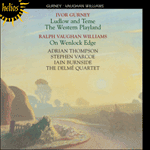 Gurney: Ludlow and Teme & The Western Playland; Vaughan Williams: On Wenlock Edge Gurney: Ludlow and Teme & The Western Playland; Vaughan Williams: On Wenlock EdgeCDH55187Download only  ‘Adrian Thompson's superb performance … is a clear first choice’ (BBC Music Magazine Top 1000 CDs Guide) ‘A recording to cherish’ (Gramophone)» More |
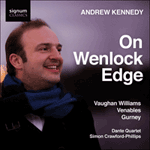 Vaughan Williams, Venables & Gurney: On Wenlock Edge & other songs Vaughan Williams, Venables & Gurney: On Wenlock Edge & other songsSIGCD112Download only  Andrew Kennedy provides the listener with performances from three great English composers ranging from the late nineteenth- century to the present day, namely Vaughan Williams’ great and innovative work, 'On Wenlock Edge', followed by works by Ivo ...» More |
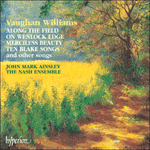 Vaughan Williams: Songs Vaughan Williams: SongsCDA67168 ‘John Mark Ainsley's performance is among his best on record in these austerely beautiful, imaginatively scored settings’ (Gramophone) ‘It would be hard to find an interpreter more beautifully suited to the Blake Songs than John Mark Ainsley’ (BBC Music Magazine)» More |