As a composer of piano music, Mendelssohn is primarily remembered for creating the
Lied ohne Worte, a new type of short character-piece for piano that Robert Schumann described as a ‘song’ with its text suppressed and vocal line transferred to the keyboard, so that the verbal imagery of the poem was magically subsumed in the purely musical, abstract gestures and figurations of the piano. Mendelssohn produced
Lieder ohne Worte throughout his career, publishing no fewer than thirty-six examples in six books between 1832 and 1845; twelve additional
Lieder in two more volumes appeared posthumously. The six
Lieder ohne Worte, Op 67, appeared in 1845, with a dedication to Sophie Rosen, fiancée of the composer’s close friend Karl Klingemann. As with Mendelssohn’s earlier
Hefte of
Lieder ohne Worte, he employed a mixture of keys—flat and sharp, major and minor—and types of
Lieder: solo
Lied in Nos 1, 3 and 6; and solo and duetting textures in Nos 2 and 5. No 1, which features in addition to the melody bell-like static pitches in the soprano, inspired the composer to arrange a piano-duet version for Queen Victoria and Prince Albert. Standing apart is No 4, a brilliant piano piece in the neutral key of C major that, on account of its incessant whirling figures, became known as the
Spinnerlied (‘Spinning song’), a designation, however, not authorized by the composer.
from notes by R Larry Todd © 2021
Comme compositeur de musique pour piano, on se souvient surtout de Mendelssohn pour avoir créé le
Lied ohne Worte («Romance sans paroles»), une nouvelle sorte de petite pièce de caractère pour piano que Robert Schumann décrivit comme une «chanson» dont le texte était supprimé et la ligne vocale transférée au clavier, si bien que l’imagerie verbale du poème était subsumée comme par magie dans les gestes abstraits purement musicaux et les figurations du piano. Mendelssohn écrivit des
Lieder ohne Worte tout au long de sa carrière; il en publia au moins trente-six réunis en six livres entre 1832 et 1845; douze
Lieder supplémentaires dans deux autres volumes parurent à titre posthume. Les six
Lieder ohne Worte, op.67, virent le jour en 1845, avec une dédicace à Sophie Rosen, fiancée d’un ami proche du compositeur, Karl Klingemann. Comme pour ses précédents cahiers de
Lieder ohne Worte, Mendelssohn utilise un mélange de tonalités—bémols et dièses, majeur et mineur—et de types de
Lieder:
Lied solo dans les nos 1, 3 et 6; textures solo et en duo dans les nos 2 et 5. Outre les hauteurs de son statiques aux sonorités de cloches de la mélodie au soprano, le nº 1 inspira au compositeur l’arrangement d’une version pour piano à quatre mains destinée à la Reine Victoria et au Prince Albert. Le nº 4 se situe en marge: c’est une brillante pièce pour piano dans la tonalité neutre d’ut majeur qui, en raison de ses incessantes figures tourbillonnantes, fut surnommée
Spinnerlied («La fileuse»), sans que ce titre reçoive toutefois l’assentiment du compositeur.
extrait des notes rédigées par R Larry Todd © 2021
Français: Marie-Stella Pâris
Als Komponist von Klaviermusik ist Mendelssohn in erster Linie als Schöpfer des
Lieds ohne Worte bekannt. Dabei handelt es sich um eine zu seiner Zeit neue Form eines kurzen Charakterstücks, welches Robert Schumann als „Lied“ beschrieb, wobei der Text ausgelassen und die Gesangslinie auf die Tastatur verlegt wird, so dass sich die Metaphorik des Gedichts in rein musikalischen, abstrakten Gesten und Figurationen des Klaviers ausdrückt. Mendelssohn komponierte seine gesamte Schaffenszeit hindurch derartige Lieder ohne Worte und gab zwischen 1832 und 1845 nicht weniger als 36 davon in sechs sogenannten Heften heraus; 12 zusätzliche
Lieder erschienen in zwei weiteren, posthum veröffentlichten Heften. Das vorliegende Album umfasst die sechs
Lieder ohne Worte, op. 67, die 1845 mit einer Widmung an Sophie Rosen, die Verlobte von Mendelssohns gutem Freund Karl Klingemann, erschien. Ebenso wie in den früheren Heften der
Lieder ohne Worte verwendete der Komponist auch hier eine bunte Mischung von Tonarten—B- und Kreuztonarten, Dur und Moll—sowie unterschiedliche Liedtypen: Sololieder im Falle von Nr. 1, 3 und 6, beziehungsweise Solo- und Duettstrukturen in Nr. 2 und 5. Das erste Stück, in dem sich zu der Melodie glockenartige, statische Klänge gesellen, wurde vom Komponisten zudem für Klavier zu vier Händen eingerichtet, und zwar für die englische Königin Victoria und Prinz Albert. Nr. 4, ein brillantes Klavierstück in der neutralen Tonart C-Dur, nimmt aufgrund seiner unablässigen, umherwirbelnden Figuren eine Sonderstellung ein—es wurde als Spinnerlied bekannt, doch stammt die Bezeichnung nicht von Mendelssohn selbst.
aus dem Begleittext von R Larry Todd © 2021
Deutsch: Viola Scheffel

 PERFORMANCE
 RECORDING
 Mendelssohn: Songs without words

 The earliest French piano recordings

 The Piano G & Ts, Vol. 2 - Alfred Grünfeld, Raoul Pugno & Natalia Janotha
 Irene Scharrer - The complete electric and selected acoustic recordings
 Mendelssohn: Valerie Tryon plays Mendelssohn
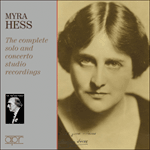 Myra Hess - The complete solo and concerto studio recordings
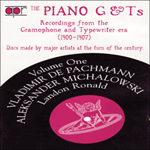 The Piano G & Ts, Vol. 1 - Vladimir de Pachmann, Aleksander Michalowski & Landon Ronald
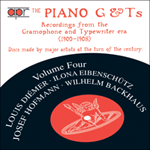 The Piano G & Ts, Vol. 4 - Diémer, Eibenschütz, Hofmann & Backhaus