Welcome to Hyperion Records, a British classical label devoted to presenting high-quality recordings of music of all styles and from all periods from the twelfth century to the twenty-first.
Hyperion offers both CDs, and downloads in a number of formats. The site is also available in several languages.
Please use the dropdown buttons to set your preferred options, or use the checkbox to accept the defaults.


Roerich and Stravinsky started work in the spring (fittingly) of 1910, but by autumn the composer had set aside his sketches to concentrate on Petrushka, and he did not return to the project until the summer of 1911, after Petrushka had reached the stage as the star item of Diaghilev’s third Paris season. By the end of September—writing from his home in Clarens, on Lake Geneva, where most of the composition was done—he was able to report good progress to Roerich, and to remark how ‘the music is coming out very fresh and new’. In the spring of the following year he played through what he had composed, which included the whole of the first part, to Diaghilev and Nijinsky. All seemed set for a premiere the coming summer. However, Michel Fokine, Diaghilev’s choreographer, was fully occupied with preparing Daphnis et Chloé, to Ravel’s music, so Stravinsky’s new score would have to remain silent another year.
By the time rehearsals began in January 1913, Diaghilev had given the task of choreographing ancient rites—and modern rhythms—to Nijinsky, who had made his debut as a dance inventor with L’après-midi d’un faune, to Debussy’s Prélude, the year before. In March, Pierre Monteux, who was to conduct, began rehearsals in Paris, and wrote to the composer, in Switzerland:
What a pity that you could not … be present for the explosion of The Rite.
But Stravinsky was certainly there two months later, for the premiere on 29 May 1913, when the explosion of the music from the pit of the Théâtre des Champs-Elysées was answered by an outburst from the auditorium. By all accounts—and there were many—the performance was accompanied by shouts, catcalls, derisory comments, angered ripostes and even fistfights. But then, how should people have sat calmly while the world was changing?
Though set in prehistory, The Rite was the first music of the machine age, and its energy and din have resounded on. This insistent, repetitive noise was meant to be provocative. Stravinsky had passed through a belated musical adolescence; he was ready both to kick over his Russian traces (no more exotic colour and folklore à la Rimsky-Korsakov and Borodin) and to prove himself to his new Parisian friends, who included Debussy and Ravel. For three centuries, music had been based on the regular rhythmic patterns of civilised dance. The Rite of Spring changed all that. The unit now was not the orderly bar but the eruptive beat. Bar lengths could alter from moment to moment, creating a turmoil of syncopations. Beats could be grouped to create themes whose identities are principally rhythmic.
A musical work could not only sound like a machine but be one, rotating on cogwheels of rhythm, chopping up lengths of time.
The Rite of Spring is machine-like, too, in its form, being made of bits and pieces, with abrupt cuts from one thing to another. To that extent, it is one of the first pieces of music made like a film. There are no developing themes; instead, sections are related at the most fundamental levels of their musical scale (often one of the old scales of eastern European folksong), rhythmic unit and tempo. The climax in each of the two parts comes when pulsation becomes rampant, in the ‘Dance of the Earth’ and the ‘Sacrificial Dance’. Ritual is recreated as arithmetic. We know that spring is brought about not by human sacrifice but by the rotation of our planet—by, indeed, the ‘dance of the earth’, a dance of force and distance and angle. But spring’s creation of new life does indeed entail death, the death of what was. So it is here, as musical ideas are beaten to death in these great culminations of sound, and as the late Romantic orchestra, the orchestra of Mahler and Richard Strauss, discovers unsuspected powers.
Stravinsky realised that The Rite was unrepeatable. However, the work’s most essential and radical qualities—pulsing rhythm, repetition, the use of rhythmic shape as theme, the creation of continuity through breaks, the evocation of antiquity by modern means—stayed with him right through the half century and more of his composing life to come. More than that, they are with us still, for composers in every generation have gone on living in the long summer this spring ushered in.
The first of the ballet’s two parts, ‘Adoration of the Earth’, begins with a slow and supple ‘Introduction’ scored largely for woodwind instruments. A lone bassoon calls out over the sleeping orchestra and is eventually answered by a cor anglais; then other groups stir themselves, already in conflicting metres. Activity stops. The bassoon’s call is heard again, and this time elicits a pounding rhythm of massed strings mimicking drums with heavy offbeat accents from horns—the music of ‘The Augurs of Spring: Dances of the Young Girls’. With no change to its insistent pulse, this section accumulates layers of tune and repeated figure, then breaks into a racing speed for the ‘Ritual of Abduction’, with excited horn calls and fizzing strings. Calm is restored by a melody for clarinets linked together two octaves apart, against trills from flutes. This opens ‘Spring Rounds’, a dance continuing at a heavy rhythm and soon moving to a threatening climax, from which the music bursts off again rapidly, only to lead to a return of the calm episode, slightly differently scored. Now the outcome is the exuberant ‘Ritual of the Rival Tribes’, with hurtling gestures and stand-offs. An awesome, menacing march is started by trombones, who keep going amid the throng, and introduce ‘The Procession of the Sage’. There is a pause. Four quiet bars—‘The Sage’—suggest a moment of anticipation and a crucial act, to a chord for string soloists playing harmonics. This unleashes the mighty ‘Dance of the Earth’.
An ‘Introduction’ also opens the second part, ‘The Sacrifice’, this time with wafting harmonies from different groups, altogether suggesting a forest of colour. Trumpets sound a warning note, and horns announce the folksong-like theme of the ‘Mystic Circles of the Young Girls’, a theme taken up by strings and passed around the orchestra. But the peaceful atmosphere is interrupted again by brass warnings, and a steady barrage of drumming leads into the quick slicing movements and rushes of ‘Glorification of the Chosen One’. The end is being prepared. Almost all the wind instruments lift their voices together in ‘Evocation of the Ancestors’, followed by ‘Ritual Action of the Ancestors’, which begins ominously and develops immense power. Its energy is left swilling around a few low woodwind instruments, then slips away into the ‘Sacrificial Dance’. Unprecedented, even within this score, for its rhythmic savagery, driven by a pulse that refuses to stay still, here the music ends—indeed, forcibly ends itself.
from notes by Paul Griffiths © 2022
Roerich et Stravinsky commencent à travailler au printemps (comme il se doit!) de l’année 1910, mais, à l’automne, le compositeur met de côté ses esquisses pour se concentrer sur Petrouchka, et il ne reviendra au projet qu’à l’été 1911, après que Petrouchka fut devenu la vedette de la troisième saison parisienne de Diaghilev. À la fin du mois de septembre—écrivant depuis sa maison de Clarens, au bord du lac Léman, où la majeure partie de la composition a été réalisée—, il est en mesure de faire part à Roerich des progrès réalisés, et de lui confier que «la musique vient fraîche et nouvelle». Au printemps de l’année suivante, il fait écouter à Diaghilev et à Nijinsky ce qu’il a composé, dont l’intégralité de la première partie. Tout semble prêt pour une première l’été suivant. Cependant, Michel Fokine, le chorégraphe de Diaghilev, est tout occupé à préparer Daphnis et Chloé, sur la musique de Ravel, de sorte que la nouvelle partition de Stravinsky devra encore attendre une année.
Avant que les répétitions ne commencent en janvier 1913, Diaghilev a confié le soin de chorégraphier les rites anciens—et les rythmes modernes—à Nijinsky, qui a fait ses débuts de chorégraphe novateur avec L’Après-midi d’un faune, sur le Prélude de Debussy, l’année précédente. En mars, Pierre Monteux, qui devait diriger l’orchestre, commence les répétitions à Paris et écrit au compositeur, resté en Suisse:
Quel dommage que vous n’ayez pas pu être là, et surtout que vous n’ayez pas pu assister à l’explosion du Sacre.
Mais Stravinsky est bien là deux mois plus tard, pour la première, le 29 mai 1913, lorsque «l’explosion» de la musique depuis la fosse du Théâtre des Champs-Élysées est suivie d’une autre «explosion» dans la salle. Au dire de tous—et nombreux furent les témoignages—, la représentation fut l’occasion de cris, de huées, de commentaires désobligeants, de ripostes hargneuses, et même de bagarres. Mais, d’un autre côté, comment les gens auraient-ils pu rester tranquillement assis quand le monde était en train de changer?
Bien qu’il se déroule aux temps préhistoriques, le Sacre est la première musique de l’ère de la machine, et son énergie et son vacarme résonnent encore aujourd’hui. Ce bruit insistant et répétitif se voulait provocateur. Stravinsky avait connu une adolescence musicale tardive; il était prêt à la fois à se débarrasser de ses empreintes russes (plus de couleur exotique et de folklore à la Rimsky-Korsakov et à la Borodine) et à faire ses preuves auprès de ses nouveaux amis parisiens, dont Debussy et Ravel. Pendant trois siècles, la musique avait été fondée sur les motifs rythmiques réguliers de la danse civilisée. Le Sacre du Printemps changeait tout cela. L’unité à laquelle se référer n’était plus désormais la mesure bien ordonnée mais le battement éruptif. La longueur des mesures allait pouvoir varier à tout moment, créant des bouleversements syncopés. Les battements allaient pouvoir être regroupés pour créer des thèmes dont l’identité serait avant tout rythmique. Une œuvre musicale pourrait non seulement sonner comme une machine, mais aussi en être une, tournant sur des roues dentées de rythme, découpant les longueurs des durées.
Le Sacre du Printemps ressemble, lui aussi, à une machine, dans sa forme, car il est constitué de pièces et de morceaux, avec des coupures abruptes entre les éléments le constituant. A ce titre, c’est l’un des premiers morceaux de musique réalisés comme un film. Il n’y a pas de thèmes susceptibles de développements; au contraire, les sections sont reliées entre elles aux niveaux les plus fondamentaux de leur gamme musicale (souvent une des anciennes gammes du folklore d’Europe de l’Est), de leur unité rythmique et de leur tempo. Dans chacune des deux parties, le point culminant est atteint lorsque la pulsation se déchaîne, dans la «Danse de la Terre» et la «Danse sacrale». Le rituel est recréé comme une arithmétique. Nous savons que le printemps n’est pas provoqué par un sacrifice humain, mais par la rotation de notre planète—par, en fait, la «danse de la Terre», une danse de force, de distance et d’angle. Mais la création d’une nouvelle vie par le printemps implique bien la mort, la mort de ce qui était. Il en va de même ici, alors que les idées musicales sont battues à mort dans ces grandes culminations sonores, et que le presque défunt orchestre romantique, l’orchestre de Mahler et de Richard Strauss, se découvre des pouvoirs insoupçonnés.
Stravinsky s’est rendu compte qu’un événement tel que Le Sacre ne pourrait jamais être répété. Cependant, les qualités les plus essentielles et les plus radicales de l’œuvre—la pulsation rythmique, la répétition, l’utilisation de la forme rythmique comme thème, la création d’une continuité par ruptures successives, l’évocation de l’Antiquité par des moyens modernes—l’auront accompagné tout au long du demi-siècle et plus de la vie de compositeur qu’il lui restait à vivre. Plus encore, elles sont toujours avec nous, car des compositeurs de toute génération ont continué à vivre durant le long été que ce printemps a finalement permis.
La première des deux parties du ballet, «L’Adoration de la Terre», commence par une «Introduction» lente et souple, écrite essentiellement pour des instruments à vent. Un basson solitaire sollicite l’orchestre endormi, auquel répond finalement un cor anglais; puis d’autres groupes instrumentaux s’agitent, déjà dans des mètres contradictoires. L’activité cesse. L’appel du basson se fait à nouveau entendre et, cette fois-ci, il cède la place à un rythme martelé de toutes les cordes réunies, imitant des tambours avec de lourds accents décalés de la part des cors—la musique des «Augures printaniers—Danses des adolescentes». Sans changement aucun au niveau de sa pulsation insistante, cette section accumule des couches de mélodies et de figures répétées, puis s’accélère pour le «Jeu du rapt», avec des appels de cors surexcités et des cordes effervescentes. Le calme est rétabli par une mélodie pour clarinettes associées à deux octaves d’intervalle, sur fond de trilles de flûtes. Cela débouche sur «Rondes printanières», une danse exécutée sur un rythme pesant et qui atteint bientôt un point culminant menaçant, à partir duquel la musique explose à nouveau sans attendre, pour aboutir à un retour de l’épisode calme, sur une partition légèrement différente. Puis vient le très énergique «Jeux des cités rivales», avec ses gestes précipités et ses esquives. Une marche impressionnante et menaçante est amorcée par les trombones, qui continuent à avancer au milieu de la foule, et introduisent «Cortège du sage». Survient une pause. Quatre mesures calmes—«Le Sage»—laissent penser à un moment d’anticipation et à une action cruciale à venir, sur un accord pour les cordes solistes jouant des harmoniques. La puissante «Danse de la Terre» peut alors commencer.
Une «Introduction» ouvre également la deuxième partie, «Le Sacrifice», avec cette fois-ci des harmonies flottantes provenant de différents groupes instrumentaux, suggérant au bout du compte, tous réunis, une forêt de couleurs. Les trompettes émettent une note d’avertissement et les cors annoncent le thème folklorique de «Cercles mystérieux des adolescentes», un thème repris par les cordes et transmis à l’orchestre tout entier. Mais l’atmosphère paisible est à nouveau perturbée par les avertissements des cuivres, et un déferlement de percussions nous achemine vers les mouvements rapides et tranchants de «Glorification de l’élue». La fin est imminente. Presque tous les instruments à vent prennent la parole d’une seule voix dans «Évocation des ancêtres», suivi par «Action rituelle des ancêtres», qui commence de manière sinistre et témoigne d’une incroyable puissance. Son énergie tourbillonne autour de quelques instruments à vent graves, puis gagne la «Danse sacrale». Sans précédent, et même au sein de cette partition, pour sa sauvagerie rythmique, entraînée par une pulsation qui refuse de s’assagir, la musique s’arrête là—en fait, c’est contrainte et forcée qu’elle s’arrête.
extrait des notes rédigées par Paul Griffiths © 2022
Français: Pascal Bergerault
Roerich und Strawinski begannen (passenderweise) im Frühjahr 1910 mit der Arbeit, im Herbst jedoch hatte der Komponist die Skizzen beiseitegelegt, um sich auf Petruschka zu konzentrieren, und wandte sich dem Projekt erst wieder im Sommer 1911 zu, nachdem Petruschka als Hauptattraktion von Djagilews dritter Pariser Spielzeit inszeniert worden war. Ende September konnte er Roerich—von seinem Wohnhaus in Clarens am Genfer See, wo ein Großteil der Komposition entstand—gute Fortschritte vermelden: „Die Musik kommt sehr frisch und neu aufs Papier.“ Im Frühjahr des folgenden Jahres spielte er das bisher Komponierte, darunter den gesamten ersten Teil, Djagilew und Nijinski vor, und alles schien auf eine Premiere im kommenden Sommer hinzuweisen. Allerdings war Michel Fokine, Djagilews Choreograf, vollauf damit beschäftigt, Daphnis et Chloé zu Ravels Musik zu gestalten, sodass Strawinskis neue Partitur ein weiteres Jahr warten musste.
Als im Januar 1913 schließlich die Proben begannen, hatte Djagilew die Choreografie der alten Riten—und der modernen Rhythmen—Nijinski überantwortet, der im Jahr zuvor sein Debüt als Erneuerer des Tanzes mit L’après-midi d’un faune zu Debussys Prélude gegeben hatte. Im März begann Pierre Monteux, der ausersehene Dirigent, in Paris mit den Proben und schrieb dem Komponisten in die Schweiz:
Wie schade, dass Sie … bei der Explosion des Sacre nicht dabei sein konnten.
Natürlich aber war Strawinski dabei, als zwei Monate später bei der Premiere am 29. Mai 1913 im Théâtre des Champs-Elysées auf die musikalische Explosion aus dem Graben eine Explosion im Publikum folgte. Den Berichten zufolge—und davon gab es viele—wurde die Aufführung begleitet von Schreien, Buhrufen, abschätzigen Bemerkungen, geharnischten Widerworten und sogar Raufereien. Aber warum hätten die Menschen auch stillhalten sollen, wenn die Welt um sie her sich veränderte?
Le sacre mag in vorgeschichtlicher Zeit spielen, doch war es die erste Musik des Maschinenzeitalters, und seine Energie und sein Getöse zeigten nachhaltige Wirkung. Dieser insistente, repetitive Lärm wollte bewusst provozieren. Strawinski hatte verspätet eine musikalische Pubertät durchlaufen und war bereit und willens, sowohl seine russischen Relikte auszutreiben (keine exotischen Farben mehr, keine Folklore à la Rimski-Korsakow und Borodin mehr), als auch, sich seinen neuen Pariser Freunden zu beweisen, zu denen unter anderem Debussy und Ravel gehörten. Drei Jahrhunderte lang hatte Musik auf den regelmäßigen rhythmischen Mustern des zivilisierten Tanzes beruht. Mit Le sacre veränderte sich das auf einen Streich. Als Einheit diente jetzt nicht mehr der ordentliche Takt, sondern der explosive Schlag. Taktmaße konnten sich jederzeit verändern und damit einen Wirbelwind von Synkopen entfesseln. Schläge konnten zu Gruppen verbunden werden und damit Themen schaffen, deren einziges Kennzeichen Rhythmik war. Ein Musikwerk konnte nicht nur klingen wie eine Maschine, sondern tatsächlich auch eine sein, sich auf rhythmischen Zahnrädern drehen und Zeitlängen zerhacken.
Auch der Form nach ist Le sacre maschinenartig, aus Teilen und Stücken zusammengesetzt, jäh wird vom Einen zum Anderen geschnitten. So betrachtet ist es das erste Musikwerk in der Art eines Films. Keine Themen werden entwickelt, die Beziehung der Abschnitte besteht vielmehr auf der grundlegendsten Ebene in ihren Tonleitern (häufig eine der alten Tonleitern osteuropäischer Volkslieder), in der rhythmischen Einheit und dem Tempo. Zum Höhepunkt jedes der zwei Teile kommt es, wenn das Pulsieren im „Tanz der Erde“ und im „Opfertanz“ rasend und zügellos wird. Ritual wird als Arithmetik wiedererschaffen. Wir wissen, dass der Frühling nicht durch Menschenopfer hervorgerufen wird, sondern durch die Drehung unseres Planeten—tatsächlich ein „Tanz der Erde“, ein Tanz der Kraft, der Entfernung und des Winkels. Aber während der Frühling neues Leben erschafft, muss tatsächlich etwas sterben: das Gewesene. Und so entdeckt das spätromantische Orchester, das Orchester Mahlers und Richard Strauss’, hier unvermutete Kräfte, während musikalische Gedanken in dieser wuchtigen Ansammlung von Klang erschlagen werden.
Strawinski war bewusst, dass sich Le sacre nicht wiederholen ließ. Doch die wesentlichen und radikalsten Eigenschaften des Werks—pulsierende Rhythmen, Wiederholungen, die Verwendung rhythmischer Formen als Themen, die Entstehung von Kontinuität durch Brüche, die Beschwörung des Urzeitlichen mit modernen Mitteln—behielt er in den über fünfzig Jahren seines weiteren Komponistenlebens bei. Mehr noch sogar: Sie sind nach wie vor unter uns, denn Komponisten jeder Generation haben sich in dem langen Sommer eingerichtet, den dieser Frühling einläutete.
Der erste der zwei Teile des Balletts, „Die Anbetung der Erde“, beginnt mit einer langsamen, geschmeidigen „Introduktion“ vorwiegend in den Holzbläsern. Ein einsames Fagott ruft über das schlafende Orchester hinweg, schließlich antwortet ihm ein Englischhorn. Allmählich regen sich nun auch die anderen Gruppen, bereits in widerstreitenden Taktmaßen. Alles kommt zum Erliegen. Wieder erklingt der Ruf des Fagotts, und dieses Mal ertönt darauf ein hämmernder Rhythmus in den vielen Streichern, die Trommeln nachahmen, dazu wuchtige Off-Beat-Akzente der Hörner—die Musik von „Vorboten des Frühlings – Tanz der jungen Mädchen“. Ohne im unablässigen Pulsieren innezuhalten, legen sich Melodieschichten und wiederholte Figuren übereinander und steigern sich dann mit erregten Hornrufen und spritzigen Streichern für die „Entführungsspiele“ zu einem rasenden Tempo. Durch eine Melodie in den Klarinetten, die durch den Abstand von zwei Oktaven verbunden sind, und vor dem Trillern der Flöten kehrt Ruhe ein. Damit beginnt der „Frühlingsreigen“, ein Tanz, der in einem schweren Rhythmus fortfährt und sich bald zu einem drohenden Höhepunkt aufschwingt, von dem die Musik schnell wieder davonstürmt, um zur Rückkehr der ruhigen Episode zu führen, nun in etwas veränderter Instrumentierung. Daraus entstehen die überschäumenden „Spiele der rivalisierenden Stämme“ mit rasanten Gesten und Abbrüchen in die Stille. Ein erschreckender, bedrohlicher Marsch beginnt in den Posaunen, die inmitten von Chaos unbeirrt vorwärtsschreiten und die „Prozession des alten Weisen“ einführen. Eine Pause. Vier leise Takte—„Der Weise“—beschwören einen Moment der Vorahnung und einen entscheidenden Akt, dazu ein Akkord für Solostreicher, die Obertöne spielen. Das entfesselt den wuchtigen „Tanz der Erde“.
Mit einer „Introduktion“ beginnt auch der zweite Teil, „Das Opfer“, nun eine Einleitung mit schwebenden Harmonien in verschiedenen Gruppen, die gemeinsam einen Klangfarbenwald heraufbeschwören. Trompeten rufen warnend, und Hörner verkünden das volksliedartige Thema vom „Mystischen Reigen der jungen Mädchen“, das von den Streichern aufgegriffen wird und durchs Orchester wandert. Doch die friedliche Stimmung wird erneut von Warnrufen in den Blechbläsern aufgestört, ein trommelndes Sperrfeuer leitet über zu den schnellen, schneidenden Bewegungen und dem Stürmen der „Verherrlichung der Auserwählten“. Das Ende wird vorbereitet. Fast alle Bläser erheben gemeinsam ihre Stimme zur „Anrufung der Ahnen“, gefolgt von der „Rituellen Handlung der Ahnen“, die nach einem ominösen Anfang immense Kraft entfaltet. Diese Energie schweift noch in wenigen tiefen Holzbläsern umher und mündet dann still im „Opfer“. Selbst für diese Partitur ist die Musik hier beispiellos in ihrer rhythmischen Wildheit, getrieben von einem Puls, der sich jedem Stillhalten verweigert, und damit endet sie—oder vielmehr, sie beendet sich gewaltsam selbst.
aus dem Begleittext von Paul Griffiths © 2022
Deutsch: Ursula Wulfekamp
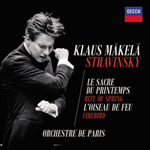 Stravinsky: The Rite of Spring & The Firebird Stravinsky: The Rite of Spring & The FirebirdStudio Master: 4853946Download onlyStudio Master FLAC & ALAC downloads available  Klaus Mäkelä, the first conductor signed to Decca for forty years, brings the wonderful Orchestre de Paris to the label for a major new album of Stravinsky's most iconic ballet scores.» More |
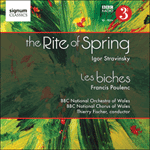 Stravinsky: The Rite of Spring; Poulenc: Les biches Stravinsky: The Rite of Spring; Poulenc: Les bichesStudio Master: SIGCD205Download onlyStudio Master FLAC & ALAC downloads available  Almost no musical work has had such a powerful influence or evoked as much controversy as Stravinsky's ballet score The Rite of Spring. Also featuring Francis Poulenc's ballet Les Biches, the present recording captures the excitement and vibrancy ...» More |
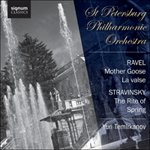 Ravel: Mother Goose & La valse; Stravinsky: The Rite of Spring Ravel: Mother Goose & La valse; Stravinsky: The Rite of SpringSIGCD330Download only Contrasting pieces by two masters of orchestral composition, these live performances capture the energy and movement of three much-loved balletic works; Ravel's intricate vignettes of childrens' stories in Mother Goose and 'choreographic poem' La ...» More |
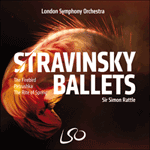 Stravinsky: Ballets Stravinsky: BalletsStudio Master: LSO5096-D2CDs Download onlyStudio Master FLAC & ALAC downloads available  Sir Simon Rattle is something of an authority when it comes to the music of Stravinsky, something clear in abundance from these visceral performances captured live in London's Barbican Hall.» More |