Welcome to Hyperion Records, a British classical label devoted to presenting high-quality recordings of music of all styles and from all periods from the twelfth century to the twenty-first.
Hyperion offers both CDs, and downloads in a number of formats. The site is also available in several languages.
Please use the dropdown buttons to set your preferred options, or use the checkbox to accept the defaults.
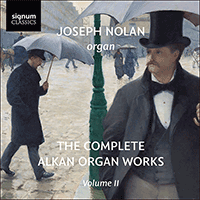


A chance to explore some of the more eccentric works of Charles-Valentin Alkan as brought thrillingly to life by Joseph Nolan on the restored Stahlhuth-Jann organ of St Martin’s in Dudelange. Reviews of the first volume in this series praised Nolan for his ‘death-defying virtuosity’, with Norman Lebrecht commenting that ‘one can only be awestruck by Nolan’s heroism in tackling this fiendishly difficult extravaganza’.

Feared pianist, maître organiste suprême, 'a man of thought and feeling' (Fétis), Alkan lived through the Bourbon Restoration, July Monarchy and Second Empire, about him a city of grandiosity and temples but also ‘putrefaction, where misery, pestilence and sickness work in concert, where sunlight and air rarely penetrate. Paris is a terrible place' (Victor Considerant, 1845). The cholera outbreak of 1832—Châteaubriand's 'mortuary sheet flying as a flag from the heights of Notre Dame … tolling funeral bells never silent'—claimed more than 18,000. That of 1849 took Kalkbrenner and Angelica Catalani within two days of each other. He beheld the Second Republic and the rise of the Third. Between 1830 and 1871 he survived the barricades and blood of uprisings and revolutions. In May 1871 the Tuileries was gunpowdered, tarred and torched. 'Out of every hundred Frenchmen ninety nine have lost their heads' he wrote post-Commune to Ferdinand Hiller. 'I have gone through forty-eight nights and fi fty days of unbroken fi ghting and fl ying bullets' (18 August 1871).
Managed by his youngest brother Gustave (a musician of lighter cut), the 'Petits Concerts de musique classique' (1873-80) staged at the Salle Érard, rue de Mail with a repertory ranging from the Baroque and great masters to the 'moderns' and his own works—a project loosely anticipating Rubinstein's 1885-86 'Historical Concerts'—briefly returned him to life beyond his window-shuttered brick-and-stone faced Haussmannian appartement on rue Daru in the Russian quarter. But, like an incoming sea mist or the capital's grandes puanteurs, silence and isolation were omnipresent, shrouding then burying his final years. By all reports a difficult, disenchanted, melancholic old ashkénaze in black, pathologically fearful for his health. Yet one who could also be a lively conversationalist not without warmth. His few surviving letters are not without endearment and humour, recipients including Fétis, Gounod, Massenet, Mendelssohn, Meyerbeer, Rubinstein, Sarasate and Clara Schumann, together with the well connected Troubetzkoy and Ney de la Moskowa families. Those to the Spaniard Santiago de Masarnau point to 'a passionate individual with almost obsessive emotional traits'. Vincent d'Indy, while indifferent to his music, recalled his playing of late Beethoven as 'more personal and humanly moving' than Liszt's.
Dreaming, voyaging the fantastical, he fashioned horizons out of Antique pasts, Classical ghosts and Romantic wraiths. For Wilfrid Mellers he was the ‘reclusive revolutionary’, ‘a superb contrapuntist in baroque tradition […] an heir to Haydn in his classical command of "symphonic" argument [sharing] Beethoven's large-scale, “morphological” approach to form—as well as his partiality for gritty textures and for the abrupt punch-line or sudden reversal'. True he wrote almost exclusively for the keyboard, but his music (as von Bülow recognised) traversed a range of sonorities, spacings and extremes, a span of melodic dialogues, chordal balances and linear voicings as brilliantly lit and theatrically managed in their associative imagery as anything orchestral. Bach and Beethoven were his gods, their German fugues, variations and sonatas his models. (Delacroix in 1849 records a Friday evening with Alkan at Chopin's discussing Beethoven 'tormented by the idea of Bach’.) Mendelssohn's Songs without Words were the stimulus for his Recueils de chants. He had no time for Liszt, Wagner ('not a musician, but a sickness', January 1860), or the aesthetic of the Neudeutsche Schule. His cosmos was a ballet of grotesqueries and graces, poésie and profundity, the beautiful and the celestial, the terse and the titanic. His palate is one of pastoral, spiritual, satirical, imploring … wild, jagged, bizarre … rampant, incised incident. As beguiling as Peitho, Aphrodite's handmaiden. As mighty as Hercules wrestling Achelous for the hand of Deianira—of which Aetolian encountered François Bosio's muscled bronze depiction formerly stood before the Tuileries.
Prowess aside (awarded the Conservatoire's premier prix d'orgue in 1834), Alkan was an infrequent visitor to Paris's organ lofts, holding no official position. It needed the coupling of piano and pedalboard, Érard's piano-pédalier', to catalyse his music 'pour orgue', explaining its dynamics, hairpins, grande pédale/pédale douce emphasis, and absence of registrations. This touch-sensitive hybrid, shown in London at the 1851 Great Exhibition, was demonstrated by him during the 1855 Paris Exposition Universelle. His illegitimate son Élie-Miriam Delaborde—he of the parrots, cockatoos and apes who fled to London during the Franco-Prussian War—was also a renowned exponent, at the Hanover Square Rooms in 1871 playing a 'specially constructed' example by Broadwood. With the pédalier Alkan metamorphosed the practice tool of organists into a medium for high art.
'Pour orgue avec pédal obligée ou piano à clavier de pédales ou piano à trois mains,' the Prières, Op 64, dedicated to the memory of Pierre Érard (who saw his illustrious family company through the economic instabilities of the 1830s), were published in 1865. They range from the hallowed to the heroic. Crossing the pages are echoes of the more suppliant among the Op 31 Préludes (1); artful Mendelssohnian/baroque invenzioni (2, 9); Schumannesque rhythms (4, 6, 13); mixed meter (4: 2/2, 3/4, 4/4); the irreverent swagger of a Lefébure-Wély sortie (8, 'Lord God of Hosts', spelt out in Hebrew, Latin and French contoured into an ascending Star of David triangulus, משולש ); tart bucolics and 'unpredictable twists and turns' (10); siciliennes, descants and bergers (11). Other spectres coalesce and dissipate: the curious tricolon of 'trinity' chords in 2; the subterranean tremolos and pedal melody of 3 (minor then major); the canons and metric oscillations of 4; the recitatives and monothematicism of 5; the juxtaposition of piano dance, forte militaria and 'central mystification' (the descending B♭-F 'funeral' tetrachord from Chopin's Second Sonata) in 6; the majesty and sweep, the main gauche cantabile of 7 (cf the pedal reprise of 6). Now and then Franck saunters by. In vintage Alkan manner 'snap' cadences sign off 4 and 6. The pianississimo cessations of 1-3, 7, 9 and 12 cloak the world in damask.
Tonally the set begins and ends in G. Keys, however, can be suspended (1, 5) or, a familiar Alkan device, paired within an orbit, modally open, circulating between A, E, B♭, F and D—in which framework A is the pivotal pitch throughout. The seventh is a regal affair of circling poles and progressive tonality: A1 C major maestoso-B1 A major espressivo-A2 G major-B2 E major-B3 A major-B4 A minor. The minor numbers (3, 5) resolve in major tierce de picardies; contrariwise the B-flat major of 10 fades to the minor with an inverted Picardy third.
Given the broad pianistic character of the collection (3, 7, 8, 12, 13, arguably the Lisztian final third of 5 and left-hand scales of 6), Franck in his 1889 organ edition favoured just seven—1, 2, 5, 6, 8, 9, 11—arranging and registering them in the process. In 1901 Liszt's Portuguese disciple José Vianna da Motta published a piano transcription of 1, 2, 3, 7, 8, 9, 11 and 12, dedicated to Busoni.
In February 1852, invited by Cavaillé-Coll, Jaak-Nicolaas Lemmens from Brussels played at Saint-Vincent-de-Paul and La Madeleine. Confounding Alkan, Benoist, Franck, Gounod and Lefébure-Wély among the many, his pedal skills revolutionised the ambit of the French Romantic organ. Fourteen years later Alkan's transcendental Études pour les pieds seulement appeared, inscribed to Lefébure-Wély. No holds barred, some might say to the point of lunacy if not gymnastic impossibility, they do for the pedalboard what Paganini did for the violin and Liszt for the piano. Marcel Dupré, Widor's successor at Saint-Sulpice, believed them to be 'the complete and indispensable foundation of pedal technique'. William Alexander Eddie suggests 'there is no other 19th century organ composition to rival these études in difficulty ... Alkan [casting] an arrow into modern times'. Testing musicality, expression and execution, the first six cover complex monophonic/polyphonic demands. From four-voiced chords (2) and precision part-playing (3, an intricately inventive Fughetta) to meditative recitativo and quasi-improvisation (6). The agility required—rapid runs, stretches, trills (3, 6), legato/staccato articulation (4), repetition, sustained melodic thirds (5)—is not for the faint of heart. Cultivating a feeling for paraphrase (1, belle danse, roi soleil style), adapting the extended pédalier compass to that of the organ, bring other challenges. 'Widor on steroids', Joseph Nolan's bon mot, sums up the prospect.
The Benedictus, Op 54, 'pour piano à clavier de pédales, ou piano à 3 mains' (Richault's title page, the ‘pour orgue’ qualification apparent only on the cover of the 1903 Delaborde/Philippe ‘nouvelle édition’) was published in 1859. Alkan dedicated it to the influential Catholic scholar and critic Joseph d'Ortigue, friend and champion of Berlioz and Liszt, and, like Alkan, a supporter of Napoléon III and the Second Empire. Darkness to dawn, dolce to drama, it reverberates across the octaves, the final paean one of thunder and gloire organistically somewhere between Berlioz's Te Deum and Saint-Saëns's Third Symphony. Cast in four linked sections, facets of metamorphosis, variation and evolving development not least among the work's tensioned building blocks, events are channelled through a marriage of traditional key relationships and high-geared harmonies, aspects of the structure ('orchestration' too) foreseeing the seventh Prière from Op 64 and the Impromptu, Op 69. Lento: A1 D minor dolce-B1 A major dolcissimo-A2 F minor-B2 C major, Un poco più animato: C1 F major-C2 D minor, Alla Breve D major: D1 sostenuto-E cantante-D2, Lento fortississimo D major: A3. 'Benedictus Dominus Deus Israel, quia visitavit, et fecit redemptionem plebis suae'; 'Blessed be the Lord God of Israel: because he hath visited and wrought the redemption of his people'.
Twenty-five Préludes Op 31. Thirteen Prières Op 64. Eleven Grands Préludes Op 66. Eleven Pièces dans le style religieux Op 72. Do such asymmetric groupings manifest Alkan's leanings towards numerology and subtext? All presume strong Jewish symbolism. Eleven: Joseph's dream in Genesis (בראשית) of 'the sun, moon and the eleven stars' making obeisance to him; the eleven scented spices of the Incense offering. Thirteen: the thirteen attributes of Divine Mercy identified in Exodus (שמות). Twenty-five: Psalm 25, 'To thee, O Lord, have I lifted up my soul' (אליך יהוה נפשי); forgiveness and guidance in tormented times; 'light' (אור), the twenty-fifth word of the Torah. Alkan's 'Prière' farewelling the Préludes. White C major.
Ateş Orga © 2026
I had vaguely heard of Alkan but knew virtually nothing about him or his music. This was to change drastically in 2018 when I received an email from Steve Long, the Managing Director of Signum Classics. I have been a long-standing recording artist for Signum since my first recording for them featuring the Grand Ballroom Organ in Buckingham Palace in 2007.
I have recorded the complete organ works of Widor as well as individual recordings from St Sulpice, Paris, St Etienne Du Mont, Paris, and St Bavo, Haarlem. It has been an amazing journey with Signum, and I am truly grateful to Steve Long for his ongoing support of my career.
The email Steve received was from an admirer of my Widor cycle by the name of Seth Blacklock. Seth believed that my Widor playing indicated that I might prove to be a natural interpreter of the organ music of Charles Valentin Alkan. I wrote to Steve that I would investigate Alkan’s organ music and revert with my thoughts.
These investigations commenced in the usual places—YouTube and IMSLP. I found recordings of Alkan’s organ music performed by Kevin Bowyer from Salisbury Cathedral (Nimbus 1998) and two albums from Blackburn Cathedral (Toccata Classics 2005 and 2007). Helpfully, IMSLP provided copies of all the repertoire on the three albums.
I thought the music to be wonderful and instantly original. The sound world for me on first hearing was like Widor on steroids in the opera house. It has been a delight for me to learn that Widor and Alkan were, by all accounts, mutual admirers of each other professionally.
So, who was Alkan? For an in-depth account of the man and his life, I can highly recommend a fantastic biography, Alkan: The Man/The Music by Ronald Smith.
An organist colleague mentioned the much-hyped organ and acoustic at Eglise St Martin Dudelange, Luxembourg. I listened to the organ online and was impressed. Signum and I wrote to the custodians of the organ, led by Mr Alex Christoffel, who welcomed our proposal warmly. Rehearsals and recording nights were set for 17-24 January 2025.
It is hard to describe quite how thrilling the tutti of the Stahlhuth/Jann organ sounds and feels in the first few seconds. Breathtaking doesn’t come close. However, it is not just the tutti that is special about this organ. There is a major arsenal of colour from pppp to ffff, which, when coupled with the perfect handing acoustic, elevates Alkan’s genius to the maximum.
I urge all musicians and music lovers to delve into the world of Alkan if he is a stranger to you. He has transformed my musical life for the better. I hope he does for you too.
Joseph Nolan © 2026



