Welcome to Hyperion Records, a British classical label devoted to presenting high-quality recordings of music of all styles and from all periods from the twelfth century to the twenty-first.
Hyperion offers both CDs, and downloads in a number of formats. The site is also available in several languages.
Please use the dropdown buttons to set your preferred options, or use the checkbox to accept the defaults.
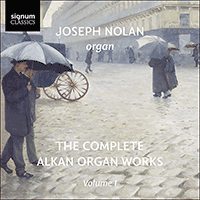


Did Alkan write much for organ? It’s a churlish question once you’ve heard the extraordinary Impromptu sur le choral de Luther: rarely has so innocuous a title disguised a work of such deranged wizardy. (And fortunately, Alkan had a penchant for all sorts of exciting keyboard instruments—harmoniums, pedal pianos, and yes, the organ—and accordingly many of his scores give all the options.)

Alkan auditioned for the Paris Conservatoire aged five. Here he studied solfège, piano (with Joseph Zimmermann), harmony, and organ (with François Benoist, a committed Bachian). By the age of twelve or so he was appearing in concerts in the capital, a couple of years later teaching at his father’s predominantly Jewish music school in the Marais. The 1830s saw him in ascendence, two Prix de Rome failures notwithstanding. He visited England twice, in 1835 appearing with Cramer and Moscheles. On home soil he shared the platform with Liszt and salons with the aristocracy, enjoying, it’s said, the patronage of ‘highly perfumed and frilled’ Russian ladies. He moved to rue Saint-Lazare/Square d'Orléans in 1837 (Nick Hammond, ‘A tour of Alkan’s residences in Paris’, Alkan Society Bulletin 95, December 2017), socially and culturally removed from le Marais, staying until 1851, his neighbours including Chopin and George Sand. Between 1868 and his death twenty years later he lived in rue Daru in the 8th arrondissement, doors away from the Alexander Nevsky Cathedral and Russian orthodoxy.
The birth in February 1839 of a natural son, Élie-Miriam Delaborde, the outcome of ‘an affair with [an older] married pupil of high social rank’ (Stephanie McCallum, ‘Alkan: Enigma or Schizophrenia?’, Alkan Society Bulletin 75, April 2007), occluded Alkan’s etoile. Withdrawing from public life, aged twenty-six, he immersed himself almost entirely in composition, Talmudic/Biblical study and translation (he was versed in Greek, Latin, Hebrew and Syriac), and—obstructed from leading the piano department at the Conservatoire—private teaching (on Chopin’s death in 1849 acquiring several of his pupils). A comeback in 1845 underwhelmed the critics. ‘Driven by passion in a cold, systematic way … [lacking] breadth, passion, poetry, and individuality, despite his pretence of showing them in his compositions … still much to learn’ (Revue et gazette musicale de Paris, 4 May 1845). A series of programmatically/historically exploratory Petits Concerts at the Salle Érard footnoted the 1870s …
'It was necessary for him to die in order to suspect his existence' (Le Ménestrel, 1 April 1888). ‘Alkan battled all his adult life with problems many would characterise as an eccentricity of personality,’ problems ‘we should reassess as indications of a [serious] mental illness [affecting his ability to engage successfully with the world] which would have been continuously debilitating and very likely occasionally frightening’ (Stephanie McCallum). ‘I have lost the strength to be of any economic or political use’ (to Santiago de Masarnau, March 1850). ‘I'm becoming daily more and more misanthropic and misogynous … nothing worthwhile, good or useful to do … no one to devote myself to. My situation makes me horridly sad and wretched. Even musical production has lost its attraction for I can't see the point or goal’ (to Ferdinand Hiller, April 1863).
Alkan promoted Jewish values and practised at least some of its obligations (David Conway, ‘Alkan and his Jewish Roots’, Alkan Society Bulletin 61, 62, March, June 2003). In his music he introduced or paraphrased Jewish motifs and nuances, among the first of the Romantics to do so (trailing Beethoven’s allusion to the sighing falling/rising contours of Kol nidre in the adagio of his C sharp minor Quartet, but ahead of others including Joachim and Moscheles). Pianists and organists will be familiar with the ‘Prières’, ‘Ancienne Mélodie de la Synagogue’ (referencing the Ahavah Rabbah mode), and the quasi-cantillation aura and curvature, akin to ‘a distant memory or a sound from another world’ (Jascha Nemtsov, ‘Ein jüdischer Musiker im Zeitalter der Emanzipation’, Charles Valentin Alkan, Musik-Konzepte Neue Folge 178, August 2017), of ‘J’étais endormie mais mon coeur veillait …’ (‘I sleep, but my heart waketh’, Song of Songs, V:ii) from the Op 31 Préludes ‘pour piano ou orgue’ printed in 1847 but likely written earlier. Correspondingly the musing Levantine inflexions of the G minor Barcarolle closing the Op 65 Recueil de Chants (1864), and the barbed barbaresque finale of the ‘Concerto’ from Op 39. Alkan wasn’t the first Jewish composer to embrace the organ. Nor in the assimilated Jewish climate of 19th-century Paris was the organ denied its place in synagogues. Rather it was ‘the emblematic instrument of the emancipation of the Jews [marking] the regeneration of the French citizen of Jewish religion’ (Hervé Roten, ‘The organ in the Jewish tradition’, Institut Européen des Musiques Juives, nd). When the ‘great’ Synagogue de la rue Nazareth, funded by the banker and philanthropist James de Rothschild, was inaugurated in 1852, an organ was available, with Alkan, highly regarded by the Paris Consistoire, appointed as organist, a position, however, he swiftly resigned (reminiscent in manner, years earlier, of declining a professorship at the Geneva Conservatoire to which he’d been proposed by Liszt).
‘Embracing the organ’ needs a caveat. Of the works on this album only the Petits Préludes are described ‘pour orgue’. The Grands Préludes Op 66 specify ‘pour piano à clavier de pédales, ou piano à trois mains’, similarly the Impromptu Op 69, the latter’s ‘pour orgue’ qualification only being added to the cover of the posthumous Delaborde/Philippe ‘nouvelle édition’. Piano-pédaliers of the type Alkan owned (his straight-strung, seven-octave Érard, No 24598, incorporating standard piano pedals, dating from February 1853) were pianos including a coupled pedal-board enabling thirty-two lower register chromatic notes (A1-e4) to be played with the feet, organ style. The two sound worlds, of course, are radically different, certain of Alkan’s ideas clearly demanding the power, registrations and spatial environment of an organ, other (pianistically sourced) figurations calling for the dexterity, touch and response of a pédalier. Then there’s the fact, necessitating score adaptation, that an organ’s keyboard compass is less than a piano’s. Whatever the medium, the innovative complexity and alacrity of footwork (unaccustomed as Parisians were to the prospect) is something to strike fear and disbelief—hence Alkan alternatively sanctioning a regular piano along with a duettist’s ‘third’ hand to articulate event and stabilise ensemble.
Eleven Grands Préludes and a transcription (transposed down a semitone) of Handel’s ‘Thy rebuke hath broken His heart’ (Psalm LXIX:xx) and ‘Behold, and see’ (Lamentations I:xii) from Messiah comprise Op 66, its publication listed in the Bibliographie de la France, 9 March 1867. Alkan dedicated the set to his ‘colleague’ and friend César Franck, maître du Cavaillé-Coll and titular organist at St Clotilde in the 7th arrondissement. Following Liszt’s key plan in his Études d’exécution transcendante (falling fifths), rather than Chopin’s sequencing in his Préludes (rising fifths) or Bach’s in the Forty Eight (chromatic ascent), Alkan structures a series of pivotally-linked majors and relative minors: F/D minor, B-flat/G minor, E-flat/C minor, A-flat/F minor, D-flat/B flat minor, F-sharp [G-flat]/E-flat minor. No 1, 4/4, tersely homages the canonic subject/pedal solos of Bach’s same-key 3/8 Toccata, BWV540 (one of Alkan’s pédalier warhorses for which he was much admired, programmed in the Petits Concerts), a via lactea of semiquavers and unisons cascading across the firmament. No 2, Ronald Smith declared (Alkan: the Music, London 1987), celebrates Alkan’s ‘happy and glorious’ 3/4 rhythm familiar from the first movement of the Op 39 ‘Concerto’ (three crotchets/dotted crotchet – quaver – crotchet) along with mordent repetitions and a pedal part neatly illustrating than two feet are synonymous with two or more parts irrespective of physical distance or contortion. No 3, a 6/8 andantino, combines pedal recitative (quasi ad lib), tenor refrain (sostenuto), and soprano response (dolce e legato), the recitative returning at the end in imposing unisons across the octaves. To Smith No 4 suggested ‘intense passion’ seemingly locked within a ‘frivolous façade’ (marcia-like), a ‘contradiction [releasing] tensions absolutely unique to this composer’. Cadentially the final six tierce de picardie bars oblige dynamically if without overly affirming the spirit of their ancien glow. In E flat with a breath of Mixolydian flattened seventh, No 5 is pensive in mood and polyphony, its sostenuto middle section marked by rapid left-hand tremolandos reinforcing right-hand chords which change harmony but in the main preserve an inverted G-octave pedal-point. No 6 is another 6/8 andantino, marked by Alkan piano, mais assez lourdement (‘quiet, but quite heavily’). Two separate ideas dominate, one sostenuto molto (cantabile, dolce, chromaticised/modulating, dotted rhythms, smooth, minore), the other ppp staccatissimo (detached, rests, crescendo, maggiore). The concluding dolcissimo e sostenutissimo, transmoded into C major, consolidates hallowed pastorale images from earlier.
No 7 is an alla giudesca—‘in the Jewish manner’. A congregational andante occidentally assimilated—the opening, devotionally hushed, for just the left hand (cantor?)—it ascends to a life affirming climax, its cumulative reverberations calling for space and air to decay naturally. ‘Incisiveness’ is the ‘life-blood’ of No 8, ‘a darkly cogent piece’(Smith) where elements of sonata and motivic development are key to its architecture and rhythmic momentum. A curt pedal motif, binding the movement with near-Brahmsian determination (cf the fugue from Brahms’s Handel Variations, 1861), underpins the first subject, soutenu e noblement. The second theme is a pianistic cantabile, indirectly quoted in the reprise. Smith believed that the final three Préludes, Nos 9-11, ‘consummate three contrasted aspects of Alkan’s genius: his inner calm, his wild abandon, and his mysticism’. No 9 is a Brucknerian adagio twenty years early (down to the Germam langsam marking), obsessive in its quietly throbbing 6/8 quaver repetitions, tender in melody, inspiringly glorious in its placed orchestrally fortissimo climax. No 10 is Smith’s lively ‘Cossack dance’ (Ukrainian Yiddish?), a 2/8 study in repetitive staccatos and slurs, relentless in beat and spiralling hopak style, urgently tensile. For Liszt’s student José Vianna da Motta, who in 1906 arranged nine of the Grands Préludes for piano duet, No 11, opening germinally with a dark, cabalistic recitativo in F sharp minor (pedals), represented ‘the martyr's final, resigned monologue (Gethsemane)’. Via chromatic progressions and a blossoming dominant point d’orgue on C-sharp—offset by eighteen grinding acciaccaturas a semitone lower, eighteen being numerologically the Judiac symbol for ‘life’—resolution, Christ risen from the dead, is attained, thundering in bronzed major. Questing recitative and harmonies (Handel’s) prepare for E flat minor and arioso in the transcription forming No 12. But with its half-close cadence, it never anchors, leaving the listener suspended. Subjectively, the pedal line (Handel’s) might be heard/thought of as an extreme rhythmic augmentation of the pedal figures in No 8.
Spiritually humble, the Petits Préludes (printed 1859) are spare, aphoristic, white-note invenzioni for manuals alone. Deceptively simplistic, they essay the eight authentic and plagal modes of Gregorian plainchant. Respectively Dorian D (No 1), Hypodorian D (No 2), Phrygian E (No 3), Hypophrygian E (No 4), Lydian F (No 5), Hypolydian F (No 6), Mixolydian G (No 7), Hypomixolydian G (No 8). Given how ‘meticulously worked out’ they are—a ‘super-saturation of symmetry and patterning’—one recent analyst calls the series ‘the ne plus ultra of Alkan’s experiments in his genre ancien idiom’ (Michael W Beauvois, ‘Alkan’s Petits Préludes for organ: a case study of composition by constraints’, Music & Science, 29 January 2018).
Inscribed to the composer’s ageing old master, François Benoist, the E flat Impromptu (a humoured label, 1866), is another matter, conceived and ‘pianostrated' on a scale reminiscent of the complexes met in the Op 39 Études nine years earlier. It’s based on Heine’s Marseillaise of the German Reformation, Luther’s 16th-century hymn Ein feste Burg ist unser Gott—«Un fort rempart est notre Dieu», ‘A Mighty Fortress Is Our God’. Following Schubert’s Wanderer Fantasy and Liszt’s Ad nos, ad salutarem undam and B minor Sonata, earlier still the sonata quasi una fantasia format of Beethoven’s Op 27 pair, the work is a rigorous variation-immersed ‘sonata’ subdivided into four l’istesso tempo movements of differing metre, played without a break but demarcated by pauses. I, ‘tema’ (pedals), twelve ‘divisions’, E flat 2/2—in the guise of a passacaille, the chorale functioning registrally as an ostinato real and inverted. II, double ‘scherzo’, E flat 6/8, C major 12/8—the ‘waterfalls’ of Chopin’s Third Scherzo ghosting the first half, rhythmic augmentation and diminution against torrents of right-hand semiquavers, flooding the second. III, ‘slow movement’, dolce ed espressivo, C minor 3/4—the chorale, initially plain, ultimately bizarre in harmonisation, traversing a range of canonic treatments and segmentations, etchings of legato, staccato and tart grace-notes vitalising pigment and character. A strident brocade of theatre transitions into IV, ‘fugue’, E flat 2/2—supremely displaying Alkan’s polyphonic majesty, Bach and Handelian Beethoven stretching the canvas indelibly. Ein feste Burg is metamorphosed into a staccato-sprung subject, three cells from the first bar impelling the whole organically. The peroration is monstrous, terrifying, wondrous, extraordinary … consuming instrument, player and building … floor to cupola vibrating to eternity—no delay long enough (even the six seconds of Dudelange’s Église Saint-Martin, the venue of this recording) to stem the adrenalin rush. Yet at the very end it’s the fading descent of the chorale against a trinity of velvet-cloaked E flat chords that has the last word.
Alkan is buried in the Cimetière de Montmartre, a slab of grey Tarn granite from the Massif Central marking the spot. Four mourners attended his funeral.
Ateş Orga © 2026