Welcome to Hyperion Records, a British classical label devoted to presenting high-quality recordings of music of all styles and from all periods from the twelfth century to the twenty-first.
Hyperion offers both CDs, and downloads in a number of formats. The site is also available in several languages.
Please use the dropdown buttons to set your preferred options, or use the checkbox to accept the defaults.


Abel, however, was the last great composer for his instrument, and his music shows a beguiling mixture of styles, from the high baroque reminiscent of J S.Bach, through to the elegant classical style of Mozart and Haydn.
Recently, over twenty virtuosic sonatas by Abel have been discovered in a castle in Poland that once belonged to the Prussian Ambassador to London. Two of these are recorded here for the first time.
By 1650, English viol players were regarded as the best in the world, and many were employed in the courts and chapels of Europe: Christopher Simpson, Charles Butler, Alfonso Ferrabosco, Daniel Norcombe, Walter Rowe and William Young were just some of the English virtuosi both at home and abroad. But a century later, few people played the instrument, no-one wrote for it, and it was regarded as an antique curiosity at best.
But the viol wasn’t dead, and one great player and composer came to London and re-ignited a passion and taste for the instrument. Carl Friedrich Abel’s first appearance in London was on 5 April 1759 (a few days before Handel’s death) in the Great Room in Dean Street.
He came from a large family of German musicians, mostly viol players and violinists, and his father, Christian Ferdinand, was a close friend of J S Bach in Cöthen, where our Abel was born in the same year that Bach left for Leipzig. When his father died in 1737, he went to Leipzig and studied with Bach, and then followed Bach’s eldest son to Dresden until the destruction of that city in 1757. Then he moved to London, where he was to spend the rest of his life.
In that first concert, he played the harpsichord, the newly invented pentachord and the viola da gamba. He was an immediate success. He was given a royal privilege to publish his music in 1760, which established him as a significant composer of symphonies, concerti, quartets and sonatas. His output was almost entirely instrumental, though in 1767 he contributed an aria to the pasticcio Sifari, for the castrato Guarducci. Frena le belle lagrime has a viol obligato, originally played by Abel himself; I have transposed it down to accommodate a countertenor voice and given the orchestral parts to my colleagues in Fretwork.
In 1763, J S Bach’s youngest son, Johann Christian came to London, and he and Abel quickly renewed the friendship between the two families. They moved in together that same year, sharing rooms in Mead Street, Soho, and gave their first concert together 29 February 1764. The Bach-Abel concert series was to run for 17 years, from 1765 to 1781. There was roughly one concert per month, and they started in Carlisle House in Soho Square, but moved to King St in St James’s. Such was the success of the concerts, that they built their own concert room in Hannover Square in 1775.
Abel was also a visitor to that other great cultural centre in England at the time, and made his Bath debut on 4 February 1760 at Wiltshire’s Assembly Rooms, in which, among many other things, he played two solos on the viola da gamba. Also in Bath at the same time was the great English portraitist, Thomas Gainsborough. The two became close friends, and Gainsborough became an accomplished viol player.
In June of 1760 he painted a celebrated portrait of the young and controversial Ann Ford. This remarkable work shows this no-less remarkable woman holding an English guitar, but with a 7-string viol hanging on the wall in the background, alluding to her performances on the viol. It wasn’t a commission, but a calling card, so to speak: Gainsborough displayed it in one of his rooms, while he painted portraits in the other. Prospective clients were able to assess his talent and book an appointment. It was a deliberately provocative, voluptuous painting, intended to shock and attract. It seems to have worked. Mary Delany commented:
This morning went with Lady Westmoreland to see Mr. Gainsborough’s pictures, and they may well be called what Mr. Webb unjustly says of Rubens, ‘They are splendid impositions.’ There I saw Miss Ford’s picture, a whole length with her guitar, a most extraordinary figure, handsome and bold; but I should be very sorry to have any one I loved set forth in that manner.
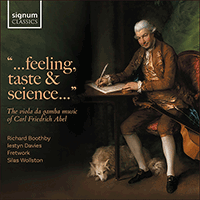
Gainsborough was a diligent pupil and highly musical. He painted two wonderful portraits of his friend, one on the cover of this album and an earlier one in the National Portrait Gallery in London. You’ll see the similarity of the viol in this portrait to the instrument hanging on the wall in the Ann Ford portrait; but we have a sketch of this painting, showing Abel with a quite different instrument. It could be that the acquisitive Gainsborough had bought the viol from Abel and used it in the Ford portrait, then preferred it to the viol Abel himself had brought to the NPG portrait—but we shall never know.
Gainsborough certainly had plenty of other viols, as this letter to William Jackson shows:
I’m sick of Portraits and wish very much to take my Viol da Gam and walk off to some sweet Village where I can paint Landskips and enjoy the fag End of Life in quietness and ease … My Comfort is, I have 5 Viol’s da Gamba, 3 Jayes and two Barak Normans.
Abel published only a very small number of simple works for viol, but what has survived is an autograph manuscript of some 27 works for solo bass viol, now housed in the New York Public Library, known as the Drexel Manuscript. I have the feeling that this collection was written for Gainsborough—almost all the pieces are in the home key of D and are beautifully written for the instrument.
Abel himself was famous for his improvisations—as his obituary suggests:
Justly admired as he was at his publick Performances, it was a few only of his intimate friends in private who were witnesses of his most wonderful musical Powers, to come at which, a Bottle or two of good Burgundy before him, and his Viol di Gamba within his reach, were necessary. In that situation his Friends would introduce the subject of the human passions, and Abel not very capable of expressing in English his own sentiments, would catch up his Viol di Gamba, and tell the story of Lefevre thereon, till he brought tears into the eyes of his hearers, and not lay it down, till he had made his friends Gainsborough dance a Hornpipe on the Bottom of a Pewter Quart Pot.
He would have had no need to write down such things. And Gainsborough was criticised, in an account after his death, by an estranged musical friend, the composer William Jackson:
… he frittered away his musical talents; and though possessed of ear, taste and genius, he never had application enough to learn his notes.
This account was shortly to be flatly contradicted by a correspondent to a newspaper: ‘Arbitrator’ described Jackson’s anecdotes as ‘a series of improbable tales’ and went on:
Your present correspondent has, more than once, seen Gainsborough playing from notes; but not content with his own oracular testimony, he has applied to several musicians of eminence, who had a personal knowledge of that artist, and they unite in opposing Mr Jackson’s statement: nay, one of them assures me that Abel composed a fugue purposely for his friend Gainsborough to practise on the viol-di-gamba:—And could this be done without having learned his notes?
And the Drexel manuscript contains just such an excellent Fugue, recorded here.
But much music for viol by Abel, though not published, must have been lost over time; and recently a number of sonatas for viol and continuo have been discovered in a castle in what is now Poland.
The current town of Milicz in Poland was in the 18th century the Silesian town of Militsch, and the castle there was owned by the Maltzan family. Count Joachim Carl Maltzan, an amateur viol player, was a politician, first posted to Berlin, where he may have met that other great virtuoso of the instrument, Ludwig Christian Hesse at the court of Frederick Wilhelm II. He was then moved to London in 1766, where he became Prussian Minister Plenipotentiary, coinciding with the height of the Bach/Abel concerts. He returned home in 1782, but came back to London the very year that Abel died in 1787.
It seems likely that he acquired some manuscripts from Abel while in London and when Abel’s effects were sold at auction after his death. Some of these are in the composer’s own hand.
His collection of music contains 109 pieces, over 30 of them for viola da gamba. It was transferred to the University Library at Poznan, where they are now; and the significance was noticed by Sonia Wronkowska only in 2014 when researching her master’s dissertation. Two of the three sonatas on this disc are recorded here for the first time.
The count didn’t die until 1817, so his musical activities, heavily biased towards the viol, continued until then; and, indeed, his son, Count Joachim Alexander Kasimir continued to play the viol. So we have viol playing going on well into the 19th century in eastern Germany.
Mention of a couple of bottles of Burgundy in his obituary alludes to Abel’s fondness for the demon drink, and it is clear he was something more than merely a bon viveur; he often spent time in Paris, not only to partake of the musical life there, but to buy himself the best claret. In 1782, after the death of his partner in concert promotion, Johann Christian Bach—who had left considerable unpaid debts—Abel left for Germany, to avoid his own creditors. He visited Berlin & Potsdam and met the viol-loving Prince Friedrich Wilhelm, and then to Ludwigslust, where he met his brother again for the first time since childhood.
His drinking had reached prodigious proportions, and we can see the effects in two portraits. The first by Gainsborough, done in 1777: sympathetic, rich, sumptuous even. It shows the composer in the act of composing, his viol across his lap and a no doubt faithful dog resting under the table. This is held at the Huntingdon Library in San Marino, California, and was first shown in the Royal Academy Summer Exhibition of 1777, when Gainsborough came back to that institution after many years of absence. The second is by Alexandre-Auguste Robineau, just three years later in 1780, now at Kew Palace. Not so sympathetic, but probably much more realistic.
On one occasion, at least, the drink did get the better of him:
The same season (in 1782), on the occasion of the Musical Fund entertainment his particular friends dined with him in order to conduct him to the theatre in safety. In that they succeeded, but not in keeping him from indulging in his supposed necessitous error. He was led on to the stage between two persons, and his instrument was given to him ready tuned. He played almost better than ever, and when his concerto was finished they dropped the curtain for he could not rise from his seat to bow.
When Abel died on 20 June 1787, just over a year before Gainsborough’s own death, he wrote this heartfelt letter to his friend Henry Bate-Dudley that same day:
Poor Abel died about one o’clock to-day, without pain, after three days sleep. Your regret, I am sure, will follow this loss. We love a genius for what he leaves and we mourn him for what he takes away. If Abel was not so great a man as Handel it was because caprice had ruined music before he ever took up the pen. For my part I shall never cease looking up to heaven—the little while I have to stay behind—in hopes of getting one more glance of the man I loved from the moment I heard him touch the string. Poor Abel!—’tis not a week since we were gay together, and that he wrote the sweetest air I have in my collection of his happiest thoughts. My heart is too full to say more.
Richard Boothby © 2026