Welcome to Hyperion Records, a British classical label devoted to presenting high-quality recordings of music of all styles and from all periods from the twelfth century to the twenty-first.
Hyperion offers both CDs, and downloads in a number of formats. The site is also available in several languages.
Please use the dropdown buttons to set your preferred options, or use the checkbox to accept the defaults.
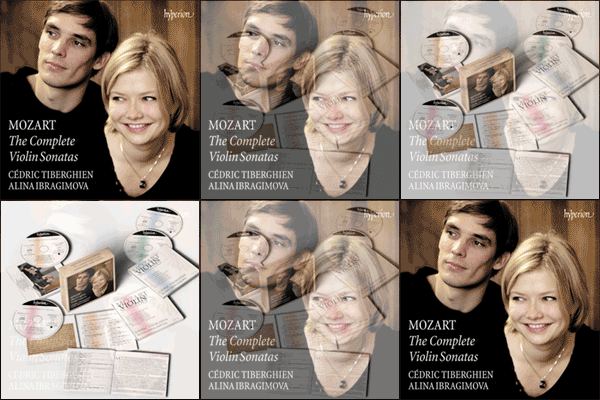


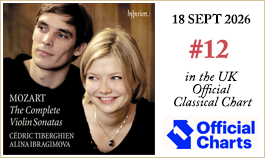
Hyperion presents Alina Ibragimova and Cédric Tiberghien in their celebrated cycle of the complete Mozart violin sonatas: a 10-CD collection recorded between 2014 and 2016.
Composed between his childhood years and the full maturity of his Viennese period, these works chart the profound transformation not only in Mozart but in chamber music itself. The very earliest of them are essentially keyboard sonatas with violin accompaniment and were his first published works (Opp 1 & 2, no less!) dating from the month of his 8th birthday. By contrast, the mature works display a continuous and eloquent dialogue of equals between the instruments.

In the first work of the group, the Sonata in C major, K6, unusually cast in four movements, only the concluding allegro was new. Of the remaining movements, the earliest is the second in the pair of minuets, which was entered in Nannerl’s notebook on 1 July 1762, when Mozart was just six years old. The piece was actually a free transcription of a movement from an orchestral serenade by Leopold Mozart. The first minuet, together with the andante and the opening allegro were probably contributed to the notebook in October 1763, while the Mozarts were in Brussels. Mozart added violin accompaniments to all three movements, and also fleshed out the piano part of the allegro’s first subject with some strategically placed chords. Both the allegro and the andante have a left-hand part in ‘Alberti’ bass virtually throughout, but the newly composed finale is more imaginatively laid out, with a syncopated second subject, and a development section set largely in the minor.
The opening Allegro of the Sonata in D major, K7, is in Mozart’s brilliant manner associated with this key, and only the latter half of the brief development section, where the music turns to the minor, momentarily stems the energetic flow. The pulsating inner-voiced accompaniment of the central andante, together with its long-spun melody and its overlapping harmonies, lends the music a precocious air of sensuousness. This was presumably the piece to which Leopold Mozart referred when he told Maria Theresia Hagenauer that the sonatas contained an andante ‘of a quite special goût’. More conventional is the concluding pair of minuets, of which the second is in the minor. Mozart entered the first minuet into Nannerl’s notebook as a self-standing piece shortly before he (or his father?) added the violin part for its role in the sonata.
Adding a violin part to a pre-existing keyboard piece was literally child’s play, and in the case of the Sonata in B flat major, K8, the opening movement was adapted from a piece which Mozart entered in Nannerl’s notebook shortly after the family arrived in Paris, in November 1763. A few awkward switches between major and minor were ‘corrected’ in the published version, but the keyboard parts are otherwise identical. Following a graceful slow movement, the sonata ends with a pair of minuets, the second of them, with its jagged ‘dotted’ rhythm, in the unusual key of B flat minor.
The Sonata in G major, K9, begins with a piece on an ambitious scale for a composer of such tender age. The latter half of its opening subject is made up of an expansive, chromatically rising sequence of mounting tension, and the central development section unfolds for the greater part in the minor. The opening subject of the slow movement is given out in caressing thirds, while the second subject consists largely of a series of ascending scales. Given the modest scope of the exposition—a mere two dozen bars—the central development section is surprisingly broad. Here, Mozart explores both the main subject’s rhythm and its melodic shape, bringing its parallel thirds into play. The first in the pair of minuets that concludes the sonata features an intermittent figure in flowing triplets. The triplets spill over into the second minuet, in the minor, which is written in triplet motion throughout.
In April 1764 the Mozarts travelled on to London, and it was there, ten days or so before Wolfgang’s ninth birthday the following January, that his Op 3 appeared: a set of six sonatas (K10-15). The London series bore a title page describing the pieces as Sonates pour le Clavecin qui peuvent se jouer avec L’accompagnement de violon, ou Flaute traversière, even though the accompanying part was not strictly playable on the wind instrument. In order to maximize potential sales still further, some copies had an additional part for cello doubling the keyboard’s bass line, so that the pieces could be performed as trios. The six sonatas K10-15 were dedicated to Queen Charlotte, the wife of George III, and in one of the many long letters Leopold Mozart wrote to his Salzburg landlord, Lorenz Hagenauer, he proudly told him: ‘The Queen has given our Wolfgango a present of 50 guineas for the dedication of the sonatas.’
The Mozarts were received at Buckingham House (now Palace) no fewer than three times during their London visit, so the eight-year-old composer would have had ample opportunity to play his new sonatas to the royal couple. Certainly, the opening movement of the first work in the series, the Sonata in B flat major, K10, was tailor-made to show off his keyboard facility, with rapid skips of the left hand over the right, and the greater part of the piece written in a patter of ‘Alberti’-bass figuration. The middle movement’s melody has a ‘rocking’ left-hand accompaniment, and the octave leaps in its central development section are echoed by the violin. The finale, as in several of these early sonatas, is a minuet and trio.
The Sonata in G major, K11, has only two movements, but the second of them, following an expressive andante, is really a pair of contrasting pieces rolled into one—a brisk allegro in duple time, and a minuet in the minor based on a closely related theme. Once the minuet has run its course, the allegro is repeated. The Sonata in A major, K12, is also cast in two movements. In its elaborate opening andante a rising arpeggio figure in the left-hand keyboard part, echoed by the violin, punctuates the musical discourse until, in the closing moments of each half of the piece, the arpeggio is replaced by a rushing scale. The only remaining movement is a lively allegro whose final reprise is preceded by a turn to the minor bringing with it a touch of exotic chromaticism.
The Sonata in F major, K13, is notable for its precociously expressive slow movement in the minor. The piece is essentially based on a single theme, played at the outset by keyboard and violin in imitation, and it has an unusually expansive development section. The minuet finale features slithering chromatic scales in which the two instruments echo each other by inversion. The trio is another affecting piece in the minor, again plumbing depths remarkable for a composer of such tender age.
The Sonata in C major, K14, begins impetuously, with rapid scale-like figures that give the impression of music beginning in midstream. Unusually, the sonata contains two allegros and a minuet, but no slow movement. In the optional cello part, though not in the original edition’s piano and violin parts, the second allegro was placed after the minuet, but since in the remaining works of the series featuring a minuet (i.e. Nos 1, 2 and 4) that piece forms the finale, Mozart may well have intended the two allegros to be placed side by side, as they are on the present recording. The second of them is a rondo whose outer sections are characterised by their ‘chirping’ acciaccaturas (auxiliary notes struck almost simultaneously with the adjacent principal note), while the short middle episode has a proliferation of trills. But perhaps the sonata’s most striking feature is the minuet’s trio, with its pizzicato accompaniment. It is described as being ‘en carillon’, and the bell-like effect Mozart had in mind can be conveyed, as it is here by Cédric Tiberghien, through liberal use of the sustaining pedal.
The Sonata in B flat major, K15, is another two-movement work, though both pieces are on a comparatively large scale. In the opening andante the violin for the first time achieves a measure of independence, not only adding significant thematic material to the majestic dotted rhythm of the first subject, but also filling out the long-sustained keyboard chords with an expressive line. In the graceful second movement, too, the violin echoes the keyboard part in imitation, lending the music an interest it would not have without the presence of the stringed instrument.
Mozart’s next group of sonatas with violin, K26-31, was composed in The Hague in February 1766, and dedicated to Princess Caroline, the daughter of William IV of Orange. It was when, on 11 March 1766, Mozart and his sister performed at the celebrations in The Hague to mark the eighteenth birthday of Prince William of Orange that ‘our little composer’, as Leopold Mozart called him, was invited to write this last series for Princess Caroline. The set was published in Amsterdam, as his Op 4.
The Sonata in E flat major, K26, is alone in the series in having three movements, rather than two. Its energetic opening movement is highly condensed, and after a brief development section culminating in C minor the music wrenches itself abruptly back into the home key, omitting the main subject’s opening stage altogether. A sudden switch between the same two keys occurs at two moments during the course of the finale. The first of them is preceded by a brief flurry of counterpoint based on the main rondo theme, and involving both instruments. The C minor slow movement highlights the contrast between the angular ‘dotted’ rhythm of its opening bars and the smoother phrases that follow. Mozart draws particular expressive value out of the flattened second degree of the scale—a ‘Neapolitan’ tinge that lends the music a haunting quality.
The Sonata in G major, K27, begins with a slow movement whose ornate melody seems to unfold in a single sweep. The impression of continuity is further strengthened in the second half of the piece, where, by omitting any reprise of the melody’s opening bars, Mozart effects a seamless join between the development section and the recapitulation. The finale, with its violin accompaniment in a patter of rapid repeated notes, is a simple ternary form, with a middle section in the minor.
The opening movement of the Sonata in C major, K28, finds Mozart making a return to the pervasive use of ‘Alberti’ left-hand figuration in constant semiquavers. All the same, the brilliance of the piece, with its sustained trills, is tempered by its unusual tempo marking of allegro maestoso. The finale is a graceful allegro—not a rondo, but a sonata design. Following its miniature development section, Mozart again marks the return to the home key with a reprise not of the first subject (which is omitted), but of the second.
The Sonata in D major, K29, is alone in this group in ending with a minuet and trio, with the latter again being in the minor. The opening allegro is a piece that seems to be over in a flash—not only in view of its speed, but also on account of a truncated recapitulation which sees the initial stage of the main subject omitted altogether.
The Sonata in F major, K30, opens with an adagio in which the keyboard player’s right hand constantly crosses over the left, punctuating the melody with a bass line that drops through an octave. The left-hand accompaniment unfolds in smooth triplets, and the closing moments of each half of the piece seem to peer momentarily across the years to the famous slow movement, also in hypnotically reiterated triplets, of the C major piano concerto K467. In the concluding rondo the final reprise is interrupted by a passage in which the rondo theme finds itself transformed into the minor, and into an expressive adagio. The moment is one that lends the sonata’s closing stages an unexpected air of tragedy.
The main weight in the last of Mozart’s early works of its kind, the Sonata in B flat major, K31, is carried by the second in its pair of movements—a set of variations on a minuet-like theme. The third variation features acrobatic leaps for the pianist, with one hand continually crossing over the other. Following the constant right-hand semiquaver motion of variation 4, the fifth variation is syncopated throughout. The stream of semiquavers is resumed in the final variation, where it is transferred to the pianist’s left hand, while the right plays a version of the theme decorated throughout with trills.
A dozen years were to elapse before Mozart composed any further violin sonatas. When he did so, in the early months of 1788, both he and his music had undergone considerable changes. The previous autumn he had set off with his mother on a prolonged and ill-fated journey that was to take them to Munich, Mannheim and Paris, where, following a brief illness, Maria Anna Mozart died. In Munich, Mozart came across the recent violin sonatas of the successful opera composer Joseph Schuster, and thought highly enough of them to send them on to the remaining members of the family. ‘I am enclosing for my sister’, he told Leopold on 6 October, ‘6 duets for harpsichord and violin by Schuster. I have often played them here—they are not bad. If I stay here I shall also write 6 in the same style, as they go down very well here. In fact, I am only sending them to you so that you can have fun together.’
As things turned out, Mozart didn’t begin writing his own set of violin sonatas until early in the following year. Of the six sonatas K301-306, four were composed in Mannheim, while the last two were added after Mozart and his mother had reached Paris, in the summer of 1778. Mozart had, however, written a further violin sonata in Mannheim. Quite why he elected not to include the Sonata, K296, in his series isn’t known: after all, he could easily have made use of it in order to supplement the four pieces he had written in Mannheim, thus leaving himself only a single further work to be composed after his arrival in Paris. Perhaps he held K296 back because he had decided to dedicate it to Therese Pierron, the fifteen-year-old stepdaughter of his landlord in Mannheim, Councillor Anton Joseph Serrarius. Mozart and his mother were offered free lodgings with the Serrarius household in exchange for piano lessons which Mozart was to give to Therese. Mozart referred to her on more than one occasion in letters to his father as ‘our house-nymph’, and was scathing about her pianistic abilities.
In the opening movement of the Sonata in C major, K296, the piano assumes very much the primary role. Only in the central development section does the violin come briefly to the fore, with a sequential series of phrases arising out of a repeated-note idea heard during the exposition’s closing moments. The violin takes a back seat in the opening section of the warmly lyrical slow movement, too, with its characteristic two-against-three melody and accompaniment. But in the andante’s middle section the violin suddenly takes wing, with a new idea replete with soaring melodic leaps; and the start of the reprise finds the melody again given to the stringed instrument. Perhaps the most memorable of the three movements is the exuberant final rondo, where each successive idea seems to grow directly out of the last. The second of its themes turns rapidly from major to minor and back again, before its panting two-note phrases generate a new episode in the minor. A further new theme, in the key of F major, is introduced immediately after this, and the main rondo theme does not get a further look-in until the closing moments, immediately prior to the exuberant coda.
During his stay in Mannheim Mozart made the acquaintance of a wealthy Dutch amateur flautist by the name of Ferdinand Dejean, who commissioned him to write three flute concertos as well as a number of quartets. Mozart managed to complete only two of the concertos and two quartets; but there is evidence to suggest that the Sonata in G major, K301, had also originally been intended for Dejean. Its opening stage was written with the flute in mind, before Mozart had a change of heart. In adapting the music for violin, he was able to take advantage of the stringed instrument’s wider range, and to shift several passages into a lower register.
From the sonata’s very first bars we can see how radically Mozart’s approach to the medium had changed since his early works of the kind: the first subject is now given out by the violin, before it is answered by the piano. The unifying thread that runs through the first movement is the emphatic idea given out in octaves by both players as a form of punctuation mark between the theme’s two statements. The same idea in more subdued form provides a transition to the second subject, and it returns above a throbbing repeated pedal-note on the piano to round off the movement’s first stage. More strikingly still, the central development section is framed by two further appearances of the same passage, played once again in forceful octaves—first, at the start of the section, in inversion; and then, as a lead-in to the recapitulation, in its original form.
All but the last in the series of sonatas K301-306 are in two movements only, and in the majority of them Mozart compensates for the absence of a slow movement by writing the finale in a moderate tempo. Exceptionally, however, K301 is made up of two allegros. All the same, the second of them is a graceful, waltz-like piece in a simple ternary design, with a central episode in the minor whose siciliano-like melody is entrusted to the violin throughout. The reprise follows the plan of the opening section exactly, but Mozart adds a lilting coda which brings the sonata to a close of considerable charm.
The opening movement of the Sonata in E flat major, K302, finds Mozart attempting to recreate the sound of the famous Mannheim court orchestra, and in particular the long crescendo over a repeated pedal-note which was one of the orchestra’s trademark effects. The opening subject, with its fanfare-like beginning answered by a smoother idea, leads to a long crescendo whose sonority is carefully built up over a span of nearly a dozen bars. The crescendo is followed by a quiet suggestion of horns on the violin, and by a series of expressive minor-mode phrases on the piano. The piano’s expressive phrases frame the development section, whose central stage features a dramatic return of the movement’s initial fanfare, accompanied by violin tremolos which conjure up the sound of orchestral strings. The fanfare appears at this point in genuine Sturm und Drang style, both in its original form, and—in another characteristic Mannheim gesture—upside-down. It is with the same fanfare, too, that both the exposition and recapitulation come to a close.
The finale is an easy-going rondo whose contrasting episode is a delicately tripping staccato idea, presented for the most part in a sparse two-part texture which has the violin doubling the keyboard’s upper line at the octave below. At the end, the rondo theme, with its characteristic dactylic rhythm, is transformed into a closing subject of melting beauty, given out by the piano in smooth octaves while the violin provides a gently rocking accompaniment.
Among the Mannheim sonatas, the Sonata in C major, K303, is unusual in beginning with an adagio whose broad melody is given out by the violin before it is handed over to the piano for an even more rhapsodic continuation. This is, however, no ordinary slow movement, but rather a sonata form whose various stages unfold in contrasting tempi. The opening adagio modulates towards the dominant key (G major), before breaking off with the music poised on the threshold of G minor. At this point an allegro begins, with a theme which modulates constantly, bringing with it at first a hint of the key of A minor. The entire allegro, indeed, has an agitated feel, and it conspicuously fails to establish any stable theme before a brief transition leads to a reprise of the adagio, which this time paves the way for a final return of the allegro in the home key.
Perhaps because the first movement is so unstable, Mozart brings the sonata to a close with a minuet which, although in a highly personal sonata form, is entirely free of conflict. Rather than offer any genuine development, its second half is content to present the main subject in a form even more relaxed than at the start of the movement. No doubt for this reason, Mozart begins the recapitulation in the traditional Mannheim manner with the second subject, and follows it with an abbreviated reference to the first subject. At the end, this unpretentious piece fades gently away into the distance.
Among the six violin sonatas of 1778, it is the quietly tragic Sonata in E minor, K304—Mozart’s only composition in this key—that leaves the deepest impression. Both the austere character of its opening movement and the haunting nostalgia of its minuet-style finale place it apart from its companions.
When Mozart begins a work with a theme in subdued bare octaves, as he does here, that beginning more often than not presages an unexpected form of harmonization of the theme at a later stage. In this case, the harmonized version, which occurs at the start of the recapitulation, is so intensely chromatic that it momentarily gives the impression that the preceding development section is continuing.
The sotto voce minuet theme of the second movement, with its descending bass line (chromatically intensified in the melody’s second half), is one that carries an infinite feeling of melancholy. Even so, the theme is surpassed in expressive intensity by the movement’s major-mode middle section. The return to the minor brings with it a new accompanimental figure in smooth triplets, though its more flowing motion serves only to set in relief a coda whose halting phrases seem stricken with grief.
While the E minor sonata provides what is no doubt the most memorable work in the Mannheim series, the most popular of them is the unpretentious and genial Sonata in A major, K305. It seems to have been Beethoven’s favourite, too, and the lively 6/8 rhythm of its allegro di molto is mirrored in the opening movement of his own A major sonata Op 12 No 2; while the theme of Mozart’s variation second movement would appear to have rubbed off on the middle movement—again a set of variations in A major—of the first work in Beethoven’s set. And as in Mozart’s opening movement, the second subject of Beethoven’s Op 12 No 2 sets out as an unaccompanied melody for the pianist’s right hand. Mozart’s melodic line here consists largely of a chain of descending thirds, arranged in arpeggios of four notes each. Since the prevailing beat consists of three-note divisions, the placing of the top note of the arpeggio—the apex of the phrase—constantly shifts in relation to the bar-line, creating an intriguing cross-rhythm of its own. At the start of the development section Mozart further amuses himself by taking the main theme, plunging it unceremoniously into the minor, and having it played upside-down.
The theme of the second movement contains in microcosm all the rhythmic ideas that will recur in the variations that follow. The rushing four-note scales of its first half anticipate the figuration of the first variation, for the piano alone, while the dotted rhythm of its second half makes a return in variation 2. Perhaps because the theme itself is in a relaxed tempo (the marking is andante grazioso) Mozart does not furnish the variations with an adagio, as he habitually did. Instead, the second half of the fourth variation is expressively enhanced—first, with a tinge of minor harmony, and then through the insertion of a yearning slow piano cadenza. The following variation is in the minor, all whisperings and scurrying footsteps; while in the final variation the theme undergoes a rhythmic transformation, into a brilliant waltz.
The dedicatory preface to the sonatas K301-306 (they were inscribed to the Electress Elisabeth Maria) laid special emphasis on the fame of the Mannheim school of composers. Of the six works, it is the Sonata in D major, K306, that most overtly pays homage to their manner of composing. In particular, the recapitulation of its opening allegro begins not with the first subject, but with the second, reserving an abbreviated reprise of the forceful first subject for the closing bars—a typical Mannheim gesture. Since the second subject is conspicuously unstable, beginning, as it does, in the minor, and approaching its actual key only obliquely, the start of the recapitulation gives the impression that the development is actually continuing, and a firm return to the home key is considerably delayed.
The theme of the slow movement, given out initially by the piano on its own, consists of two strongly contrasted halves: a gentle idea played mezza voce and anchored to a repeated pedal-note; and an outward-going, more richly harmonized phrase, with the bass now rising in octaves to counteract the descending melody-line. When the violin enters, it does so surreptitiously, with a solitary held note which seems to add resonance to the melody’s opening bars. Only gradually does the violin step into the foreground, to seize the initiative in the subject’s second half, and to expand it into a soaring, lyrical conclusion. No less remarkable are the exposition’s closing bars, which bring with them a hint of a miniature cadenza. Here, above another repeated pedal-note, the pianist’s right hand plays a series of winding phrases while the violin descends in a smooth, syncopated line, until the two instruments converge and proceed momentarily in parallel. Following a development section that is unusually elaborate for a slow movement, the recapitulation presents a version of the main theme whose second half is accompanied by intricate arabesques on the piano—a type of texture whose effect was not lost on Beethoven.
If the sonata’s opening movement pays tribute to the Mannheim style, its concluding rondo is written in the French manner, with alternating themes in different tempi and metres. The principal rondo theme, given out by both instruments moving together in octaves, is a gentle allegretto. Its second half brings with it a suggestion of horns and trumpets on the piano, while a rapid repeated note on the violin adds a hint of timpani. The allegretto gives way without warning to a brilliant allegro in 6/8 time, designed in the manner of a sonata-form exposition. These two very different types of material proceed to alternate, before Mozart throws a large-scale cadenza into the melting pot. However, the trill that traditionally heralds the end of a cadenza is not resolved. Instead, an abbreviated return of the allegretto comes to rest with a single bar in adagio tempo that recalls the cadenza’s closing moments, before matters are swiftly wrapped up with a further fragment of the allegro.
On 12 March 1781 Mozart was summoned by his employer, the Prince-Archbishop of Salzburg, to join him and his retinue in Vienna, where they were staying during the celebrations marking the accession of the Emperor Joseph II. Mozart had been in Munich since the previous November, preparing for the premiere there of his opera Idomeneo, and he arrived in the Austrian capital on 16 March. That evening he found himself obliged to organize a private concert centred around the talents of some of the Salzburg court musicians. Mozart’s deep resentfulness of the Archbishop’s refusal to grant him permission to perform in public can be discerned from his letters of the time to his father.
The Variations in G major on ‘La bergère Célimène’, K359, were composed that summer, probably for Countess Maria Karolina Rumbeke, who was Mozart’s first Viennese piano pupil. Mozart will have found the melody, together with that of the contemporaneous variations K360, among the collections of airs put together by the castrato and composer Antoine Albanèse. The theme of the chanson ‘La bergère Célimène’ is of utmost simplicity. Its second half comes to a momentary rest on a fermata which also features in the variations themselves, and Mozart may have expected the player to improvise miniature cadenzas at these points. Of the twelve variations, the third is a piano solo with a left-hand part in constant semiquavers, while the seventh is a forceful march in the minor. The penultimate variation is an adagio whose ornate piano melody is accompanied in pizzicato; and the work ends with an allegro which transforms the gavotte-like melody into a livelier rhythm.
The Variations in G minor, K360, remain popularly known as ‘Hélas, j’ai perdu mon amant’—an invented label, but one that perhaps fits the music’s melancholy mood rather better than the actual title of Albanèse’s air, which is ‘Auprès d’une source’. The only change Mozart made to the original melody was to transpose it from E minor into a more pathetic G minor. In the theme and first variation the violin acts as accompanist, but it emerges into the foreground in the strikingly chromatic second variation, whose lilting rhythm stresses the melody’s siciliano-like character with gentle pathos. Following the more forceful next variation, variation 4 has groups of rippling semiquaver triplets alternating between the two instruments, while the penultimate variation sees the melody transformed into the major. At the end of the last variation, with its fleeting arpeggios, the music seems to disappear into a hole at the bottom of the keyboard.
In the early days of June, Mozart had at last freed himself from the Archbishop’s service and launched himself on a freelance career in Vienna. Naturally enough, he was anxious to establish his credentials in the city as both composer and pianist as soon as possible, and the easiest way for him to do so was through the popular medium of the piano sonata with violin. Already the previous month Mozart had told his father that he was about to issue a set of six sonatas by subscription; but he must have heeded the advice of his Viennese friend Countess Thun, who assured him there was no use trying to sell anything by that method before the autumn, since everyone with any money had retired to their country residence. At any rate, the subscription plan was dropped, and on 4 July Mozart informed his sister that he was sending four sonatas to the engraver’s. Two of them—the sonata in C major, K296, and the B flat major, K378—had been composed some years earlier, but the other two were new. However, three weeks later Mozart had a further change of heart, and decided to revert to his plan of publishing a full set of six sonatas. One of the four new works—K379—had been written in April, for a soirée given by the Archbishop, and Mozart hurriedly added the three remaining works, K376, 377 and 380. The complete set appeared in December 1781, under the imprint of the Viennese firm of Artaria, who announced its publication in an advertisement in the Wiener Zeitung as ‘6 Sonatas for piano with the accompaniment of a violin by the sufficiently well known and famous Herr Wolfgang Amadee Mozart, Op 2’. The sonatas were dedicated to Josepha von Auernhammer, who was Mozart’s pupil.
Of the six violin sonatas, the Sonata in F major, K376, is in many ways the least flamboyant. Certainly, its first movement lacks the virtuoso brilliance of its successor in the same key, K377, and its central development section, in particular, is as relaxed as could be imagined. Mozart was always keen to seek out ways of dissolving the tacitly accepted borderlines between the successive stages of the sonata-form opening movement, and there were occasions—among them the ‘Hunt’ string quartet, K458, and the B flat major piano trio, K502—when he conspicuously failed to include a stable contrasting second subject in the movement’s opening half, only to place such a theme at the start of the central development section instead. The second-subject stage of the F major sonata, K376, actually does contain two new melodic ideas, but Mozart nevertheless chooses to begin the development with yet another theme, and one that is calmer and more stable than anything that had been contained in the exposition. When the violin takes over the new melody from the piano and presents it in the home key of F major, the sense of relaxation in what is traditionally the most unsettled portion of the movement is further enhanced.
In contrast to the first movement’s thematic extravagance, the slow movement is based on a single theme, unfolding in leisurely fashion. As presented during the exposition’s second stage, the theme is heard beneath a long-sustained trill on the piano, before the trill is taken over by the violin in the form of a single held note, as though to leave the music hanging in suspension. In place of a central development section, Mozart simply writes a four-bar transition to the reprise of the theme in its original form; and since the same subject has already dominated proceedings for so long, its appearance in the reprise is restricted to a single statement, before a miniature coda brings the piece to a gentle close.
If the theme of the rondo finale, with its symmetrical shape and its simple harmony, has an air of naivety about it, the piece is one of considerable charm, and a dramatic gesture consisting of forceful cadences and rushing scales does not seriously disturb its elegant surface. At the end, Mozart is content to allow the music to fade away with a simple reminiscence of the rondo theme’s final two bars.
Considerably more energetic is the opening allegro of the Sonata in F major, K377. Its owes its exhilarating effect to the fact that its driving triplet rhythm doesn’t pause to draw breath until the very last bar of each half of the piece. The vertiginous effect is enhanced by the music’s rising sequences—not only in the transition towards the exposition’s second stage, but also in the development section and the approach to the recapitulation. So concerned is Mozart not to interrupt the music’s dizzying flow that the recapitulation actually sets in at the apex of one of these rising sequences, with the spiralling pattern of ascending triplets which had been established in the piano part during the development section absorbed into the violin’s accompaniment to the first subject. To add emphasis to this moment, the subject is now briefly played in canon by the pianist.
Following the opening allegro’s frenetic activity, the measured tread of the D minor slow movement’s variation theme comes as a welcome relief. The theme itself is a close relative of the more expansive, siciliano-like subject Mozart used two years later for the variation finale of his D minor string quartet, K421—the second in the series he dedicated to Haydn; and when, in the last of the violin sonata’s six variations, the theme is transformed into an actual siciliano, the resemblance between the two pieces is unmistakable. In both, moreover, the concluding variation is preceded by one in which the music turns from minor to major, casting a glow of warmth over the proceedings. (The sonata’s major-mode interlude is rendered the more effective by following, as it does, a stormy variation complete with rushing scales.) In the sonata, as in the string quartet, the theme’s second half culminates in an expressively enhanced ‘Neapolitan’ cadence passing through the chord of the flattened second degree of the scale. In the quartet Mozart loses sight of this exotic tinge following the first variation, but in the sonata he maintains it throughout, adding emphasis to it in the coda which follows the siciliano sixth variation.
The finale is a gentle minuet whose understated simplicity may remind us of the ‘Tempo di menuetto’ last movement from the piano concerto, K413, in the same key of F major. Framing the piece is an actual minuet whose two halves each have a written-out repeat in which the piano’s melodic line is doubled an octave higher by the violin. Its short phrases are separated by silences which curiously leave the music as though suspended in mid-air. Between this calm outer framework, the material is more continuous and animated; and the figuration of the middle portion of the piece is echoed in a coda containing a hint of a cadenza. At the end, a long-sustained trill at the top of the keyboard acts as a background to a suggestion of horn-calls in the pianist’s left hand, and, in double-stops, on the violin, before the piece sinks to a quiet conclusion.
Nothing is known of the origin of the fine Sonata in B flat major, K378, but Mozart probably composed it in or around 1779, while he was still living in Salzburg. Although it is not without its moments of brilliance, its opening movement is a broad and largely relaxed affair, with an admirable sense of give-and-take between the players. If for the greater part it is the piano that leads and the violin which answers, it’s worth noting that the spacious main theme is followed by a yearning new idea, passing briefly through the key of G minor, initiated by the violin. The second subject, with its minor-mode tinges, offers a foretaste of the turn to the minor which occurs with the onset of the development section. Here, the piano spins a melancholy new theme whose continuation passes to the violin; and if we may feel that the following agitated crossed-hands passage for the piano rather overstays its welcome, with at least one harmonic sequence too many, Mozart makes amends with a condensed recapitulation in which the violin seizes the initiative after only four bars.
Having treated piano and violin very much as equals in the opening movement, Mozart allows the stringed instrument to take a back seat at the opening of the slow movement. The piano’s theme here, striving upwards with subdued passion, is given out against a background of triplets which conflicts with the melody’s duple rhythm. Formally, the piece is highly original, with the middle section and reprise fused into a continuous whole. That middle section begins with an unremarkable violin theme which, however, takes wing in its second half with a much more expressive continuation, before the music comes to an unresolved halt, and the violin takes over the movement’s opening theme. Only once this has run its course does the piano assume command once more, with a rerun of the middle section in which the instruments’ previous roles are reversed. In order to ensure the music’s seamless flow, this quasi-repeat begins with the more ornate second half of what had been the middle section’s new theme, but the omitted first half is reserved, in a still plainer form, for the start of the coda.
The finale’s heading of ‘rondeau’ provides a pointer to the fact that this is to be a piece in the French style, involving changes in metre. Its opening pages, with their G minor middle section invoking a hint of siciliano rhythm, are notated in a pattern of three quavers to the bar. They give way to an allegro in four beats, whose repeated-note patter brings with it a whiff of opera buffa. In the reprise the opening material is even more dance-like than hitherto, with the music’s lilt at one point underlined by a violin accompaniment in pizzicato chords.
On 8 April 1781, some three weeks after his arrival in Vienna, Mozart had reluctantly found himself obliged to provide new pieces for a musical soirée organized by the Archbishop of Salzburg at his Viennese residence to show off the talents of some of the performers in his employment. For the castrato Francesco Ceccarelli, Mozart composed the recitative and aria ‘A questo seno deh vieni’, K374, and for the leader of the Salzburg court orchestra, Antonio Brunetti, a rondo for violin and orchestra (K373), and the Sonata in G major, K379. The sonata was so hurriedly put together on the evening before the concert (in a letter to his father, Mozart claimed to have dashed it off within the space of a single hour) that that there was no time to write out the piano part, and Mozart had to play it out of his head at the work’s premiere. Despite the circumstances in which it was written, this is one of the most beautiful and original of all Mozart’s violin sonatas. It is one that was well known to Schubert, who based his only song in variation form, ‘Im Frühling’, D882, on a theme very similar to that of Mozart’s variation finale.
The sonata begins with an elaborate adagio—a sonata movement in its own right, complete with a repeat of its exposition, although the music breaks off at the moment where we would have expected the recapitulation to set in. At this point Mozart instead writes an agitated allegro in the minor. An unusual feature of this restless movement is that its central development section occupies no more than ten bars. Mozart compensates for its brevity by expanding the scope of the recapitulation, interpolating further development which drives the music forward to its turbulent close.
The gently rustling trills of the finale’s theme are no mere ornament, but an integral part of the melody, and they return in one form or another in almost all of the variations that follow. The exceptions are the first variation, for the piano alone, which transforms the melody into a freely floating three-part invention; and the intricate adagio fifth variation, where the piano’s elaborate flights of fantasy are accompanied by the dry sound of violin pizzicato—a wonderfully effective idea. The adagio is preceded by a variation in the minor, and followed by a reprise of the original theme. The reprise, however, is in a more flowing tempo, and the increase in urgency is one that significantly alters its character. So, too, does the coda, which sets out with more brilliant figuration, though in the end Mozart is content to allow the work to come to a gently understated conclusion.
The Sonata in E flat major, K380, the last in Auernhammer’s series, opens with imperious tonic chords dropping from one octave to the next. The chords form punctuation marks during the course of the piece, their appearance almost invariably heralding a startling change of key. The central development section at first takes off in a new direction, with a fanfare-like idea for the piano; but the chords soon make a return, leading to a dramatic passage in the minor. Right at the end of the development, the chords are subdued to a sudden pianissimo, and presented in note-values of twice their original duration—an effect which lends added impetus to the start of the recapitulation.
The G minor slow movement, with its main theme featuring ‘sighing’ appoggiaturas, has an affecting mood of pathos, and its atmosphere looks forward to the variation slow movement, also in G minor, of Mozart’s piano concerto K456. The key of its beginning is not maintained for long, but the change to the major brings with it a barely altered form of the same melody; while towards the end of the movement’s first half, the theme—still in the major—assumes a rising shape that carries a still greater sense of yearning. The middle section introduces a new idea, accompanied on the piano in a manner that evokes the sound of murmuring clarinets. Gradually the music increases in intensity, until a rising chromatic scale leads into the reprise. This time, there is no turn to the major following the main theme. Instead, to the accompaniment of a winding line on the piano, the violin continues to develop the theme’s outline—and in particular, its sighing appoggiatura. The impression that Mozart has postponed the music’s melodic development from its normal position at the start of the second half of the movement to this later stage is strengthened by the fact that the actual development section had consisted entirely of new material.
The finale’s ‘hunting’ theme is a precursor of the rondo from the K482 piano concerto in the same key. The theme’s tail-end, immediately preceding the violin’s first entry, features not only a sudden crescendo, but also a rhythmic acceleration resulting from a series of octave leaps which change the division of the bar, from two groups of three quavers each, to three groups of two. Once the lengthy opening paragraph has run its course, Mozart throws in a fanfare which seems to have horns and trumpets blaring away together, before a new episode is introduced. Such is the music’s urgency that the eventual reprise of the main rondo theme is short-lived, and the music plunges almost immediately into the minor for an intense development of the rondo theme, with a running accompaniment in constant semiquavers. The influence of that accompaniment makes itself felt during the more animated final reprise, too; not even the sudden intervention of two bars of adagio can more than momentarily stem the music’s irrepressible flow.
In 1782, Mozart undertook a thorough study of the music of Bach and Handel—thanks in no small part to the director of the Viennese court library, Baron Gottfried van Swieten, who was an enlightened admirer of those two neglected baroque masters. The immediate fruit of Mozart’s study was a series of contrapuntal pieces in which he sought to satisfy not only his own new enthusiasm, but also that of his wife, Constanze, who rapidly became enamoured of fugues. Like several of the pieces Mozart composed at this time, the Sonata in A major, K402, consisting of an andante followed by a fugue in the tonic minor, remained unfinished. The design of its pair of movements is similar to that of the opening half of the G major sonata, K379, which Mozart had written the previous year: a sonata-form slow movement (the opening subject in K402 shares its repeated-note rhythm with the famous minuet in the first-act finale of Don Giovanni) which breaks off at the point where the recapitulation would have been expected, followed by a quick movement in the minor. In the sonata K402 the latter takes the form of a Handelian fugue on a chromatic subject initially given out by the violin on its own. The piece was completed by the composer and musical scholar Maximilian Stadler, who helped Constanze by performing a similar service for several of Mozart’s fragmentary works following his death.
Mozart’s manuscript of the Sonata in C major, K403, breaks off shortly after the start of its finale, and the remainder of the last movement, including a substantial development section unfolding largely in the minor, was supplied by Maximilian Stadler. The work was first published in 1830, under the title of ‘Sonate facile’. For all the easy-going nature of its opening theme, the sonata shows Mozart in an experimental frame of mind. That theme achieves an unexpected intensity near the start of the recapitulation, where the violin’s statement turns to the minor, introducing a lengthy developmental passage. At the start of the slow movement the piano’s phrases are punctuated by a gentle descending arpeggio-like motif on the solo violin. Following the opening subject Mozart introduces a soaring, passionate new idea in the minor, and thereafter the music remains in the minor almost throughout. A development of the arpeggio motif gives way to a lengthy chromatic passage which leaves the music poised on the threshold of A minor, before a short modulatory link leads directly into the theme of the allegretto finale.
In April 1784 the Italian violinist Regina Strinasacchi paid a visit to Vienna. She was clearly a player of the front rank, and Mozart—spurred on, no doubt, by the fact that the event was to be held in the presence of the Emperor Joseph II—hurriedly took advantage of the occasion to write a new sonata for the concert she was to give in the Kärntnertor Theatre. As Mozart told his father:
We now have the famous Strinasacchi from Mantua here—a very good violinist. She has much taste and feeling in her playing. I am just now writing a sonata which we will play together in the theatre on Thursday at her benefit concert.
As had happened with the G major sonata, K379, Mozart had so little time to compose the new work, the Sonata in B flat major, K454, that he was able to write out only the violin part before the concert, and had to play the piano part from compositional memory. That Mozart actually carried out this tour de force is confirmed by the appearance of the final manuscript of the work, in which the two parts are written in different inks. Moreover, at several points Mozart had not allowed himself sufficient room to fill in the more intricate passages of the piano part, and they consequently spill over the already ruled bar-lines.
K454 is the first of the three large-scale masterpieces that form the crowning glory of Mozart’s series of sonatas for piano and violin. It is one of his grandest works of the kind, and the only example from his high maturity to begin with a slow introduction. That introduction lends imposing grandeur to the first movement as a whole, and enables the allegro to be set in motion with a quiet, yet urgent main theme. Despite the fact that the allegro itself contains a wealth of thematic ideas, Mozart chooses to base its central development section on new material, taking as his starting-point the tiny staccato cadence figure that rounds off the exposition. The staccato idea makes a return in the coda, before a series of brilliant piano arpeggios brings the piece to a close.
Mindful of Regina Strinasacchi’s fondness for slow, cantabile playing, Mozart originally designated the sonata’s middle movement as an adagio, though he subsequently altered the marking to andante. It is among his most profound slow movements, notable above all, perhaps, for the harmonic daring of the closing stage of its development section, where the music moves within the space of a half-dozen bars from B flat minor to a very remote B minor, and then threatens—but neatly sidesteps—an even more elliptical modulation into C minor. Mozart was to carry harmonic experimentation of a similar kind to a further extreme in the slow movement of the E flat sonata, K481.
The final rondo is based on a gavotte-like theme with a repeated-note upbeat. The tempo is allegretto, rather than allegro, but Mozart nevertheless provides the sonata with a brilliant conclusion through the simple expedient of writing nothing quicker than quaver triplets until the final moments, where the pianist is suddenly confronted with a virtuoso flourish of semiquavers.
Mozart completed the imposing Sonata in E flat major, K481, on 12 December 1785, just four days before his piano concerto in the same key K482. In the last variation of the sonata’s finale, with its ‘hunting’ undertones, we seem to hear a pre-echo of the concerto’s concluding rondo; and the chamber work’s closing bars are also conceived very much in orchestral terms.
The unusually quick opening movement—a three-to-the-bar molto allegro—is on a large scale, with no fewer than three contrasting themes. Despite the abundance of material, Mozart opts to base the development section on a new idea—a four-note violin motif in long notes, more familiar from its use as the main subject of the ‘Jupiter’ symphony’s finale. As he so often does when introducing new material in the development, Mozart brings back the same motif in the movement’s coda.
The slow movement is one of Mozart’s most profound, and its enharmonic changes of key are among his most remarkable experiments, with the music moving at one point from ‘flat’ to ‘sharp’ regions and back again with startling rapidity, and with the two instruments—and even the pianist’s right and left hands—notated briefly in different key signatures simultaneously. At the central point of the passage in question the main theme of this A flat major movement appears in the very remote key of A major, and Mozart renews the expedition into distant territory during the closing moments of the piece by moving within the space of a mere half-dozen bars from A flat major to E major and back again.
The A major excursion allows the violin momentarily to take over the main theme; but for the rest, that theme is confined to the piano, with the violin taking off between its various appearances in a series of passionate, soaring episodes. The theme itself becomes ever more intricately ornamented during the course of the movement, until in its final reprise it appears shrouded in trills.
The theme of the concluding variation movement is laid out in striking fashion, with the melody played by the two instruments in octaves, and a single-line accompaniment in the pianist’s left hand. Mozart was pleased enough with his transparent two-part texture to recall it some three years later in the variation movement of his divertimento for string trio, K563, also in E flat major. The sonata’s variations unfold in leisurely fashion, largely eschewing the traditional increase in brilliance from one variation to the next. Only in the penultimate variation is the music enlivened with more animated figuration. Here, Mozart presents a double variation, with each half varied in a quasi-repeat which has the pianist’s left-hand semiquaver triplets replaced with notes of even shorter value for the right hand, before a coda leads to a concluding variation in ‘hunting’ style.
Mozart entered the Sonata in A major, K526, in his running catalogue of works on 24 August 1787, just a fortnight after ‘Eine kleine Nachtmusik’. It is one of the most dazzling of all his works of the kind, with outer movements in exceptionally quick tempi, and everywhere a feeling that the composer is revelling in the effortless mastery of his linear counterpoint.
The opening movement’s first subject owes its impetus at least in part to intriguing cross-rhythms, set up in its first half by a chain of two-note phrases that cut across the underlying three-note beat; and in its second half, by a series of syncopations whose impression of dislocating the beat is still stronger. The main unifying element behind the piece is the descending scale figure with which it begins. The scale is echoed in ascending form during the theme’s second half, and it returns in a delicate staccato as a transition leading towards the exposition’s second stage. The second subject itself is largely formed out of the same figure, and only the tiny chromatic idea which rounds off the exposition departs significantly from the pattern. It is this last idea, together with the first subject’s initial descending scale, that Mozart takes as the basis of the central development section.
The intricate counterpoint that has threaded its way so unostentatiously through the movement reaches a climax at the approach to the recapitulation, where the first subject’s initial phrase is played in tightly knit canon between the two instruments. Following this passage the music settles on a long-repeated pedal note, while the little chromatic idea is thrown back and forth between the players, before the first subject’s scale figure is presented in a descending sequence which plunges with splendid energy straight into the recapitulation.
Weaving its way through the slow movement is the gently rocking figure in bare octaves with which the piano sets the piece in motion. The figure sounds for all the world like an accompaniment played on its own; and yet when the violin enters in the second bar, it is with a halting phrase that is itself scarcely more thematic. It is this deliberate ambiguity between what is thematic and what accompanimental, as well as the sparse texture of parallel octaves, that underlies the piece.
The long opening paragraph is eventually followed by a sudden turn to the minor, for a melancholy new theme replete with Mozart’s beloved ‘Neapolitan’ tinges, played against a more conventional form of accompaniment. The return to the major brings with it a renewal of the movement’s opening quasi-accompanimental figure, which is soon given out by the piano in a new syncopated form which has the right hand shadowing the left with a fraction of a second’s delay. Mozart chooses to use this syncopated version to launch the recapitulation.
The breathless finale takes as its point of departure a theme from a trio sonata by Carl Friedrich Abel—the German composer and gamba player who spent the last three decades of his life in London. Abel died some two months before Mozart composed his sonata K526, and it is likely that he intended its finale as a tribute to a musician he had admired ever since his own early visit to London. Mozart’s finale contains no fewer than four recurring themes, the last of them a chromatic idea in warm parallel thirds, whose calmness contrasts with the bubbling energy of the surrounding material. As if this were not enough, the central episode quietly introduces an expressive new violin melody in the melancholy key of F sharp minor. As he almost invariably does in his rondos, Mozart alters the pattern of thematic events following that developmental episode, reserving the last word for the reappearance of the main rondo theme itself.
The Sonata in F major, K547, was Mozart’s last work of its kind, and it makes a curious postscript to the series. Listening to it, we would hardly guess that it comes from one of the richest periods of his life—the period of the last three symphonies, the piano trio in E major, K542, and the miraculous divertimento for string trio, K563, all of which were written in rapid succession in the summer of 1788. A few months earlier Mozart had tried to raise some much-needed cash by selling his three string quintets K515, 516 and 406 (the last of the group was his transcription of the sombre C minor wind serenade, K388) by subscription. However, lack of public interest in the scheme forced him to abandon it, and he had to look for other means of making an income. One potential source lay in the lucrative market of technically undemanding music for amateurs, and on 26 June 1788 Mozart entered his famous sonata K545 into his catalogue of works, listing it as ‘A little Piano Sonata for beginners’. It is a work that manages to combine obvious pedagogical intent with profound musical originality. Rather less distinguished, perhaps, is the violin sonata K547, completed on 10 July, and described by Mozart in very similar terms: ‘A little Piano Sonata for beginners with a violin’.
As things turned out, neither sonata was published during Mozart’s lifetime. K547 first appeared in its original form in 1805, though its concluding variation movement had been issued a full decade earlier by the publisher and composer Franz Anton Hoffmeister, in a version for solo piano. Hoffmeister substituted a new fourth variation for the original, in which the melody had been given to the violin, and also rewrote the coda, where the stringed instrument had again taken a leading role. His version of the variations was reprinted in 1799, as part of Mozart’s Oeuvres complettes (sic), published by Breitkopf & Härtel. In that edition, the variations were followed by a two-movement sonata, again in solo piano guise, made up of the violin sonata’s allegro middle movement and the finale of the C major ‘Sonate facile’, K545, transposed into the allegro’s key of F major.
The temptation to transform the K547 sonata into a marketable solo piano work is understandable enough, since for the most part the violin assumes a subsidiary role. Its part is, however, far from being merely an accompaniment: besides the already mentioned fourth variation of the finale, the violin steps into the limelight in the first movement as soon as the opening theme has run its course, as well as at the start of the development section and recapitulation of the allegro middle movement. The impetus of the development would seriously be impaired without the tiny rhythmic figure interjected by the violin during the greater part of its length.
The sonata’s overall design, with a quick central movement flanked by two slow, or moderately slow, movements is quite unlike any other by Mozart, and the fact that all three movements are in the same key is also uncharacteristic. It is difficult not to feel that the sonata’s shape would be more satisfactory without the concluding variations, and we have to allow for the possibility that Mozart intended them to stand as an independent piece. In any event, the sonata as it has come down to us seems to have been tampered with. In particular, the piano cadenza leading to the reprise in the opening movement is far too elaborate for its unpretentious context, and is unlikely to be authentic. Altogether, Mozart’s last violin sonata is an enigma in search of a solution.
Early in 1789, just a few months after he had completed his divertimento for string trio, Mozart composed his penultimate piano sonata. Its lean contrapuntal textures seem to reflect something of the experience gained in writing the string trio, and its opening theme—nothing more than an elongated arpeggio given out quietly in bare octaves—recalls the divertimento’s similarly understated beginning. When the Sonata in B flat major, K570, appeared in print, some five months after Mozart’s death, it had acquired an accompaniment for violin. In this version the work was included among Mozart’s violin sonatas throughout the nineteenth century and a good deal of the twentieth, even though the violin part is patently not authentic: Mozart’s own catalogue entry is clearly labelled as ‘Eine Sonate auf Klavier allein’ and the surviving portion of his autograph score contains no trace of a violin part. In the case of the first movement, the violin part of the first edition is quite skilfully put together, with the second subject’s contrapuntal texture enhanced through the addition of a canonic voice answering the piano’s left-hand part, and the approach to the recapitulation lent additional tension by means of dramatic tremolos. Rather less happy are the violin’s contributions to the slow movement’s two episodes—the first of them overlain with a virtuoso patter of semiquaver triplets, and the second with a sentimental pizzicato accompaniment in imitation of a guitar. Here, as indeed elsewhere in the sonata, the simplicity and economy of means in Mozart’s original are to be preferred. But if nothing else, the sonata’s first edition shows us that the genre of the accompanied piano sonata was still alive and well in the last decade of the eighteenth century.
Misha Donat © 2026