Welcome to Hyperion Records, a British classical label devoted to presenting high-quality recordings of music of all styles and from all periods from the twelfth century to the twenty-first.

Hyperion offers both CDs, and downloads in a number of formats. The site is also available in several languages.

Please use the dropdown buttons to set your preferred options, or use the checkbox to accept the defaults.
Click cover art to view larger version
Track(s) taken from CDA68311/2

Partita No 2 in C minor, BWV826

composer
1727

Mahan Esfahani (harpsichord)
Studio Master FLAC & ALAC downloads available
CD-Quality:
Studio Master:
CD-Quality:
Studio Master:
Recording details: March 2020
Concert Hall, Wyastone Estate, Monmouth, United Kingdom
Produced by Mark Brown
Engineered by David Hinitt
Release date: June 2021
Total duration: 22 minutes 15 seconds

Cover artwork: Character head (1770-83) by Franz Xaver Messerschmidt (1736-1783)
Image © The Metropolitan Museum of Art, New York / Art Resource / Scala, Firenze
 

Other recordings available for download

Lucy Carolan (harpsichord)
Parker Ramsay (harp)
Angela Hewitt (piano)

Reviews

‘Esfahani imparts a distinct character upon each of the three sections of the Second Partita’s Sinfonia. He arpeggiates the Grave adagio’s opening chord in slow motion, and continues to probe the music at free-floating leisure (imagine if Ennio Morricone had recomposed these seven bars!), easing his way into the Andante’s two-part counterpoint, in contrast to the final section’s headlong intensity. His subtle agogic stresses in the Courante create a slightly tipsy aura that will keep you alert, not to mention the Rondeaux’s emphatic off-beat accents and the hefty kick of the Capriccio finale’s left-hand octave coupling … [his] decisions regarding tempos and articulation throughout each of the Fourth Partita’s movements add up to one of this big work’s most satisfying recorded interpretations, highlighted by a hypnotic, deliberately unfolding Allemande … there’s no questioning Esfahani’s inquiring musical mind and absolute mastery of his instrument’ (Gramophone)

‘If the first volume of Mahan Esfahani’s foray into Bach’s keyboard music showcased the youthful flamboyance of the Toccatas, the sequel embraces a composer pushing at the boundaries of the suite, upscaling its possibilities through an encyclopaedic assault buttressed by assorted national styles, compositional techniques old and new and an array of ‘Galantieren’ ranging from Rondeau and Capriccio to Burlesca and Scherzo. All keyboard life is there, and they raise plenty of issues for a performer. Esfahani is keen to tackle them head on, and his liner notes make for required reading … Trevor Pinnock (on Hänssler) or Richard Egarr (Harmonia Mundi) offer less idiosyncratic readings, but then Esfahani has never been one to play it safe. BWV 825’s ‘Menuet 1’ has the solidity of a bürgermeister mindful of his respectability, but its da capo positively boogies, darting embellishments doing the not-so-heavy lifting. A set not for everyone perhaps; but at its pungent best, Esfahani’s joie de vivre can be uniquely captivating’ (BBC Music Magazine)» More
PERFORMANCE
RECORDING

‘Part of the startling immediacy and modernity of Mahan Esfahani's performances comes from the range of sounds his modern harpsichord can produce, with its rich bass register … but also the breadth of Esfahani's imagination, his sense of theatre, his willingness to explore and experiment. It might be too much for some, but it'll be a revelation to others’ (BBC Record Review)

‘Esfahani is a passionate performer rather than a scholarly purist and chooses the readings, like his choice of instrument, that make most musical sense to him—the sources he has consulted are all listed … the instrument delivers a smooth and homogenous performance under Esfahani’s nimble fingers, and—as always—his readings, as well as his playing, challenges many of the more conventional ‘period instrument’ assumptions … I recommend this recording not just for its well-argued and committed performances but for Esfahani’s challenging approach. He is on the way to recording all Bach’s keyboard for Hyperion, and if you like his style they will be well worth watching out for’ (Early Music Review)» More

‘While I like Colin Tilney’s expressiveness, Trevor Pinnock’s forthrightness, Robert Wooley’s sense of architecture, Pascal Dubreuil’s élan and Masaaki Suzuki’s grace in this repertoire, I love Esfahani’s rigor and clarity … the opening Sinfonia of the Partita No 2 in C Minor is glorious, the spacious, spread chord of the first bar establishing a dramatic tension which underpins the subsequent faster sections of the movement. Well-dramatised, too, are relationships among movements, such as those among the flowing Fantasia, the busy Corrente, the transparent Sarabande, the bustling Burlesca and the exciting Gigue in the Partita No 3 in E minor. Which sets up the sunny, tirade-streaked Ouverture in the following Partita No 4 in D just nicely. And its bittersweet cousin, the Sarabande in the same suite. Some of the best playing here can be found in Esfahani’s improvisatory and beautifully characterised account of the fifth Partita’s Praeambulum—which again points ahead to the sixth Partita’s opening Toccata, as thrilling an account as you’re likely to hear anywhere’ (Limelight, Australia)» More

‘Mr Esfahani does not slavishly follow historical performance practice creeds. Bach’s six keyboard partitas are essentially suites of 18th-century dance forms with distinctive rhythms, each preceded by an introduction. Mr Esfahani renders them with super-charged technical flair and a point of view. In the opening Toccata of the sixth partita, his tempo is slower than most, but the momentum never sags, and his playing is expressive. His jubilant take on the Capriccio of the second partita captures the maniacal quality in much of Bach’s most virtuosic writing. The harpsichordist’s performance of the third partita goes from strength to strength: touchingly wistful in the Allemande, stately in the Sarabande and vibrant in the Burlesca, where imaginative registration choices for some chords accent the section’s jaunty, humorous character … [Esfahani] invariably proves stimulating’ (Wall Street Journal)

‘I’ve always admired Mahan Esfahani as one of the finest keyboard players of his generation. This latest recording in his Bach solo keyboard cycle, the Six Partitas published as Clavier-Übung I, once again reasserts 'his interpretive flair, expressive freedom and meticulous scholarship' … these are compelling and imaginative readings, both bold and convincing, captured in superb sound. Microphone placement is ideal. Esfahani has written his own scholarly liner notes in which he discusses the texts he’s used and his personal choices’ (MusicWeb International)» More
Great musical and technical challenges are present in the Partita No 2 in C minor. The Sinfonia is remarkable for the drama of the opening Grave adagio, the lyrical beauty of the Andante (a rare tempo marking in Bach), and the energetic counterpoint of the two-part fugue that brings this movement to a close. After this powerful beginning the Allemande and Courante can seem slightly sober, but the counterpoint is masterful and always imaginative. The Sarabande is calm and flowing, with a steady stream of semiquavers. Then the excitement begins to build up—first with a jaunty Rondeaux, the theme of which is characterized by leaps of a seventh, and then, in place of the customary jig, a Capriccio of tremendous strength, ingenuity and humour. It is not at all hard to imagine a stringed-bass player having fun with the pizzicato leaps of a tenth in the left hand. Though difficult to play (Malcolm Boyd has called it ‘a graveyard for all but the most nimble-fingered executants’), it is one of Bach’s most enjoyable pieces.

from notes by Angela Hewitt © 1997

La Partita nº 2 en ut mineur présente de grands défis musicaux et techniques. La sinfonia est remarquable par l’adagio du grave initial, la beauté lyrique de l’andante (une indication de tempo rare chez Bach) et l’énergique contrepoint de la fugue à deux parties qui conclut ce mouvement. Après ce début puissant, l’allemande et la courante peuvent sembler légèrement plus sobres, mais le contrepoint, magistral, est toujours imaginatif. La sarabande est calme et fluide, avec un flot incessant de doubles croches. Ensuite, l’animation commence à prendre forme—d’abord avec un rondeau allègre, dont le thème est caractérisé par des sauts de septièmes, puis avec, au lieu de la gigue habituelle, un capriccio à la puissance, à l’imagination et à l’humour vertigineux. Il est extrêmement facile d’imaginer une contrebasse s’amusant avec les sauts de dixièmes, en pizzicato, à la main gauche. Quoique ardu à jouer (Malcolm Boyd le qualifia de «cimetière pour tous les exécutants, sauf pour ceux aux doigts les plus agiles»), ce morceau est l’un des plus agréables de Bach.

extrait des notes rédigées par Angela Hewitt © 1997
Français: Hypérion

Größere musikalische und technische Herausforderungen tun sich jedoch bereits in der Partita Nr. 2 in c-Moll auf. Die Sinfonia besticht aufgrund der Dramatik ihres eröffnenden Grave adagio, der lyrischen Schönheit des Andante (eine von Bach sehr selten verwendete Tempoangabe) und des energischen Kontrapunkts der zweistimmigen Fuge, die diesen Satz beendet. Nach einem so ausdrucksvollen Beginn erscheinen die Allemande und die Courante fast ein wenig nüchtern, doch der Kontrapunkt ist meisterhaft und durchweg phantasievoll. Die Sarabande ist ruhig und fließend mit einem gleichmäßig dahinziehenden Sechzehntelnoten-Fluß. Dann beginnt sich die Spannung langsam aufzubauen: zuerst durch ein munteres Rondeaux, dessen Thema durch Septimensprünge gekennzeichnet ist, und später durch ein Capriccio von gewaltiger Dynamik, großem Einfallsreichtum und Humor anstelle der üblichen Gigue. Man kann sich wohl leicht vorstellen, welches Vergnügen die Pizzicato-Dezimsprünge der linken Hand einem Kontrabaßspieler bereiten. Trotz des hohen Schwierigkeitsgrades (Malcolm Boyd nannte dieses Stück „den Tod für alle Spieler ohne ungewöhnlich flinke Finger“) handelt es sich hierbei um eines der mit Vorliebe gespielten Bach-Kompositionen.

aus dem Begleittext von Angela Hewitt © 1997
Deutsch: Manuela Hübner
Other albums featuring this work

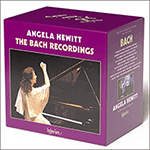
Bach: Angela Hewitt – The Bach Recordings
CDS44621/4727CDs Boxed set (at a special price)
Higher-value orders will be automatically discounted at check-out
Bach: Angela Hewitt plays Bach
CDS44421/3516CDs Boxed set (at a special price) — Download only
Bach: The Six Partitas
CDA67191/22CDs
Bach: The Six Partitas
Studio Master: CDA68271/22CDsStudio Master FLAC & ALAC downloads available

Bach: The Six Partitas
SIGCD0122CDs Download only
Muhly & Goodman: The Street
Studio Master: KGS0066-D2CDs Download onlyStudio Master FLAC & ALAC downloads available
York Bowen - The complete solo 78-rpm recordings
APR60072CDs for the price of 1 — Download only
Waiting for content to load...