Welcome to Hyperion Records, a British classical label devoted to presenting high-quality recordings of music of all styles and from all periods from the twelfth century to the twenty-first.

Hyperion offers both CDs, and downloads in a number of formats. The site is also available in several languages.

Please use the dropdown buttons to set your preferred options, or use the checkbox to accept the defaults.

Click cover art to view larger version
Track(s) taken from CDA68301

Magnificat and Nunc dimittis in F minor

composer
published in 1912; SATB SATB
author of text
Magnificat: Luke 1: 46-55; Nunc dimittis: Luke 2: 29-32

Westminster Abbey Choir, James O'Donnell (conductor)
Studio Master FLAC & ALAC downloads available
CD-Quality:
Studio Master:
CD-Quality:
Studio Master:
Recording details: June 2019
All Hallows, Gospel Oak, London, United Kingdom
Produced by Adrian Peacock
Engineered by David Hinitt
Release date: June 2020
Total duration: 8 minutes 5 seconds

Cover artwork: Statue of Moses at the High Altar, Westminster Abbey.
Copyright © Dean and Chapter of Westminster
 

Other recordings available for download

St Paul's Cathedral Choir, Andrew Carwood (conductor)

Reviews

‘The masterpieces come at the beginning and the end, the motets by Stanford and the songs by Parry, in which whole worlds of pain, belief, hope and tradition are condensed into telling cadences that internalise rather than boast about technique and aspiration … it’s in these more classical designs that O’Donnell’s choir shows its poise: thrillingly bright and straight-backed in Stanford’s ‘Caelos ascendit hodie’ (and judicious in that vibrant final cadence) and going with the flow in the tremendous text-led freedoms of Parry’s Songs of Farewell, the most remarkable meeting of English choral style with sheer instinct … it radiates an optimism of its own, which may well prove even more special in the long run’ (Gramophone)

‘I couldn't resist this Parry [My soul, there is a country], which places those voices right in the middle of the building and makes you feel like you're there. We're incredibly lucky to have this tradition … the producers on this disc are the dream team of Peacock and Hinitt and, for me, one of their real USPs is how they really do manage these difficult acoustics … it works beautifully’ (BBC Record Review)

‘James O’Donnell and his fine choir give an excellent performance of these incomparable Parry songs … the technical side of the recording was in the highly experienced hands of David Hinitt (engineer) and Adrian Peacock (producer). They’ve achieved very satisfying results in the acoustic of All Hallows Church, Gospel Oak, which seems ideally suited to repertoire such as this. The booklet essay is by Jeremy Dibble, who writes with his customary authority in these matters’ (MusicWeb International)» More

‘Looking for spiritual consolation in troubled times? Look no further. The Choir of Westminster Abbey could hardly have timed this release any better, coming at a time of lockdown when many of us are considering what really matters in life and looking for something deeper … the sound of the recording is part of what makes it special. For one thing, using boys' voices makes a massive difference—you definitely wouldn’t mistake these for adult females—and James O’Donnell’s shaping of the sound shows his familiarity with both the music’s shape and the tradition in which the composers were writing. Furthermore, the quality of the recording gives the music and more ethereal, slightly distanced feel. This is contemplation of the divine from a reverent distance, giving the music a spirituality that I found really compelling … it’s hard to imagine any ecclesiastical choir singing this music any better’ (MusicWeb International)» More

‘O’Donnell’s version of the Parry is the standout, and … the other pieces, especially the Wood, make this an excellent disc overall and a worthy addition to the Westminster Abbey discography’ (MusicWeb International)
Alan Gray, Stanford’s successor as organist of Trinity College, Cambridge, was a lawyer by training, but chose to pursue music after his studies with Edwin G Monk in York. As an undergraduate at Trinity College, Gray became known to Stanford, and gave occasional organ recitals there. After a period as director of music at Wellington College, he took up his appointment as organist of Trinity in January 1893—a position he held until 1930. Gray inherited a decline in the fortunes of the Trinity choir. In 1896 the choir school was abolished, and the boys were thence educated at the local Perse Grammar School in Cambridge. With less control over the interaction of their education, he found it difficult to organize rehearsals and voice-training to the same extent that Stanford had enjoyed. Much of Gray’s church music has suffered neglect. The First World War affected him deeply and he lost two of his three sons late in the conflict, their memory commemorated in his best-known anthem What are these that glow from afar?. His settings of Rupert Brooke, in his cycle of partsongs entitled 1914, are also very moving, as is the orchestral Elegy of 1915, played in memory of W C Denis Browne who died in the Dardanelles. His most enduring work for the Anglican liturgy is his a cappella Magnificat and Nunc dimittis in F minor for double choir, which was published in 1912. Evincing some robust handling of well-established double-choir techniques—eight-part counterpoint, antiphony, imitation—there are also some attractive Romantic touches in Gray’s adaptation of sonata form, notably the ‘genuflection’ (‘holy is his name’) in E flat which prepares the way for the second subject in A flat (‘And his mercy is on them that fear him’). This material later returns in F major (‘As he promised to our forefathers’) before the Gloria establishes the darker hue of F minor. The more penitential Nunc dimittis sets out more prayerfully in F minor, but its optimistic message (‘to be a light to lighten the Gentiles’) drives the music forward to A flat major before the Gloria, somewhat modified, once again brings the movement to its more familiar F minor conclusion.

from notes by Jeremy Dibble © 2020

Other albums featuring this work

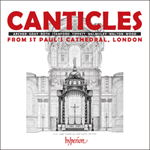
Canticles from St Paul's
Studio Master: CDA68058Download onlyStudio Master FLAC & ALAC downloads available
Waiting for content to load...