Welcome to Hyperion Records, a British classical label devoted to presenting high-quality recordings of music of all styles and from all periods from the twelfth century to the twenty-first.
Hyperion offers both CDs, and downloads in a number of formats. The site is also available in several languages.
Please use the dropdown buttons to set your preferred options, or use the checkbox to accept the defaults.


| Dante Quartet» More |
 PERFORMANCE RECORDING

My intention was to paint a tone picture of my life. The first movement depicts my youthful leanings towards art, a Romantic atmosphere, the inexpressible yearning for something I could neither express nor define, and also a kind of warning of my future misfortune. The long persistent note in the finale owes its origin to this. It is the fateful ringing of the high-pitched tones in my ears, which, in 1874, announced the beginning of my deafness. I allow myself this small joke, though [my loss of hearing] was ultimately disastrous.
The second movement, a quasi-polka, recalls the joyful days of my youth when I composed dance tunes and was widely known as a passionate lover of dancing.
The third movement (the one which, in the opinion of the gentlemen who play this quartet, is unperformable) reminds me of the happiness of my first love, the girl who later became my first wife [and whom Smetana sadly lost to tuberculosis, caught in the harsh Gothenburg climate].
The fourth movement describes my discovery that I could incorporate national elements in my music, and my joy in following this path until it was terminated by the onset of my deafness, the outlook into a sad future, the tiny rays of hope of recovery; but remembering the promise of my early career, a feeling of painful regret.
There can be no doubt about the sincerity of Smetana’s feelings. Having wished for wider recognition and eventually realizing that his reputation would come through the Czech National Revival, Smetana had become its most vocal devotee. Lauded as the father of Czech music, his deafness cruelly consigned him to an increasingly hermitic existence. The sudden interruption of the quartet’s vivacious finale is an eloquent depiction of creativity cut down. The melancholic (if consoled) lullaby that follows, with its whispers of past glories, tells of his painful acquiescence.
from notes by Gavin Plumley © 2011
Mon intention était de brosser un tableau sonore de ma vie. Le premier mouvement dépeint mes inclinations juvéniles vers l’art, un climat romantique, l’ineffable aspiration à quelque chose que je ne saurais ni exprimer ni définir, et une manière d’avertissement quant à mon malheur à venir. La longue note persistante du finale trouve là son origine. C’est le funeste tintement de sons aigus dans mes oreilles qui, en 1874, annonça le début de ma surdité. Je me permets cette petite blague, même si [ma surdité] fut en définitive un désastre.
Le deuxième mouvement, une quasi-polka, évoque les heures riantes de ma jeunesse, quand je composais des airs de danse et que j’étais partout reconnu comme un fervent amoureux de la danse.
Le troisième mouvement (le seul qui, de l’avis des messieurs qui jouent le quatuor, soit injouable) me rappelle le bonheur de mon premier amour, la jeune fille qui allait devenir ma première femme [et qu’il aura le malheur de perdre, emportée par une tuberculose contractée sous le rude climat de Göteborg].
Le quatrième mouvement décrit ma découverte de la possibilité d’incorporer des éléments nationaux dans ma musique, la joie que j’ai éprouvée à suivre cette voie jusqu’à ce que ma surdité naissante vînt y mettre un terme, les sombres perspectives d’avenir, les infimes lueurs d’espoir de guérison; mais, me remémorant les promesses de mon début de carrière, un sentiment de douloureux regret.
La sincérité des sentiments de Smetana ne fait aucun doute. Ayant souhaité une plus large reconnaissance, il était devenu le plus énergique apôtre du Renouveau national tchèque, car il avait fini par comprendre que sa réputation passerait par ce mouvement. Encensé comme le père de la musique tchèque, il vit sa surdité le cantonner cruellement à une vie de plus en plus érémétique—une créativité terrassée que traduit éloquemment la brusque interruption du vivace finale de son quatuor. Avec ses murmures de gloires révolues, la berceuse mélancolique (mais consolée) qui vient ensuite dit le douloureux acquiescement du compositeur.
extrait des notes rédigées par Gavin Plumley © 2011
Français: Hypérion
Meine Absicht war es, ein Tonbild meines Lebens zu malen. Der erste Satz stellt meinen jugendlichen Hang zur Kunst dar, eine romantische Atmosphäre, die unaussprechliche Sehnsucht nach etwas, was ich weder in Worte fassen noch beschreiben konnte und auch eine Art Warnung vor meinem bevorstehenden Unglück. Der langgedehnte Ton im Finale stammt daher. Es ist das schicksalsschwere Pfeifen in den höchsten Tönen in meinen Ohren, das 1874 meine beginnende Taubheit ankündigte. Ich erlaube mir diesen kleinen Scherz, obwohl [mein Gehörverlust] letztendlich katastrophal war.
Der zweite Satz, sozusagen eine Polka, erinnert an die freudigen Tage meiner Jugend, als ich Tanzmelodien komponierte und allgemein als leidenschaftlicher Tänzer bekannt war.
Der dritte Satz (derjenige, der nach der Ansicht der Herren, die dieses Quartett aufführen, unspielbar ist) erinnert mich an das Glück meiner ersten Liebe, ein Mädchen, das später meine erste Ehefrau wurde [und die tragischerweise in dem harschen Klima in Göteborg an Tuberkulose erkrankte und starb].
Der vierte Satz beschreibt meine Erkenntnis, dass ich nationale Elemente in meine Musik aufnehmen konnte und meine Freude daran, diesem Weg zu folgen, bis er durch den Beginn meiner Taubheit beendet wurde, der Ausblick in eine traurige Zukunft, die kleinen Strahlen der Hoffnung auf Besserung; die Erinnerung an die Aussichten zu Beginn meiner Karriere, ein schmerzhaftes Gefühl des Bedauerns.
Die Gefühle Smetanas sind zweifellos aufrichtig. Er hatte sich größere Anerkennung herbeigesehnt und schließlich realisiert, dass er diese durch die tschechische Nationalbewegung erreichen würde, woraufhin er ihr stimmgewaltigster Anhänger wurde. Er wurde als Vater der tschechischen Musik gepriesen, doch bewirkte seine Taubheit eine zunehmend einsiedlerische Existenz. Die plötzliche Unterbrechung im lebhaften Finale des Quartetts ist eine anschauliche Darstellung seines zurückgestutzten Schaffens. Das melancholische (wenn auch trostreiche) Schlaflied mit seinem Geflüster über vergangenen Ruhm, das darauf folgt, drückt seine schmerzvolle Ergebung aus.
aus dem Begleittext von Gavin Plumley © 2011
Deutsch: Viola Scheffel
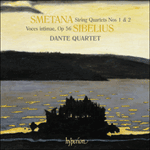 Smetana & Sibelius: String Quartets CDA67845  BBC Music Magazine award winners the Dante Quartet return for their third Hyperion recording with the string quartets of Smetana and Sibelius. This group, renowned for their inventive interpretations and sensitive articulation, capture perfectly t ...» More |