Welcome to Hyperion Records, a British classical label devoted to presenting high-quality recordings of music of all styles and from all periods from the twelfth century to the twenty-first.
Hyperion offers both CDs, and downloads in a number of formats. The site is also available in several languages.
Please use the dropdown buttons to set your preferred options, or use the checkbox to accept the defaults.
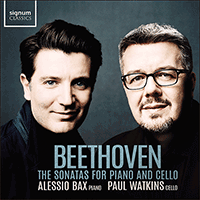


Recorded in the gorgeous acoustic of Cedars Hall in Wells, this double album sees cellist Paul Watkins and pianist Alessio Bax follow Beethoven’s evolving formal and expressive concerns through the five sonatas for keyboard and cello. These works illustrate their composer’s early, middle and late styles, from the Op 5 sonatas written during in 1796, through Op 69 from the period of Symphonies Nos 5 & 6, and on to the Op 102 set which marked the beginning of Beethoven’s final creative phase.

It was Prince Lichnowsky who, early in 1796, organised a concert tour for Beethoven that took him to Prague, and then on to Berlin via Dresden and Leipzig. In Berlin, where he stayed for several months, Beethoven was received at the court of the Prussian king, Friedrich Wilhelm II. The king was a keen amateur cellist, and he employed two of the finest players of the day: Jean-Pierre Duport and his younger brother (and pupil) Jean-Louis. Both brothers composed sonatas that called for extreme virtuosity on their instrument. However, their accompaniment was written not for keyboard, but for a second cello, and a similar layout was adopted in the sonatas by the king’s official chamber composer, Boccherini (who, however, was not in residence, but dispatched his compositions from his adopted home city of Madrid). While aspects of the cello technique displayed in the Duport brothers’ works clearly left their mark on the two sonatas Beethoven composed during his Berlin residency, he was understandably keen to display his own prowess as a virtuoso pianist, and as a result he produced what was essentially an entirely new genre. It’s true that Bach had composed three sonatas for viola da gamba (or cello) and keyboard, but the increased power of the piano over the harpsichord presented Beethoven with new problems of balance between the two instruments, particularly when it came to exploiting the warm, but less penetrating, sonority of the cello’s low register. The problem became more acute in music of a slow, sustained character, and it’s significant that not until his last cello sonata did Beethoven attempt to write a fully-fledged slow movement. In the first four he opted instead for a slow introduction either to the first movement (the two Op 5 sonatas), the finale (Op 69), or both (the C major Sonata Op 102 No 1). Moreover, in the last sonata, Op 102 No 2, the slow movement presents an altogether dark sonority in which the cello has for the most part the upper voice.
The avoidance of a slow movement in the Op 5 sonatas led Beethoven to adopt a form in two movements only—a scheme that may have stemmed from some of the violin sonatas of Mozart. (Mozart’s G major sonata K379, with its long slow introduction followed by a dramatic Allegro in G minor, may well have provided the model for the second work of Beethoven’s pair.) The design is one that places the main weight of the work as a whole squarely on its first movement, and the opening movement of the F major Sonata Op 5 No 1 is on a grand scale indeed. Following the slow introduction, the Allegro’s exposition contains no fewer than four well defined themes; and its scope is further enlarged through excursions into the ‘flatter’ regions of C minor and A flat major. The concerto propensities of the piece—essentially a virtuoso vehicle for the pianist—are underlined by a cadenza near its close, and by a conclusion unabashedly written in orchestral style.
The theme of the rondo finale begins momentarily away from the home key, and Beethoven compensates for its instability by presenting a much more conventionally shaped melody—albeit in the minor—in the movement’s central episode. With its lilting rhythm and its pizzicato accompaniment, the episode foreshadows the light-hearted use of the minor we find in the finales of Beethoven’s first two piano concertos.
The Sonata in G minor Op 5 No 2 finds Beethoven’s early style at its most dramatic, and its slow introduction is considerably more expansive than that of its companion work—indeed, it conveys the weight and substance of a sonata movement in itself, complete with a contrasting second subject and an elaborate development section. The Allegro eventually begins at the point where we might have expected a recapitulation to set in. The introduction’s closing bars provide one of the most protracted uses of silence to be found anywhere in Beethoven. The music, moreover, is deliberately left hanging in mid-air, with the fi rst half of a cadence that is not actually resolved until the end of the Allegro’s opening phrase. The Allegro itself begins quietly and calmly, as though reluctant to break the spell; but with the first forte outburst the mood changes dramatically, and the music from here on becomes intensely agitated. Towards the end, Beethoven brings the recapitulation to a forceful full-close—only to launch quite unexpectedly into a coda which actually comes to rest far less conclusively. Its ending, in fact, provides a natural link to the rondo finale, whose theme begins as though it were to be in C major.
The notion of having a G major rondo setting off for all the world as though it were to be in C major is one that Beethoven was to take up again in his Fourth Piano Concerto. In the case of the sonata the off -tonic beginning enables him to approach the reprise of the rondo theme each time as part of a continuing harmonic sequence, so that the listener isn’t aware of its return until it is already under way.
The A major Sonata Op 69 belongs to one of the richest periods of Beethoven’s life. He composed it in 1807, when he was also working on his Fifth Symphony. By the following year, not only had that symphony and its successor, the ‘Pastoral’, been completed, but also the two piano trios Op 70. The five works are astonishingly varied, in both character and outward shape. The cello sonata and the first of the trios—both of them among Beethoven’s most original and perfectly achieved chamber works with piano—are in a sense complete opposites: while the sonata lacks a self-contained slow movement, and has instead a scherzo as its centrepiece, the ‘Ghost’ trio absorbs scherzo-like elements into its exceptionally quick outer movements, thus leaving room for a sombre slow movement at the heart of the work.
The success of the Op 69 sonata’s unusual plan is due not only to the relaxed, lyrical nature of its opening movement, but also to the presence of a short, serene Adagio preceding the finale—not so much an introduction, as a drastically curtailed slow movement. The sonata begins with one of Beethoven’s profound inspirations: a quiet theme whose first half is given out by the cello alone. This opening phrase remains unharmonised virtually throughout the piece: only the start of the recapitulation offers a fleeting, skeletal harmonisation in the shape of a ‘running’ accompaniment for the pianist’s right hand alone. The theme’s third and fourth bars, however, provide the basis for a sonorous and plangent passage in the central development section, where the melody soars high above a widely spaced piano accompaniment written in imitation of a cello bowing back and forth across its strings. The result seems to anticipate the nocturnes of Chopin, but the melody itself is strikingly reminiscent of the aria ‘Es ist vollbracht’ from Bach’s St John Passion. That aria, moreover, contains a part for solo viola da gamba. Whether Beethoven can have known Bach’s as yet unpublished masterpiece is a moot point, but the passage certainly seems to hold some deep personal meaning. Not by chance, perhaps, the same grief-laden theme occurs in the Arioso dolente, or ‘mournful song’, of Beethoven’s late piano sonata Op 110.
For his second movement Beethoven makes use of the expanded scherzo form he had established the previous year with the second of his three ‘Razumovsky’ string quartets and the Fourth Symphony, whereby the trio is heard twice, between three appearances of the scherzo itself. The cello sonata’s scherzo is a curiously obsessive piece, with a trio—in the contrasting major—entirely based on the two-note figure with which the scherzo ends, running through it in a form of ostinato. The scherzo’s theme is unsettlingly syncopated, and Beethoven instructs the pianist to change fingers on its tied notes. His pupil Carl Czerny, who played the sonata in the composer’s presence, maintained that the second in each pair of tied notes should actually be sounded: “the first note (with the 4th finger) very tenuto, and the other (with the 3rd finger) sharply detached and less marked… The 4th finger must therefore glide aside and make way for the 3rd.” Czerny’s advice is followed by Alessio Bax in the present recording.
Clearly, such an agitated piece could not ideally be placed side by side with the sonata’s finale, and Beethoven duly provides a calm interlude, in the shape of what sounds at fi rst as though it is to be a full-scale slow movement. But for all the expansiveness of its opening theme, the piece is broken off almost before it has had time to establish itself, and there follows one of Beethoven’s most exhilarating finales—one that provides an ideal foil to the claustrophobic atmosphere of the scherzo.
The two Sonatas of Op 102, written in the summer of 1815, mark the start of Beethoven’s last period. His radically new style emerged out of a comparatively fallow period, and in the previous two and a half years he had produced little new music of importance, other than the highly concentrated piano sonata Op 90. His return to the full flood of creativity was marked by a new-found interest in the strict discipline of fugue as well as a fascination with open-ended forms, and the first fruit of this new style was avowedly experimental: the manuscript of the C major Cello Sonata Op 102 No 1 describes it as a ‘free sonata’, and its design, consisting of two quick sonata-form movements each prefaced by a slow introduction is unique in Beethoven. Moreover, not only does the sonata appear to begin in midstream, but the material of the opening bars returns immediately before the final Allegro, as a means of highlighting the underlying unity of the work as a whole. Much the same happens in the Op 101 piano sonata, composed the following year; and Beethoven’s interest in cyclic form is further reflected in the song cycle An die ferne Geliebte, written around the same time.
The change in mood from the quiet introspection of the C major cello sonata’s opening introduction to the ferocity and rhythmic incisiveness of the ensuing Allegro is as startling a juxtaposition of opposites as Beethoven ever conceived. Nor is there any other instance of his having written the entire first sonata-form Allegro in a ‘foreign’ key: it is actually in A minor, and it even avoids the perfectly logical choice of C major for its second subject. Even so, the function of the second slow introduction is not so much to re-establish the home key (it does not do so with any degree of firmness), as to provide a transition between the two quick movements. Its intensely expressive style spills over into the reminiscence of the sonata’s beginning, which is recalled in an elaborated form. As for the finale itself, its main theme was originally conceived as a straightforward fugue subject. Beethoven was to put a similar theme to altogether Handelian treatment some seven years later, in his Overture Die Weihe des Hauses; in Op 102 he chose instead to reserve a fully worked out fugue for the second work of the pair, and to cast the finale of the first as a sonata form with a contrapuntal development section.
The Sonata Op 102 No 2 is altogether more conventionally shaped. Its first two movements have features in common with the ‘Ghost’ piano trio, in the same key of D major: both works have an assertive opening theme in bare octaves, followed immediately by a much calmer contrasting idea, and both have a brooding slow movement in D minor. The Adagio of Op 102 No 2 is, indeed, one of Beethoven’s great tragic utterances—a piece that shows a progressive increase in poignancy, from its dark chorale-like opening, through a warmly lyrical D major middle section and an intensified reprise, to a coda in which the cello introduces a new bitter-sweet melody of infinite sadness. This new melody derives in effect from the middle section, whose ascending scale theme is also closely related to the finale’s fugue subject.
The calm of the slow movement is broken hesitantly, and with the most neutral material imaginable: a simple scale played first by the cello, and answered by the piano. A further pause, and the cello repeats the scale, now revealing it to be the start of the fugue’s subject. It is an extraordinary moment, and one that Beethoven may perhaps distantly have remembered from the famous halting opening—also based on an ascending scale—of the finale of his First Symphony. The cello sonata’s finale is headed ‘Allegro fugato’—a disclaimer from strict contrapuntal procedure that is less explicit than those printed over the fugues of the ‘Hammerklavier’ piano sonata (con alcune licenze) and the string quartet Op 133 (tantôt libre tantôt recherchée), though similar in intent. It is a piece that has much in common with the ‘Hammerklavier’ fugue: the use of both subject and countersubject in inversion; the inclusion at a late stage of a new countersubject in long notes, affording a brief moment of calm; and the subsequent contrapuntal combination of the new subject and the original fugue theme. Although the cello sonata’s fugue is much shorter than that of the ‘Hammerklavier’, it, too, presents the pianist, in particular, with technical hurdles that are not easily overcome; and it is a characteristically Beethovenian paradox that in turning to the music of the past for inspiration he should have produced a piece in such an uncompromisingly new style.
Misha Donat © 2026
When I first heard Alessio Bax play the “Moonlight” Sonata, a work whose extraordinary popularity can sometimes make it seem clichéd, the freshness and clarity of his interpretation gave it new meaning for me. After that performance, I knew that I wanted to record the Beethoven cello sonatas with him.
I have been fortunate to be able to perform almost all of Beethoven’s chamber music during my time as cellist of The Nash Ensemble and the Emerson String Quartet. I’ve also played and conducted much of his orchestral music over the last 30 years. During the process of recording the sonatas, Alessio and I heard countless echoes of this wonderful repertoire, illuminating and guiding us in every bar. Working with Alessio and my long-time friend and colleague, our producer Andrew Keener, has been a joyful experience, in many ways a summing-up of my musical life so far.
These sonatas have brought me endless pleasure and fulfillment throughout my life, and I hope this recording reflects the inspiration Beethoven has given me.
Paul Watkins © 2026