
Welcome to Hyperion Records, a British classical label devoted to presenting high-quality recordings of music of all styles and from all periods from the twelfth century to the twenty-first.
Hyperion offers both CDs, and downloads in a number of formats. The site is also available in several languages.
Please use the dropdown buttons to set your preferred options, or use the checkbox to accept the defaults.
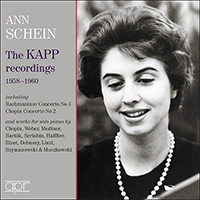

Ann Schein’s grandfather, a violinist from a European town in Galicia, then part of the Austro-Hungarian Empire, formed a family chamber orchestra and took them to Chicago to perform at the World’s Columbian Exposition of 1893. He became very active in the opera and theatre orchestras in Chicago and raised eight children there, one of them Ann’s father, who married an American violinist trained at the Chicago Musical College. Born in 1939, Ann was the youngest of their four children and when she started to play the piano at the age of three her parents found what she describes as ‘the best teachers for me’—Glenn Dillard Gunn and his pianist wife, Bessie Bracken Gunn, both prominent musicians in Chicago. They had both gone from Chicago to Berlin to join the classes given by Ferruccio Busoni and were both important musical leaders in Chicago. Glenn Dillard Gunn (1874-1963) was music critic for the Chicago Tribune, the Chicago Herald Examiner and the Washington Times-Herald. His collection at the Library of Congress includes correspondence from Ferruccio Busoni, Teresa Carreño, Percy Grainger and Moriz Rosenthal. Gunn and his wife taught Ann the piano from the age of four to thirteen.
In 1951, at eleven years of age, Ann went to the summer music camp at Interlochen, Michigan, where she entered the piano concerto competition playing Beethoven’s Concerto No 1. She was not placed, so did not get to perform the concerto with orchestra. However, two years later she returned and won the competition (the youngest person ever to do so) with MacDowell’s Piano Concerto No 2 in D minor, Op 23, and played the first movement with the orchestra.
Schein’s parents were very supportive and realised that by now she needed the best teacher that could be found to nurture her talent. They decided to choose between three pianist-teachers—Eduard Steuermann at the Juilliard School in New York, Mieczysław Horszowski at the Curtis Institute in Philadelphia and Mieczysław Munz at the Peabody Institute of the John Hopkins University in Baltimore. Steuermann would not take children, Horszowski was often away performing, but Munz was delighted to accept the thirteen-year-old Ann as a student.
She was indeed fortunate to have the Polish pianist Mieczysław Munz (1900–1976) as her teacher. A pupil of Busoni who made his Berlin debut in 1920 followed by his New York debut two years later, his career had been halted by a medical problem with his right hand in the early 1940s causing Munz to accept teaching posts at some of the major schools in America including the Curtis Institute (at the invitation of Josef Hofmann), Peabody Conservatory and Juilliard School of Music.
Between the ages of thirteen and fifteen Ann had a lesson each day for three months in Mexico where Munz spent his summers. During the winter she had three lessons a week with him at Peabody. He expected her to learn a great deal of demanding repertoire very quickly—the fourth and fifth concertos of Beethoven, as well as the ‘Waldstein’ and ‘Appassionata’ Sonatas. Fortunately, her school allowed this and she had to make up her lessons whenever possible.
In 1954, when she was fifteen, Munz assigned Rachmaninov’s Piano Concerto No 3 in D minor to improve her technique telling her, ‘You will never perform it.’ Schein said that Munz was a magician with innovative fingering, especially in difficult technical passages, designing them for each hand of his many students. This enabled them to conquer difficult passages, so that they could be played with greater ease, making them sound more musical. Indeed, when attending the Berlin classes of Busoni, Munz had immediately been invited to become Busoni’s assistant. Busoni was unusually imaginative with his pedalling, and Schein says that both the Gunns and Munz gave many helpful ideas on this in her lessons, making the harmonic and pianistic effects more poetic and beautiful. After studying the work for a year, Munz was so pleased with her progress that he suggested that Ann play it with the Peabody Conservatory Orchestra. In January 1956, at the age of sixteen, she gave the first of more than 100 performances of this concerto throughout her career. The Baltimore Review was positive and even said, ‘she was not at all intimidated by the difficult Cadenza’: evidence of Munz’s innovative ways to ease hard technical passages!
It was at this time that Schein began to study full time at Peabody with Munz until 1961. In 1957 she made her professional debut in Mexico City with the Rachmaninov Concerto, and in 1958 made her first tour of twelve European cities, returning each year after that, most frequently to Holland and Norway. Her London debut took place in January 1959 where the main work on the programme was Schumann’s Humoreske:
It is heartening to see a pianist who is young and pretty, and musical as well. Miss Ann Schein, who gave her début recital at Wigmore Hall on Friday, has a useful technique, brilliant though not leonine, with a particularly attractive range of touch from forte downwards.
(Times, 19 January 1959)
Schein made her New York debut in August 1960 when she played Rachmaninov’s Third Concerto at Lewisohn Stadium, a vast open-air amphitheatre seating 8,000. She loved the experience even though it was 100 degrees Fahrenheit. People listened from windows that overlooked the stadium. Ann’s father knew conductor Alfred Wallenstein and wanted him to conduct the performance, but Wallenstein was not keen on performing this particular work with a young girl. After hearing Ann play, he changed his mind.
In 1961 and 1966, she made extensive tours of Russia during the Cold War, and in 1966 made her first trips to the Far East and South America.
Upon completion of her studies with Munz, Schein decided that she wanted to study with Arthur Rubinstein and Myra Hess. She contacted both and studied with Rubinstein in Paris in the summer of 1961 and again in Paris and Lucerne in 1962.
It was in 1962 that Schein made her Carnegie Hall debut under the auspices of impresario Sol Hurok, who invited her onto his roster thanks to the encouragement of Rubinstein, who was always there to support her in her early career. He attended her debut recital, yelling ‘Bravo’ afterward!
There is a story about how she came to study with Arthur Rubinstein. Although her mother chaperoned her until the age of twenty-three, Ann had a great friend and surrogate mother in Halina Rodzinski, wife of the great Polish-American conductor Artur Rodzinski. Without Ann’s knowledge, Halina went to a party that Rubinstein gave at his home during Easter of 1961. She took with her Ann’s new LP of Rachmaninov’s Third Concerto. Rubinstein told her he did not want to hear a child prodigy. Later Halina put the LP on the record player and Rubinstein was so impressed with the playing he asked the guests to be silent so they could listen to the playing. As a result, he arranged to meet Schein with Munz. Ann, her mother and Munz went to Rubinstein’s home where, at Munz’s suggestion, she played a Chopin mazurka. This is how she came to study with him in Paris.
At the same time, Schein was having lessons with Myra Hess to whom she had been introduced by Stephen Bishop (later Kovacevich) who was already her pupil. When she told Rubinstein about this he said: ‘Of course you should have lessons with her, she is a bit boring, but a fine choice.’ When Ann asked the permission of Myra Hess to study with Rubinstein simultaneously, she replied: ‘Of course! Rubinstein—a bit of a show-off, but a fine artist!’ Hess wanted to hear Ann play Beethoven, Brahms and Schumann and coached her particularly in the Schumann Piano Concerto. Her strongest advice was to take slower tempi and feel more depth in all musical phrases as Ann’s tempi were fast and Hess generally showed disapproval over this, the only exception being when she played Brahms Op 119 which Ann had just been studying with Rubinstein. Of Hess, Ann told this writer: ‘She remains one of the greatest artists I ever heard, and I can recall vividly so many of her performances and being moved to tears by feelings I could not even articulate.’
In 1963, she was invited to perform at the White House in the administration of John F. Kennedy. That same year, she was asked to tour many countries as an American Cultural Ambassador, adding more than 50 countries to her growing performing career.
As mentioned above, Schein was popular in Holland and Norway and visited both regularly. She also gained success and a following in the United Kingdom and, from around 1960, for fifteen years recorded and broadcast regularly for the BBC, participating in six Proms (1963-1970) including two Last Nights. Schein was with the British agent Ibbs and Tillett whose representative for the BBC was Audrey Hurst and it was she who took the Kapp LP of the Rachmaninov Concerto to Malcolm Sargent. He was impressed and on 29 January 1961 broadcast a performance of the work with her and the BBC Symphony Orchestra on the Home Service.
Twenty years of performing followed where Schein worked with the greatest conductors and instrumentalists, including George Szell, Seiji Ozawa, Jessye Norman, and the American and Cleveland String Quartets. Schein’s also had a regular duo partnership, as well as fifty-five years of happy marriage, with her husband Earl Carlyss, a member of the Juilliard String Quartet for twenty-one years. Earl sadly died in January 2026.
In 1980 Schein joined the piano faculty of Peabody Conservatory and presented an all-Chopin series of six recitals (1980-1981) in New York’s Alice Tully Hall, the first all-Chopin series given there since 1946. Rubinstein gave her advice on the interpretation of the music. Most recently, she presented an all-Chopin recital in Carnegie Hall on 12 March 2021, celebrating the 40th anniversary of the Tully Hall events. Dramatically, the following day New York completely shut down for the next several seasons at the onset of the Covid pandemic. In 2022, she was again invited onto the piano faculty at Peabody Conservatory, as well as the Mannes School of Music in New York; she currently teaches at both schools.
The Kapp LPs
Although Schein recorded for many labels—including Delos, Desto and Ivory Classics—it is the five LPs made for Kapp between 1958 and 1960 that are the best representation of her work. Ann told this writer the story of how the LPs came to be made. Alan Silver, a recording engineer, previously had piano lessons with Munz. He was working for David Kapp who had set up Kapp Records in 1954 achieving great success with popular artists such as Jane Morgan and pianist Roger Williams. Kapp decided he wanted to add some classical artists to his roster so asked Silver to find some pianists. Silver went to his old teacher to convince him to record for Kapp but Munz refused. However, he played Silver a tape recording of Schein’s Peabody performance of Rachmaninov’s Third Concerto from 1956. Silver wanted to sign her immediately, but Munz requested he should wait two years.
All the solo discs were recorded at various studios in New York City. Schein’s first LP of Études KAPP9023, which she made at the age of eighteen, was a great success, not only because of the unusual repertoire, a suggestion from Munz. Described by the American Record Guide, Ann’s ‘stellar tributes’ made her debut record an ‘exhilarating experience’. This was followed by the Chopin Scherzi KAPP9040, which she remembers was recorded at RCA Studios using the very piano Horowitz played for his own recordings. Again, the American Record Guide was impressed: ‘To be sure, there are passages of stunning virtuosity, but also there is a wealth of poetic eloquence, deep feeling, subtle nuance and color in these performances.’ For the ‘Invitation to the Dance’ album KAPP9042 the same publication thought that, ‘the nineteen-year-old Ann Schein has, in addition to a highly spectacular technique, a remarkable interpretive insight and maturity. Granted that in the present collection she is playing to please the crowd—these are definitely extroverted performances—she shows much style as well.’
The success of the solo albums encouraged Kapp to record Schein in concerto repertoire, so they contracted Sir Eugene Goossens to conduct the Vienna State Opera Orchestra for sessions in January 1960. The recordings were made in the Musikverein in Vienna which had a giant Bösendorfer Vienna Imperial grand piano. Ann was not used to this, with its extra bass notes, different sound and touch, so a new Steinway was sent from Hamburg. However, the action of the brand-new instrument was too heavy for the passage work of the concerto, so the recordings were made on the Bösendorfer. Kapp always provided the best for her, and for the recording of the Rachmaninov and Chopin F minor Concerto she had two weeks of rehearsals and recording.
For this writer, the performance of the Rachmaninov Concerto is in many ways ideal as it avoids the frenetic speeds and brittle sound favoured by some pianists. Instead, there is a rhapsodic grandeur and nobility, a deep, full sound and perfectly judged tempi throughout. At a time when available recorded versions included those by Van Cliburn, Emil Gilels, Byron Janis, not to mention Horowitz and Rachmaninov himself, Schein had formidable competition when she entered the fray. In a review headed ‘Enormously Sensitive Rachmaninoff’ Irving Kolodin wrote a review that would be difficult to improve upon:
First of all, her approach is extremely musical; her sense of style, phrasing and shading are excellent. There is plenty of virtuosity, although not of the thundering kind such as we hear in the recordings of Horowitz or Cliburn … Miss Schein’s playing shows a thorough grasp of the concerto: what sections are important in the piano part, what sections must be supplementary to the orchestra (not all of the performers on records seem to be aware of this). And above almost everything else she has enormous sensitivity in her interpretation. She has a wonderful feeling for the line and flow of this music, and although there are moments when she departs from the strict letter of the score in matters of dynamics or tempi (she is not afraid to take a ritard when it is not written), one cannot quibble with her exceptionally musical conception. It is a highly enjoyable performance, one that gains much from the understanding orchestral support of Sir Eugene Goossens …
(American Record Guide, June 1960)
Indeed, Schein found in Goossens the ‘perfect’ concerto partner. One of his friends was William Glock, controller of BBC Radio 3 at the time and it was through this connection that Schein was initially invited to broadcast for the BBC.
This collection affords us the opportunity to hear a gifted and consummate pianist in her prime, an artist who evidently was sensitive enough to learn a great deal from some of the greatest pianists of the twentieth century, and who carries on this living tradition in her teaching today.
Jonathan Summers © 2026

