
Welcome to Hyperion Records, a British classical label devoted to presenting high-quality recordings of music of all styles and from all periods from the twelfth century to the twenty-first.
Hyperion offers both CDs, and downloads in a number of formats. The site is also available in several languages.
Please use the dropdown buttons to set your preferred options, or use the checkbox to accept the defaults.

| Anthony Marwood (violin), Susan Tomes (piano)» More |

You know how expressively Clara interprets his [Schumann’s] music. I have extraordinary joy in playing Robert’s works with her, and I only wish you could share this joy … I must not fail to tell you about the new Sonata in D minor which Breitkopf & Härtel will bring out very soon. We played it from the proof-sheets. I consider it one of the finest compositions of our times in respect of its marvellous unity of feeling and its thematic significance. It overflows with noble passion, almost harsh and bitter in expression, and the last movement reminds one of the sea with its glorious waves of sound.
The work begins with a majestic slow introduction. The melodic outline of its initial chords (they are to return at the close of the Allegro’s exposition, in a manner which implies a close tempo relationship between the two sections) gives rise to the opening theme of the main body of the movement; and even the broader second subject affords little real contrast of mood. Both subjects, together with a syncopated descending scale idea that separates them, are explored at length in the turbulent central development section; while in the coda the music’s agitation increases still further.
If Schumann had provided his A minor Sonata with a central intermezzo-like slow movement and scherzo rolled into one, this less concise companion-piece has two self-contained middle movements which are nevertheless closely interlinked. The scherzo second movement, with its driving 6/8 rhythm, is a piece that seems to have left a strong impression on the young Brahms, whose own early C minor Scherzo for violin and piano is very similar in mood. (Brahms’s piece was composed at Schumann’s instigation, as part of a joint ‘greetings sonata’ in honour of Joachim’s visit to Düsseldorf in 1853.) Schumann’s scherzo reaches its climax with the opening phrase of the chorale melody ‘Gelobet seist du, Jesu Christ’, given out fortissimo by both players—an anticipation, as it turns out, of the gentle serenade-like theme of the following variation movement. (Both in its actual melody and the manner of its presentation, the moment is one that echoes the chorale in the finale of Mendelssohn’s C minor Piano Trio, Op 66.) Conversely, the third movement’s penultimate variation recalls both the figuration and the actual material of the scherzo; and its coda ties the pieces together still more closely, in such a way that the two seem to be inextricably interwoven. Once again, one is reminded of Brahms: this time, of his F sharp minor Piano Sonata of 1854, in which the theme of the slow movement so strikingly generates the main motif of the scherzo.
Like the opening movement, the finale, with its ‘waves of sound’ so evocatively described by Joachim, is a tumultuous sonata-form movement. This time, however, the more lyrical second subject affords genuine relief from the music’s prevailing intensity; and the piece has an extended coda in the major whose hard-won effulgence provides a splendid conclusion to the work as a whole.
from notes by Misha Donat © 2001
Tu sais combien sa Clara est omniprésente dans ses idées. J’éprouve un ravissement extraordinaire à jouer avec elle les œuvres de son Robert, et j’ai souvent souhaité que tu puisses partager cette joie. Je ne dois pas oublier de te faire part de la nouvelle Sonate en ré mineur que Breitkopf & Härtel vont prochainement publier et que nous avons exécutée à partir des épreuves. Je trouve qu’il s’agit d’une des plus belles créations de notre temps de par sa merveilleuse unité d’humeur et sa richesse thématique. Elle déborde d’une passion noble exprimée avec une certaine âpreté et amertume et le dernier mouvement, avec ses merveilleuses vagues sonores, me rappelle le paysage de la mer.
L’œuvre débute par une introduction lente et majestueuse. Du contour mélodique des premiers accords (qui reviennent à la fin de l’exposition de l’Allegro, d’une manière qui indique une étroite relation de tempo entre les deux sections) jaillit le thème initial de la partie principale du mouvement; même le second thème plus ample ne présente que peu de contrastes de tempérament. Les deux thèmes, associés à l’idée d’une gamme descendante syncopée qui les sépare, sont explorés à l’envi dans la section du développement central agité tandis que dans la coda, l’émoi de la musique s’accroît plus encore.
Si Schumann avait doté sa Sonate en la mineur d’un mouvement central en forme d’intermezzo réunissant mouvement lent et scherzo, il réalisa pour celle-ci une contrepartie moins concise faite de deux mouvements centraux autonomes et pourtant étroitement entrelacés. Avec son rythme allant à 6/8, le scherzo fait office de second mouvement et semble avoir durablement impressionné le jeune Brahms qui écrivit un Scherzo pour violon et piano en ut mineur d’une atmosphère tout à fait comparable. (La pièce de Brahms fut composée à l’instigation de Schumann et incorporée à une «sonate de bienvenue» en l’honneur de la visite de Joachim à Düsseldorf en 1853.) Le Scherzo de Schumann atteint son apogée avec la première phrase mélodique du choral «Gelobet seist du, Jesu Christi», énoncée fortissimo aux deux instruments—en fait une anticipation du thème évoquant une douce sérénade du thème et variations suivant. (Mais par sa tournure mélodique et son énoncé, elle évoque dans ce passage le choral du finale du Trio avec piano en ut mineur opus 66 de Mendelssohn.) Inversement, la pénultième variation du troisième mouvement fait écho tant aux figurations qu’au matériau thématique du scherzo. Quant à la coda, elle réunit encore plus étroitement les deux mouvements de telle manière qu’ils semblent complètement intriqués l’un dans l’autre. La présence de Brahms se fait à nouveau sentir, à travers sa Sonate pour piano en fa dièse mineur de 1854 où le thème du mouvement lent génère de manière saisissante le motif principal du scherzo.
A l’image du premier mouvement, le finale, avec ses «vagues sonores» évoquées par Joachim, est un mouvement tumultueux de coupe sonate. Cette fois pourtant, le second thème de nature plus lyrique offre une réelle détente à l’intensité qui prévaut au sein de la partition. Une coda de vastes proportions écrite en majeur dévoile une félicité radieuse durement acquise qui couronne superbement l’œuvre dans son intégralité.
extrait des notes rédigées par Misha Donat © 2001
Français: Isabelle Battioni
Das rührende Aufgehen seiner Clara in seinen Gedanken kennst Du; es ist für mich eine eigene Seeligkeit gewesen, mit ihr die Compositionen ihres Robert zu spielen, und meine Gedanken haben oft Dich hinzugewünscht, an ihr Teil zu haben; … Nicht unterlassen will ich aber, dich auf die neue Sonate (D moll) aufmerksam zu machen, die nächstens bei Breitkopf & Härtel erscheint, und die wir aus dem Correktur-Exemplar gespielt haben; sie ist für mich eine der schönsten Schöpfungen der neuern Zeit, in ihrer herrlichen Einheit der Stimmung und Prägnanz der Motive. Sie ist voll hoher Leidenschaft,—fast herb und schroff in ihren Accenten—und der letzte Satz könnte an eine Seelandschaft mahnen in seinem herrlichen Auf- und Niederwogen.
Das Werk beginnt mit einer majestätischen langsamen Einleitung. Aus dem melodischen Umriß seiner ersten Akkorde (sie kehren am Ende der Exposition des Allegros auf eine Art wieder, die eine enge Tempobeziehung zwischen den beiden Abschnitten nahelegt) geht das Eröffnungsthema des Hauptteils des Satzes hervor; und selbst das breitere zweite Thema bietet kaum einen echten Stimmungskontrast. Beide Subjekte werden zusammen mit einem synkopierten absteigenden Tonleitermotiv, das sie trennt, in der turbulenten zentralen Durchführung ausgiebig erkundet, und in der Coda wächst die Erregung der Musik weiter an.
Während Schumann seiner a-Moll-Sonate einen zentralen langsamen Satz im Stil eines Intermezzos und ein Scherzo in einem gegeben hat, enthält dieses weniger prägnante Gegenstück zwei in sich geschlossene Binnensätze, die dennoch eng verbunden sind. Der zweite Satz, das Scherzo mit seinem treibenden 6/8-Rhythmus, ist ein Stück, das offenbar den jungen Brahms tief beeindruckt hat: Sein frühes Scherzo in c-Moll für Violine und Klavier ist von der Stimmung her sehr ähnlich. (Brahms’ Stück entstand auf Anregung Schumanns, als Teil einer gemeinsamen Sonate zur Begrüßung und zu Ehren Joachims, als dieser 1853 in Düsseldorf zu Gast war). Schumanns Scherzo erreicht seinen Höhepunkt mit der einleitenden Phrase der Choralmelodie „Gelobet seist du, Jesu Christ“, die fortissimo von beiden Interpreten dargebracht wird—ein Vorgriff, wie es sich herausstellt, auf das sanfte Serenadenthema des nachfolgenden Variationssatzes. (Sowohl in seiner Melodie als auch in der Art seiner Darbietung läßt der Satz den Choral im Finale von Mendelssohns Klaviertrio in c-Moll op. 66 anklingen.) Umgekehrt erinnert die vorletzte Variation des dritten Satzes sowohl an die Figuration als auch an das Material des Scherzos; und ihre Coda verbindet die angesprochenen Stücke noch enger, so daß sie unentwirrbar verstrickt erscheinen. Wieder fühlt man sich an Brahms erinnert: diesmal an seine Klaviersonate in fis-Moll von 1854, in der das Thema des langsamen Satzes so eindrucksvoll das Hauptmotiv des Scherzos hervorbringt.
Wie der einleitende Satz ist das Finale mit seinen von Joachim so treffend beschriebenen klanglichen Gewoge ein stürmischer Sonatensatz. Diesmal jedoch bietet das eher lyrische zweite Subjekt echte Erholung von der vorherrschenden Eindringlichkeit der Musik; außerdem hat die Musik eine erweiterte Coda in Dur, deren mühsam erworbener Glanz für einen herrlichen Abschluß des ganzen Werks sorgt.
aus dem Begleittext von Misha Donat © 2001
Deutsch: Anne Steeb/Bernd Müller
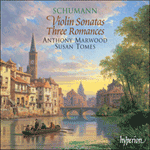 Schumann: Violin Sonatas & Three Romances Schumann: Violin Sonatas & Three RomancesCDA67180  ‘The best performances of these pieces on disc’ (Gramophone) ‘The performances have all the virtues – clarity, focus, warmth of feeling, superb technique – that have distinguished The Florestan Trio’s discs’ (In ...» More |