Welcome to Hyperion Records, a British classical label devoted to presenting high-quality recordings of music of all styles and from all periods from the twelfth century to the twenty-first.
Hyperion offers both CDs, and downloads in a number of formats. The site is also available in several languages.
Please use the dropdown buttons to set your preferred options, or use the checkbox to accept the defaults.

| Joseph Nolan (organ)» More |
from notes by Ateş Orga © 2007
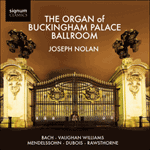 The Organ of Buckingham Palace Ballroom The Organ of Buckingham Palace BallroomSIGCD114Download only  Following the success of Joseph Nolan’s appearance in Music for the Coronation of James II, he returns to Signum with a solo disc of organ music, capturing music from some of the finest composers of the instrument.» More |