‘Isserlis plays ravishingly throughout this recital. His tone is as luminous at the bottom as it is up top (and Boccherini spends a lot of time in the stratosphere). Although he’s partnered in the concertos by members of the OAE, Isserlis is no slave to scholarship: there’s plenty of vibrato in the solo line, and the result is wonderfully engaging … if you already love Boccherini, you’ll be more convinced than ever that he’s a master. If you’re a sceptic: well, prepare to be seduced’ (Gramophone)
‘The OAE and soloist-director Steven Isserlis open with the D major Cello Concerto G479, a sunny work that suits Isserlis’s effervescent persona … Boccherini (himself a virtuoso cellist) showcases his instrument’s ability to soar into the stratosphere … nothing daunted, Isserlis produces a sweet cantabile sound even at the dizzying high end of the fingerboard … Isserlis and friends entwine Boccherini’s lyrical strands into a felicitous musical conversation: balanced, measured and fully in keeping with his gallant idiom’ (BBC Music Magazine)
 PERFORMANCE
 RECORDING
‘Why is the album called ‘Music of the Angels’? The sheer beauty and virtuosity of the music and the way, as Isserlis puts it, Boccherini’s 'ultra-light scoring'—sometimes with just cello and violins—leaves the cellist sharing the same stratosphere as they do. As he puts it, a 'remarkably translucent and ethereal’ effect; truly, music of the angels. It’s a lovely album’ (BBC Record Review)
‘The music above all is mellifluous, flowing with a natural ease and a lively disposition no doubt boosted by the 18th-century Italian’s long years in the fiery sunshine of Spain … [Isserlis] and his Enlightenment chums skip along, gracefully sigh, or do anything else required by music that regularly changes mood without losing its elegant poise. Buy this album immediately, for Boccherini’s music, like good bath salts, stimulates and relaxes at the same time’ (The Times)
‘A 19th-century musical dictionary observed that if God ever listened to music for pleasure, the composer he’d pick would be Boccherini. Isserlis and the Orchestra of the Age of Enlightenment’s album doesn’t make the choice seem impossible. The music flows with a natural ease and a lively disposition, and often exploits the cello’s top register, requiring extra dexterity. No problem for Isserlis’ (The Times)
‘The craftsmanship of Boccherini’s music is absolute, with everything held in perfect balance, extremes skirted and dramatic ferment studiously avoided … the sequence closes with Boccherini’s greatest hit … here all Boccherini’s virtues are on full display: easy melodicism, harmonic sweetness, exquisite string textures and a personal sound world’ (The Strad)
‘British cellist Steven Isserlis lovingly addresses the diversely elegant art of Luigi Boccherini (1743-1805) whose chamber music and cello concertos reflect his long tenure in Spain … exquisitely delicate and charming, this music dances on the strings of both the heart and the imagination’ (Audiophile Audition, USA)
» More‘There is much to enjoy in this new Isserlis release devoted entirely to Boccherini … the quintet tracks are personal preferences’ (The Rehearsal Studio, USA)
‘With this exceptionally lovely collection of concertos and chamber music, cellist Steven Isserlis seeks to support his argument that composer Luigi Boccherini always sought 'to create for his players and listeners a sphere of ideal beauty, of sophisticated sentiments—and in that he succeeded like no other' … a powerful argument for Boccherini’s importance. Highly recommended’ (CD Hotlist, USA)
‘Name two works by Boccherini ..! OK, I know
you can, but many people would rattle off the ubiquitous Minuet with ease and then rack their brains to find a second. Steven Isserlis is very aware of this, and his new recording ‘Music of the Angels’ with the Orchestra of the Age of Enlightenment presents a selection of Boccherini’s works with cello in order to help round out the picture of this graceful, elegant composer. It’s a surprisingly chamber-oriented album, with even the two cello concertos inhabiting an astonishingly delicate, translucent sound-world … Steven Isserlis is a man with a wry sense of humour—his programme-notes are dotted with witty asides … he gets the last laugh on the listener by selecting as his encore the very same Minuet whose over-use he has earlier bemoaned. Although he probably gleefully expects everyone to be sick and tired of this piece, it’s actually a surprisingly refreshing note on which to end—and it’s particularly good to hear it contextualised by the preceding five full-scale works rather than just wheeled out in isolation’ (Presto Classical)
» More„Steven Isserlis macht vom ersten Moment an klar, dass es ihm vor allem auf eine gesangliche Darstellung ankommt. Dabei entstehen einige äußerst poetische Momente … Das Orchestra of the Age of Enlightenment unterstützt den Ansatz des Solisten in allen Belangen. Es spielt sehr fein und agil und zeigt, dass Boccherinis Kunst des Gefälligen viele unterschiedliche Schattierungen kennt … Die neue Aufnahme zeigt Luigi Boccherini als einen in den unterschiedlichen Besetzungen sehr wandlungsfähigen Komponisten. Das macht dieses Album erfreulich kurzweilig, zumal sich Steven Isserlis als ein ebenso kundiger wie kultivierter Führer durch diese Klangwelten erweist“ (NDR Kultur, Germany)

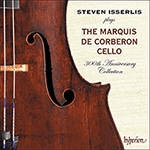 Steven Isserlis plays The Marquis de Corberon