
Welcome to Hyperion Records, a British classical label devoted to presenting high-quality recordings of music of all styles and from all periods from the twelfth century to the twenty-first.
Hyperion offers both CDs, and downloads in a number of formats. The site is also available in several languages.
Please use the dropdown buttons to set your preferred options, or use the checkbox to accept the defaults.

| Alessio Bax (piano), Lucille Chung (piano)» More |

The Petite suite dates probably from the end of 1888. It was printed in February 1889, and Debussy and his future publisher, Jacques Durand, gave the first performance at a private salon on 1 March. It’s ideal salon material—nothing too heavy or too long, easily grasped rhythms and memorable tunes. If one has to find influences, then it is to Delibes we should look, together with Fauré and, in the boisterous last movement, Chabrier: at the first performance, Debussy got over-excited here and left poor Durand struggling … Elsewhere, there is a decorous, olde-worlde air about much of the music, with its clear-cut phrases and modal inflections, as in the opening harmonies of ‘En bateau’.
The titles of this movement and the next (‘Cortège’) are to be found in Verlaine’s volume of poems Fêtes galantes, one of Debussy’s favourite quarries for song texts. It’s conceivable therefore that ‘En bateau’ depicts the skiff in the moonlight ‘gliding merrily over the dreaming water’, and ‘Cortège’ ‘a monkey in a brocaded jacket trotting and leaping in front of his mistress, as she waves a handkerchief in her delicately gloved hand’. Our only certain identification is of the third movement, ‘Menuet’, which is a transcription of Debussy’s 1882 song Fête galante to words by Théodore Faullin de Banville, described by the composer as ‘Louis XIV music with 1882 ideas’. The opening line, ‘Voilà Silvandre et Lycas et Myrtil’, introduces characters from the commedia dell’arte.
from notes by Roger Nichols © 2021
La Petite suite date probablement de la fin de l’année 1888. Elle fut imprimée en février 1889, et Debussy en donna la première exécution dans un salon privé le 1er mars, avec son futur éditeur, Jacques Durand. C’est du matériel de salon idéal—ni trop lourd ni trop long, avec des rythmes faciles à appréhender et des thèmes inoubliables. S’il faut trouver des influences, alors c’est vers Delibes qu’il faut se tourner, ainsi que vers Fauré et, dans l’exubérant dernier mouvement, Chabrier: lors de la première exécution, Debussy se mit dans un état de surexcitation et laissa le pauvre Durand se démener … Ailleurs, une grande partie de la musique a un air pseudo-ancien bienséant, avec ses phrases précises et ses inflexions modales, comme dans les harmonies initiales d’«En bateau».
On trouve les titres de ce mouvement et du suivant («Cortège») dans le recueil de poèmes de Verlaine Fêtes galantes, l’une des mines préférées de Debussy pour les textes de ses mélodies. Il est donc concevable qu’«En bateau» dépeigne le skiff au clair de lune qui «file gaîment sur l’eau qui rêve» et «Cortège» «Un singe en veste de brocart / Trotte et gambade devant elle / Qui froisse un mouchoir de dentelle / Dans sa main gantée avec art». La seule identification certaine est le troisième mouvement, «Menuet», qui est une transcription de la mélodie Fête galante (1882) de Debussy sur des paroles de Théodore Faullin de Banville, décrite par le compositeur comme de la «musique Louis XIV avec des formules de 1882». Le premier vers, «Voilà Silvandre et Lycas et Myrtil», présente des personnages de la commedia dell’arte.
extrait des notes rédigées par Roger Nichols © 2021
Français: Marie-Stella Pâris
Die Petite suite entstand wahrscheinlich gegen Ende des Jahres 1888. Sie wurde im Februar 1889 gedruckt und Debussy gab zusammen mit seinem zukünftigen Verleger Jacques Durand im Rahmen eines Privatsalons die erste Aufführung. Es handelt sich dabei um ideale Salonmusik—nicht zu mächtig und nicht zu lang, gut begreifliche Rhythmen und eingängige Melodien. Wenn man die Einflüsse sucht, so sollte man in Richtung Delibes, Fauré und—im Falle des lebhaften Finales—Chabrier schauen: in der ersten Aufführung ging mit Debussy hier die Begeisterung durch, so dass der arme Durand Mühe hatte, noch mitzukommen … Anderswo zeichnet sich die Musik mit scharfgeschnittenen Phrasen und modalen Wendungen durch eine auf alt gemachte Geziemtheit aus, wie etwa in den Anfangsharmonien von „En bateau“.
Der Titel dieses Satzes sowie des nächsten („Cortège“) stammt aus dem Gedichtband Fêtes galantes von Verlaine, eine von Debussy bevorzugte Textquelle. Es ist daher möglich, dass mit „En bateau“ das Ruderboot dargestellt wird, wie es im Mondlicht „fröhlich über das träumende Wasser gleitet“, und dass in „Cortège“ „ein Affe in Brokatjacke vor seiner Herrin her trabt und springt, während sie, elegant behandschuht, mit einem Spitzentaschentuch winkt“. Die einzig sichere Identifizierung lässt sich im dritten Satz, „Menuet“, vornehmen—eine Transkription von Debussys Lied Fête galante (1882) zu einem Text von Théodore Faullin de Banville, das der Komponist als „Musik Ludwig XIV. mit Ideen des Jahres 1882“ beschrieb. In der ersten Zeile, „Voilà Silvandre et Lycas et Myrtil“ werden die Figuren der Commedia dell’arte vorgestellt.
aus dem Begleittext von Roger Nichols © 2021
Deutsch: Viola Scheffel
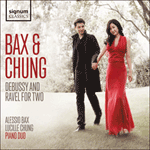 Debussy & Ravel: Debussy & Ravel for two Debussy & Ravel: Debussy & Ravel for twoStudio Master: SIGCD787Download onlyStudio Master FLAC & ALAC downloads available  A rich programme incorporating two classics of the genre, several less well-known arrangements of Debussy (including by Dutilleux and Ravel, no less) and culminating in Ravel's riotous 'La valse', heard here in the two-piano version which came bef ...» More |