Welcome to Hyperion Records, a British classical label devoted to presenting high-quality recordings of music of all styles and from all periods from the twelfth century to the twenty-first.
Hyperion offers both CDs, and downloads in a number of formats. The site is also available in several languages.
Please use the dropdown buttons to set your preferred options, or use the checkbox to accept the defaults.

| Viktoria Mullova (violin), Alasdair Beatson (fortepiano)» More |
Beethoven, however, felt no enmity towards Count von Fries—a skilled amateur violinist who’d been one of the subscribers to his Op 1 trios five years earlier. In September 1801, the Wiener Zeitung advertised 'Deux Sonates pour le Pianoforte avec un Violon', Op 23, dedicated to von Fries—although they would actually be printed as Op 23 and Op 24. And the second of the pair feels, even today, like a warm breeze blowing through a window thrown wide. The nickname 'Frühlings-Sonate' wasn’t Beethoven’s (the only note he added to the manuscript was a comment in red pencil that 'The copyist who put triplets and septuplets here is an ass'). But F major had a long history as the key of rural greenery, even before Beethoven’s own Pastoral symphony of 1808.
In any case, the blossoming, birdsong-like freshness of Beethoven’s opening melody—now the violin’s very own, with the piano supplying a gentle 'scene by the brook' accompaniment—suggests its own comparisons. It’s a suitably expansive opening to Beethoven’s first violin sonata in four movements. The motifs of the A minor sonata expanded and found fulfilment as the sonata continued; here, the opening melody is already the point to which each of the sonata’s movements will return (in spirit, if not the precise notes). And a melody of such breadth simply demands four movements over which to work its charms.
So the serene theme that launches the three leisurely variations of the Adagio molto espressivo also begins with a sustained note and a graceful turn, over a gently rippling accompaniment. The tiny scherzo plays a cheerful game of catch-up between piano and violin, with a whirling trio section so concise that it’s barely more than an ornament in its own right: the smile on Beethoven’s face is plain to read. And the finale sweeps into its amiable flow episodes of dancing glee, rustic pizzicati, and just enough of a suggestion of stormclouds to establish that this is all for real—with, just before the very end, the briefest and most unaffected possible prayer of thanksgiving. 'The original fiery and bold spirit of this composer … is now becoming increasingly serene', wrote an approving (if over-optimistic) Leipzig critic.
from notes by Richard Bratby © 2020
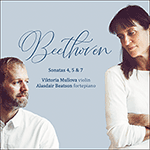 Beethoven: Violin Sonatas Nos 4, 5 & 7 Beethoven: Violin Sonatas Nos 4, 5 & 7Studio Master: SIGCD1004Download onlyStudio Master FLAC & ALAC downloads available  Celebrated violinist Viktoria Mullova and duo partner Alasdair Beatson here perform the gnomic fourth violin sonata, the ever-popular fifth (‘Spring’), and conclude with the C minor drama of the seventh.» More |
 Hyperion sampler - July 2026 Vol. 1 Hyperion sampler - July 2026 Vol. 1FREE DOWNLOADHYP202607ADownload-only sampler  |