
Welcome to Hyperion Records, a British classical label devoted to presenting high-quality recordings of music of all styles and from all periods from the twelfth century to the twenty-first.
Hyperion offers both CDs, and downloads in a number of formats. The site is also available in several languages.
Please use the dropdown buttons to set your preferred options, or use the checkbox to accept the defaults.

| Llŷr Williams (piano)» More |
 PERFORMANCE
 RECORDING
Schubert had composed the sonata in the autumn of the previous year, shortly after his only other large-scale work in the same key of G major, the string quartet D887. In his reminiscences of the composer, Schubert’s lifelong friend Joseph von Spaun recounts how he called on him one October morning and found him hard at work on a sonata:
Although he had been disturbed, he immediately played me the piece which he had just completed, and as I liked it very much he said: ‘If you like the sonata, then it shall be yours; I want to give you as much pleasure as I can.’ And soon he brought it to me engraved, and dedicated to me.
This is perhaps the most intimate of all Schubert’s piano sonatas, and it would be hard to think of another work on this scale in which each movement dies away to a pianissimo, or even ppp, ending. The opening movement is unusually expansive, and Tobias Haslinger’s description of it as a fantasy appears to have misled the reviewer in the influential Leipzig Allgemeine musikalische Zeitung, who complained that the piece lacked the freedom of expression of some of Beethoven’s pieces of the kind, and in particular the then little-known example in C sharp minor (i.e. the first movement of the ‘Moonlight’ sonata). More perceptively, the writer pointed out that some of Schubert’s keyboard writing would seem to call for a string quartet, and it’s true that we can easily imagine the long-sustained chords of the sonata’s inspired opening theme being played by stringed instruments, with the two lowest notes sounded as the cello’s open G and D strings.
Schubert’s very first chord, topped by the note B, is essentially the same as the chord with which the soloist famously launches Beethoven’s fourth piano concerto, but its scoring is rather different: while Beethoven uses eight notes, Schubert has only five, and this translucent texture is characteristic of the movement as a whole. Also typically Schubertian is the marking of ‘molto moderato e cantabile’: in both its tempo and its profoundly calm atmosphere, this is a piece that looks forward to the opening movement of Schubert’s last sonata, D960. Both sonatas begin with a broad, almost hymn-like theme of seraphic beauty, and in both the atmosphere of serenity is momentarily ruffled by a ‘foreign’ element: a trill deep in the bass, like distantly menacing timpani, in the later work; and, in the G major sonata, a move towards the realm of B minor and major, for a passage set above an unchanging bass note that is largely dissonant to the melodic line that unfolds above it. Again, in the earlier work the interpolation seems to come from afar, and the dynamic marking is ppp. At the other extreme, the G major sonata’s central development section is set largely in the minor and invokes some rare fff indications—a dynamic marking that is not to be found anywhere in the solo piano music of Beethoven. Significantly, the music’s intensity at this point is achieved without recourse to any acceleration in rhythmic or harmonic pulse.
Schubert’s autograph score shows that the slow movement was initially very different from its familiar form. In place of the forceful episode that follows the quiet opening theme, there was to have been a gentle melody in the key of B minor. Schubert wrote out the entire movement using this material, and he must have realized that it afforded insufficient contrast only while working on the minuet or finale: he removed the pages containing the greater part of his earlier version, but he couldn’t destroy its start and end since the conclusion of the first movement and the beginning of the minuet had already been written on the relevant reverse sides, and so he merely deleted the passages, leaving them still quite legible. That Schubert did discard the slow movement’s original episode is something for which posterity should be profoundly grateful, as the piece is infinitely stronger as it now stands.
The key of the andante’s forceful episode leaves its mark on the minuet third movement, which, unusually, is not in the home tonality, but again in B minor. Its theme is one that Schubert seems to have remembered when he came to write his great piano trio in E flat major, D929, whose opening movement contains a remarkably similar B minor idea. The minuet’s trio, where the music changes from minor to major, sounds as though it comes from afar: the entire section unfolds almost entirely ppp, and in the manner of a nostalgic Viennese waltz.
The scherzo’s repeated-note rhythm features again in the theme of the rondo finale, whose contrasting episodes are in the style of écossaises. The second of the episodes is expansive enough to take the form of a self-contained dance, complete with a trio whose melancholy C minor melody suffers a radiant sea-change into the major. Towards the end, the rondo theme takes a plunge into a wholly unexpected key, to wonderfully uplifting effect. It returns to the home key almost as suddenly as it had left it, with the music now underpinned again as though by the cello’s middle two open strings. The tonal excursion is one that we can imagine as having appealed to Schumann, whose Études symphoniques feature a similar abrupt switch of key in their closing moments. Schumann, who regarded the G major sonata as formally the most perfect among Schubert’s works of the kind, commented on its organic unity, and punning on the nickname that arose out of the original edition’s title page, he warned: ‘Anyone who lacks the fantasy to solve the riddles of the last movement should keep away.’
from notes by Misha Donat © 2022
Schubert avait composé cette sonate à l’automne de l’année précédente, peu après sa seule autre œuvre de grande envergure dans la même tonalité de sol majeur, le quatuor à cordes D887. Dans ses souvenirs du compositeur, Joseph von Spaun, l’ami de toujours de Schubert, raconte qu’il lui rendit visite un matin du mois d’octobre et le trouva en plein travail sur une sonate:
Bien qu’il ait été dérangé, il me joua immédiatement la pièce qu’il venait de terminer et, comme cela me plaisait beaucoup, il m’a dit: «Si tu aimes cette sonate, alors elle sera tienne; je voudrais te donner autant de plaisir que je peux.» Et il me l’apporta bientôt gravée et dédicacée à mon nom.
C’est peut-être la plus intime de toutes les sonates pour piano de Schubert et il serait difficile de trouver une autre œuvre de cette ampleur où chaque mouvement s’éteint sur un pianissimo, ou même ppp. Le mouvement initial est exceptionnellement étendu et le titre de fantaisie donné par Tobias Haslinger semble avoir induit en erreur le critique de l’influent journal de Leipzig l’Allgemeine musikalische Zeitung, qui déplorait le manque de liberté d’expression que l’on trouve dans certaines pièces du même genre chez Beethoven et, en particulier, l’exemple alors peu connu en ut dièse mineur (c’est-à-dire le premier mouvement de la sonate «Clair de lune»). Avec davantage de perspicacité, l’auteur fit remarquer qu’une partie de l’écriture pianistique de Schubert semblait s’adresser à un quatuor à cordes, et il est vrai que l’on peut aisément imaginer les accords longuement soutenus du thème initial inspiré de cette sonate joués par des instruments à cordes, avec les deux notes les plus graves sonnant comme les cordes à vide de sol et de ré du violoncelle.
Le tout premier accord de Schubert, couronné par la note si, est essentiellement le même que celui avec lequel le soliste ouvre à merveille le Concerto pour piano nº 4 de Beethoven, mais sa notation est assez différente: alors que Beethoven utilise huit notes, Schubert n’en a que cinq, et cette texture translucide est caractéristique du mouvement dans son ensemble. Également typique de Schubert, il y a l’indication «molto moderato e cantabile»: dans son tempo comme dans son atmosphère profondément calme, c’est un morceau qui anticipe le premier mouvement de la dernière sonate, D960, de Schubert. Les deux sonates commencent par un large thème d’une beauté séraphique presque dans le style d’un hymne et, dans les deux cas, l’atmosphère de sérénité est brièvement troublée par un élément «étranger»: un trille dans l’extrême grave, comme des timbales vaguement menaçantes, dans l’œuvre la plus tardive; et dans la Sonate en sol majeur, une avancée vers le domaine de si mineur et majeur, qui s’opère dans un passage sur une note immuable à la basse, en grande partie dissonante par rapport à la ligne mélodique qui se déroule au-dessus. Une fois encore, dans la première des deux œuvres, l’interpolation semble venir de loin et l’indication dynamique est ppp. À l’autre extrême, le développement central de la Sonate en sol majeur est essentiellement écrit en mineur et comporte quelques rares indications fff—une nuance que l’on ne trouve nulle part dans la musique pour piano seul de Beethoven. De manière significative, l’intensité de la musique est ici obtenue sans avoir recours à la moindre accélération de pulsation rythmique ou harmonique.
La partition autographe de Schubert montre que le mouvement lent était, au départ, très différent de la forme que l’on connaît. Au lieu de l’épisode vigoureux qui suit le thème initial calme, il devait y avoir une douce mélodie dans la tonalité de si mineur. Schubert écrivit la totalité du mouvement en utilisant ce matériel et c’est seulement lorsqu’il travailla au menuet ou au finale qu’il dût se rendre compte du fait que cela n’offrait pas un contraste suffisant: il supprima les pages contenant la majeure partie de sa version antérieure, mais ne put détruire ni le début ni la fin, car la conclusion du premier mouvement et le commencement du menuet avaient déjà été écrits sur le verso correspondant; il supprima donc simplement les passages, en les laissant quand même tout à fait lisibles. La postérité devrait être profondément reconnaissante à Schubert d’avoir abandonné l’épisode original du mouvement lent, car ce morceau est infiniment plus fort tel qu’il se présente aujourd’hui.
La tonalité de l’épisode vigoureux de l’andante imprègne le troisième mouvement, un menuet, qui, chose rare, n’est pas dans la tonalité d’origine, mais à nouveau en si mineur. Quant à son thème, il semble que Schubert s’en soit souvenu lorsqu’il en vint à écrire son grand trio avec piano en mi bémol majeur, D929, dont le mouvement initial contient une idée fort semblable en si mineur. Le trio du menuet, où la musique passe du mineur au majeur, semble venir de loin: toute cette section se déroule presque entièrement ppp, et à la manière d’une valse viennoise nostalgique.
Le rythme en notes répétées du scherzo figure à nouveau dans le thème du rondo final avec des épisodes contrastés dans le style des écossaises. Le deuxième épisode est assez développé pour prendre la forme d’une danse autonome, avec un trio dont la mélodie mélancolique en ut mineur subit une transformation radicale et rayonnante en majeur. À la fin, le thème du rondo se lance dans une tonalité totalement inattendue, ce qui produit un effet très stimulant. Il revient dans la tonalité d’origine presque aussi subitement qu’il l’avait quittée, la musique étant maintenant étayée, une fois encore, comme si elle était soutenue par les deux cordes à vide médianes d’un violoncelle. L’excursion tonale fait partie de ce que l’on pourrait imaginer avoir plu à Schumann, dont les Études symphoniques comportent un soudain changement de tonalité analogue dans leurs dernières mesures. Schumann, qui considérait la Sonate en sol majeur comme la plus parfaite œuvre de Schubert dans le genre sur le plan formel, souligna son unité organique et, faisant un jeu de mots sur le surnom découlant de la page de titre de l’édition originale, il conseilla à: «Toute personne dépourvue de suffisamment de fantaisie pour résoudre les énigmes du dernier mouvement de rester à l’écart.»
extrait des notes rédigées par Misha Donat © 2022
Français: Marie-Stella Pâris
Schubert hatte die Sonate im Herbst des Vorjahres komponiert, kurz nach seinem einzigen anderen groß angelegten Werk in der gleichen Tonart, G-Dur, dem Streichquartett D887. In seinen Erinnerungen an den Komponisten beschreibt Schuberts lebenslanger Freund Joseph von Spaun:
Ich fand ihn eines Morgens an einer Sonate schreibend. Obwohl gestört, spielte er mir sogleich das eben vollendete Stück vor, und als es mir sehr gefiel, so sagte er: „Gefällt dir die Sonate, so soll sie auch dein sein, ich möchte dir ja so viel Freude machen, als ich nur kann“, und bald brachte er sie mir gestochen und mir dediziert.
Hierbei handelt es sich um die vielleicht intimste aller Klaviersonaten Schuberts und möglicherweise das einzige Werk dieser Größenordnung überhaupt, in dem jeder Satz im Pianissimo oder sogar im dreifachen Piano ausklingt. Der Kopfsatz ist ungewöhnlich umfangreich, und Tobias Haslingers Bezeichnung als „Fantasie“ scheint den Rezensenten der einflussreichen Leipziger Allgemeinen musikalischen Zeitung in die Irre geführt zu haben, da dieser sich darüber beklagte, dass es dem Stück an der Ausdrucksfreiheit fehle, die mehrere Werke Beethovens dieser Art an den Tag legten, insbesondere die damals wenig bekannte Sonate cis-Moll (also der erste Satz der „Mondscheinsonate“). Mit Scharfsinn wies der Autor jedoch darauf hin, dass einige Passagen der Sonate streichquartettartig angelegt zu sein schienen, und man kann sich wirklich die lang ausgehaltenen Akkorde des inspirierten Anfangsthemas der Sonate gut von Streichinstrumenten gespielt vorstellen, wobei die beiden tiefsten Töne auf den leeren G- und D-Saiten des Cellos erklingen würden.
Schuberts allererster Akkord, gekrönt von einem H, ist praktisch der gleiche, der zu Beginn der Einleitung des Solisten von Beethovens viertem Klavierkonzert steht, allerdings ist er etwas anders gesetzt: während Beethoven acht Töne verwendet, sind es bei Schubert nur fünf, und diese durchsichtige Textur ist für den gesamten Satz charakteristisch. Ebenfalls typisch für Schubert ist die Bezeichnung „Molto moderato e cantabile“: sowohl das Tempo als auch die zutiefst ruhige Atmosphäre dieses Stücks weisen auf den Kopfsatz von Schuberts letzter Sonate, D960, hin. Beide Sonaten beginnen mit einem breitgefassten, fast hymnenhaften Thema von engelhafter Schönheit, und in beiden wird die heitere Atmosphäre kurzzeitig durch ein „fremdes“ Element gestört: im späteren Werk erklingt ein Triller tief im Bass, der wie eine entfernte, bedrohliche Pauke anmutet, und in der G-Dur-Sonate erfolgt ein Schritt in Richtung h-Moll/H-Dur zu einer Passage, die sich über einem unveränderlichen Basston entfaltet, welcher in einem weitgehend dissonanten Verhältnis zu der darüber erklingenden melodischen Linie steht. Auch hier, in dem früheren der beiden Werke, scheint der Einschub aus der Ferne zu kommen, und die dynamische Bezeichnung lautet ppp. Am anderen Ende des Spektrums befindet sich die Durchführung, welche weitgehend in Moll steht und einige seltene fff-Stellen enthält—eine dynamische Bezeichnung, die in der Solo-Klaviermusik Beethovens nirgends zu finden ist. Bezeichnenderweise wird die Intensität der Musik an diesem Punkt ohne jegliche Beschleunigung des rhythmischen oder harmonischen Pulses erreicht.
Schuberts autographe Partitur zeigt, dass der langsame Satz ursprünglich ganz anders aussah als in seiner heute bekannten Form. Anstelle der eindringlichen Passage, die auf das ruhige Anfangsthema folgt, stand zunächst eine sanfte Melodie in h-Moll. Schubert arbeitete den gesamten Satz mit diesem Material aus und merkte wohl erst beim Menuett oder sogar Finale, dass es nicht genügend Kontrast bot: er nahm die Seiten heraus, die den größten Teil seiner ursprünglichen Fassung enthielten, konnte aber den Anfang und das Ende nicht entfernen, da der Schluss des ersten Satzes und der Anfang des Menuetts bereits auf den entsprechenden Rückseiten notiert waren. Daher strich er die entsprechenden Passagen einfach durch, doch blieben diese gut lesbar. Dass Schubert die ursprüngliche Version verworfen hat, ist nur gut für seine Nachwelt, da das Werk in der überarbeiteten Form ungleich ausdrucksstärker ist.
Die Tonart der eindringlichen Andante-Passage hinterlässt ihre Spuren im dritten Satz, ein Menuett, das ausnahmsweise nicht in der Ausgangstonart, sondern wiederum in h-Moll steht. Das Thema scheint Schubert auch im Sinn gehabt zu haben, als er sein großes Klaviertrio in Es-Dur, D929, schrieb, dessen Kopfsatz ein bemerkenswert ähnliches h-Moll-Motiv enthält. Das Trio des Menuetts, in dem die Musik von Moll nach Dur wechselt, klingt, als stamme es aus der Ferne: der gesamte Abschnitt entfaltet sich fast vollständig im ppp und in der Art eines nostalgischen Wiener Walzers.
Der Tonrepetitionsrhythmus des Scherzos kehrt im Thema des Rondo-Finales wieder, dessen kontrastierende Episoden im Stil von Écossaisen komponiert sind. Die zweite Episode ist so umfangreich, dass sie die Form eines eigenständigen Tanzes annimmt, inklusive eines Trios, dessen melancholische c-Moll-Melodie einen strahlenden Wechsel nach Dur vollzieht. Gegen Ende taucht das Rondo-Thema in eine völlig unerwartete Tonart ein, was eine äußerst erhebende Wirkung hat. Dann kehrt es fast so plötzlich in die Ausgangstonart zurück, wie es sie verlassen hatte, wobei die Musik nun wieder wie von den leeren G- und D-Saiten des Cellos gestützt wird. Es ist anzunehmen, dass Schumann dieser tonale Exkurs gefiel, da dessen Symphonische Etüden gegen Ende einen ähnlich abrupten Tonartwechsel aufweisen. Schumann, der die G-Dur-Sonate als die formal vollkommenste unter Schuberts Werken dieser Art betrachtete, kommentierte ihre organische Einheit und sprach, auf den Beinamen des Titelblatts der Originalausgabe anspielend, folgende Warnung aus: „Vom letzten Satz bleibe weg, der keine Phantasie hat, seine Räthsel zu lösen.“
aus dem Begleittext von Misha Donat © 2022
Deutsch: Viola Scheffel
 Schubert: A Schubert Journey Schubert: A Schubert JourneyStudio Master: SIGCD6458CDs Download onlyStudio Master FLAC & ALAC downloads available  Welsh pianist Llŷr Williams is widely admired for his profound musical intelligence and the expressive and communicative nature of his interpretations. These recordings were made in conjunction with a critically lauded recital series at the Royal ...» More |
 Schubert: Piano Music, Vol. 5 Schubert: Piano Music, Vol. 5Studio Master: SIGCD835Download onlyStudio Master FLAC & ALAC downloads available The great A minor of D845 was the first of his piano sonatas that Schubert made any effort to have published. Written in the spring of 1825, there is an air of defiance about the writing, perhaps the composer's response to his terminal diagnosis. ...» More |
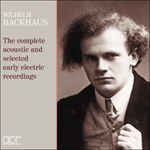 Wilhelm Backhaus - The complete acoustic and selected early electric recordings Wilhelm Backhaus - The complete acoustic and selected early electric recordingsAPR73173CDs Download only  As one of the great pianists of the 20th century, Wilhelm Backhaus (1884-1969) needs no introduction. He recorded almost continuously from 1908 until his death, but this set, focusing on his earliest recordings, completes APR’s coverage (see also ...» More |