
Welcome to Hyperion Records, a British classical label devoted to presenting high-quality recordings of music of all styles and from all periods from the twelfth century to the twenty-first.
Hyperion offers both CDs, and downloads in a number of formats. The site is also available in several languages.
Please use the dropdown buttons to set your preferred options, or use the checkbox to accept the defaults.

| Sophie Bevan (soprano), London Early Opera, Bridget Cunningham (conductor)» More |
 PERFORMANCE RECORDING
Handel’s setting was rediscovered in 2001 in connection with a project underwritten by the German Research Society. Both score and parts belong to the Royal Academy of Music in London and are not in Handel’s hand. They are bound in a collection of Handel arias owned by singer and associate William Savage (1720-1789), and the extant manuscript was probably left to the Academy by Savage’s student R. J. S. Stevens upon the latter’s death.
Although Professor Hans Joachim Marx has identified the Gloria as an early work, questions still arise as to the purpose for which Handel may have composed it. It may even predate the composer’s arrival in Rome in 1707 and stem from earlier years in Germany. However, based on musical similarities it is possible that Handel wrote this in Rome with other Latin pieces during June of 1707 and it may have been used in the church at Vignanello, the country estate of his Roman patron, Marchese Ruspoli. The soprano Margherita Durastanti might have been the intended singer as she was also in the employment of the Marquis Ruspoli, although top B flats may have been too high for her (depending on pitch) so possibly a castrato performed it. The violin parts are also extremely important and dominant so was possibly written for the virtuosic Italian players Corelli or the Castrucci brothers.
Based on the Gloria’s orchestration (specifically, the lack of a viola), the punctuated character of the final Alleluia and the piece’s fresh exuberance, musicologists ascribe its compositional date to Handel’s 1707 sojourn in Rome. When questions lingered among scholars about the identity of the work’s composer, a number of compositional details, including the generous use of melodic and harmonic dissonance, all point to the young Handel. Also there are several later borrowings and similarities with his other works such as the Laudate pueri in D major, Nisi Dominus, the Utrecht Jubilate, Chandos Anthem O be joyful in the Lord and even the Coronation anthem The King shall rejoice.
All six movements from the Gloria are magnificent from the deeply expressive Qui tollis to the breathtakingly exuberant finale with the virtuosic Cum Sancto spritu. Handel interpreted the sacred texts literally in terms of poetic rhetoric, separating praise of God from pleas for the forgiveness of sins in other more pensive movements like the different characters Allegro and Penseroso in L’Allegro, Il Penseroso ed il Moderato. The resultant contrasts of mood as the piece progresses from movement to movement reinforce the work’s underlying formal grand structure for the Mass.
from notes by Bridget Cunningham © 2015
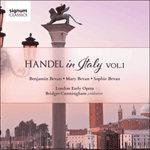 Handel: Handel in Italy, Vol. 1 Handel: Handel in Italy, Vol. 1Studio Master: SIGCD423Download onlyStudio Master FLAC & ALAC downloads available  London Early Opera performs a unique programme of Handel’s Italian-inspired works.» More |