Welcome to Hyperion Records, a British classical label devoted to presenting high-quality recordings of music of all styles and from all periods from the twelfth century to the twenty-first.

Hyperion offers both CDs, and downloads in a number of formats. The site is also available in several languages.

Please use the dropdown buttons to set your preferred options, or use the checkbox to accept the defaults.
Click cover art to view larger version
Track(s) taken from CDA68335

String Quartet in C major 'Emperor', Op 76 No 3

composer
1796/7; commissioned by and dedicated to Count Joseph Erdödy; published in Vienna and London in 1799/1800

The London Haydn Quartet
Studio Master FLAC & ALAC downloads available
CD-Quality:
Studio Master:
Studio Master:
CD-Quality:
Studio Master:
Studio Master:
Recording details: March 2020
Potton Hall, Dunwich, Suffolk, United Kingdom
Produced by Philip Hobbs
Engineered by Philip Hobbs
Release date: February 2021
Total duration: 32 minutes 12 seconds

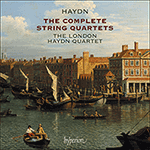
Cover artwork: View on the Thames with Westminster Bridge (c1743/44) by Samuel Scott (c1702-1772)
Yale Center for British Art, Paul Mellon Fund, USA / Bridgeman Images
 

Reviews

‘In Nos 5 and 6, Haydn even abandons the traditional sonata form for his opening allegros, shifting the expressive weight in each work to the slow second movement. It is in these—harmonically adventurous, formally ambiguous—that the London Haydn Quartet are often at their best, distilling an atmosphere of striking intensity in the ecstatic F sharp major Cantabile e mesto of No 5 and the resonant depths of the B major-ish Fantasia of No 6. The opening of the Sunrise (No 4) is similarly rich, leader Catherine Manson taking her time and unfurling the movement’s thematic material with improvisatory freedom … comparing these two period-instrument sets [the LHQ and Chiaroscuro Quartet] demonstrates once again that there is no single (or ‘right’) way to approach the infinitudes contained herein’ (Gramophone)

‘Here we have some of the greatest, most formally innovative, inventive and deeply felt string quartets ever composed, delivered by a quartet of players of faultless intonation, unanimity and blend, whose approach to Haydn has matured through eight much-praised previous albums of his quartets, and who have evidently prepared the present set with minute care’ (BBC Music Magazine)

‘Aristocrat or bumpkin? Joseph Haydn seems to be both at once, which is a large part of his appeal. His music effortlessly straddles the class divide, just as it straddles any number of other opposites: high and low, serious and comic, transcendent and everyday … this new recording of his radiant, wise and often mysterious set of six quartets Op 76 leans heavily towards the aristocratic … those minuets sidle into being with insinuating gracefulness, as if we’re in an aristocratic ballroom. It’s the same story in the spacious opening movements, the rapt hymn-like slow movements, and the helter-skelter finales … the London Haydn Quartet give those balanced phrases and sudden pauses a very different, tenderly expressive quality’ (The Daily Telegraph)

‘The performances of this glorious music—and there is so much more that could be said about it—are in general extremely rewarding … the playing is technically of a high order and the excellent balance also adds to the pleasures of a set that will delight anyone collecting a complete cycle now nearing completion’ (Early Music Review)

‘A particular triumph—of many—in this set is the rendition of Haydn’s sometimes achingly beautiful slow movements. I cannot recall performances more moving in their intensity and sensitivity. Even the most famous movement, the Kaiserlied, of Quartet No 3, becomes touchingly intense: to hear it in this performance is to encounter it as if for the first time … The London Haydn Quartet—in superior recording quality—give us so much rich treasure. These are special recordings of truly great music, and a more than worthy part of the marvellous ongoing series. Each time I have played them, I have found new insights’ (MusicWeb International)» More

„Fast anderthalb Jahrzehnte schon setzt sich das London Haydn Quartet mit den Werkes des Namensgebers auf Tonträger auseinander. Dies geschieht auf eine Weise, die immer wieder verblüfft: Statt das Bewährte auf die mit Darmsaiten bespannten Instrumente zu übertragen, werden die Originalitäten der Kompositionen hervorgeholt. Dabei mutet der Klang des Ensembles offener, aber eben weniger abgerundet an; gewonnen wird dadurch eine weitaus stärkere Charakterisierung des Individuellen … Emotionen werden hier dennoch nicht unter einer gepuderten Perücke versteckt; sie werden eben beherrscht und lassen dann auch Kontraste im Detail zu, bis hin zu nahe liegenden volksmusikalischen Allusionen (Nr. 3) oder eigenartigen Farbwirkungen unterschiedlicher Harmonien (Nr. 4)“ (HörBar, Germany)» More
Haydn was rarely a composer to do the same thing twice. That said, the celebrated ‘Kaiserquartett’—the String Quartet in C major ‘Emperor’, Op 76 No 3—follows the broad structural pattern of Op 76 No 1, with an adagio of great lyric beauty and a powerful finale that begins in the tonic minor. The forthright opening allegro, built from a single blunt, compact theme, is the culmination of the quasi-orchestral style found in parts of the ‘London’ quartets—above all the C major, Op 74 No 1. The fertile theme proves a protean creature: veiled and meditative, with a dip from G major to a mellow E flat near the end of the exposition, worked in supple contrapuntal imitation in the central development, thereafter morphing into a stomping peasant dance in the distant key of E major—perhaps the most raucous of Haydn’s peasant outbursts before the wine chorus in The seasons.

After this unabashed extroversion, the variations on Haydn’s recently composed Kaiserlied (which immediately became the Austrian national anthem) are a miraculous fusion of the popular and the elevated. Haydn seems to have planned the whole quartet around this movement. The great melody is simply stated, then repeated unchanged as a cantus firmus by second violin, cello and viola in turn against counter-melodies of growing chromatic and polyphonic complexity. In the fourth and final variation, Haydn subtly reharmonizes the tune to create a quietly moving apotheosis.

The minuet, characteristically asymmetrical in phrasing, develops its first three notes with nagging insistence; its pensive A minor trio, enclosing a pianissimo episode in A major, like a distant rustic idyll, surely struck a chord with Schubert. The presto finale, as monothematic and as sonorously massive as the first movement, begins aggressively in the minor (with an echo of the minuet in the violin’s plaintive answering phrase) and remains there for most of its impassioned course. Only towards the end of the recapitulation does C minor resolve into C major, shyly at first (shades here of the finale of Op 76 No 2), with an ethereal lightening of the texture, before building towards an exultant close.

from notes by Richard Wigmore © 2021

Haydn faisait rarement deux fois la même chose en matière de composition. Ceci dit, le célèbre «Kaiserquartett»—le Quatuor à cordes en ut majeur «L’empereur», op.76 nº 3—suit le large modèle structurel de l’op.76 nº 1, avec un adagio d’une grande beauté lyrique et un puissant finale qui débute à la tonique mineure. L’allegro initial sans détour, construit à partir d’un seul thème compact direct, est le couronnement du style presque orchestral que l’on trouve à certains endroits dans les quatuors «londoniens»—surtout celui en ut majeur, op.74 nº 1. Le thème fertile s’avère être une créature changeante: voilé et méditatif avec un fléchissement de sol majeur à un serein mi bémol majeur, à la fin de l’exposition, travaillé en souple imitation contrapuntique dans le développement central, pour se transformer ensuite en danse paysanne aux pas lourds dans la tonalité éloignée de mi majeur—peut-être les débordements paysans les plus tapageurs de Haydn avant le chœur des vendanges dans Les saisons.

Après cette extraversion sans retenue, les variations sur le Kaiserlied que Haydn avait composé récemment (qui devint d’emblée l’hymne national autrichien) sont une prodigieuse fusion de musique populaire et de musique savante. Haydn semble avoir conçu l’ensemble de ce quatuor autour de ce mouvement. La grande mélodie est simplement exposée, puis reprise à l’identique comme un cantus firmus par le second violon, le violoncelle et l’alto tour à tour sur des contrechants d’une complexité chromatique et polyphonique croissante. Dans la quatrième et dernière variation, Haydn réharmonise l’air avec subtilité pour créer une apothéose évoluant tout en douceur.

Le menuet, de phrasé typiquement asymétrique, développe ses trois premières notes avec une insistance tenace; son trio pensif en la mineur, qui contient un épisode pianissimo en la majeur, comme une vague idylle champêtre, a certainement trouvé un écho chez Schubert. Le presto final, tout aussi monothématique et massif sur le plan sonore que le premier mouvement, commence de manière agressive en mineur (avec un écho du menuet dans la phrase plaintive du violon qui lui répond) et y reste pendant la majeure partie de son parcours passionné. C’est seulement à la fin de la réexposition qu’ut mineur se résout en ut majeur, d’abord timidement (ce qui fait penser ici au finale de l’op.76 nº 2), avec un allègement éthéré de la texture, avant de s’intensifier vers une conclusion triomphante.

extrait des notes rédigées par Richard Wigmore © 2021
Français: Marie-Stella Pâris

Es lag nicht in Haydns Wesen als Komponist, sich zu wiederholen. Das berühmte „Kaiserquartett“ allerdings, das Streichquartett C-Dur, op. 76 Nr. 3, folgt in seinen Umrissen dem Vorbild des Quartetts op. 76 Nr. 1: es weist ein Adagio von großer lyrischer Schönheit auf, und das Finale beginnt in der Mollvariante. Der Eröffnungssatz, ein geradliniges Allegro, entwickelt sich aus einem ungekünstelten, kurzen Thema. In diesem Satz kulminiert der gleichsam orchestrale Stil, der sich streckenweise auch in den „Londoner Quartetten“ findet, allen voran dem C-Dur-Quartett, op. 74 Nr. 1. Das fruchtbare Thema erweist sich als äußerst wandlungsfreudig: gegen Ende der Exposition erklingt es, nach einem Absinken von G-Dur in weiches Es-Dur, verschleiert und nachdenklich; in der Durchführung erscheint es in locker-imitierendem Kontrapunkt, um sich dann zu einem stampfenden Bauerntanz im entlegenen E-Dur zu verwandeln—vielleicht der drastischste Ausbruch Haydns dieser Art vor dem Wein-Chor in den Jahreszeiten.

Nach solch ungehemmter Extravertiertheit wirken die Variationen über das kurz zuvor von Haydn geschaffene Kaiserlied als wundersame Verbindung von populärem und erhabenem Stil. Das gesamte Quartett scheint Haydn von diesen Satz aus angelegt zu haben. Die herrliche Melodie erklingt in schlichtem Satz und wiederholt sich dann als unveränderter Cantus firmus in der zweiten Geige, der Bratsche und dem Cello über Gegenstimmen von zunehmend chromatischer und polyphoner Komplexität. In der vierten und letzten Variation harmonisiert Haydn die Melodie auf subtile Weise neu und erreicht so ihre stille, bewegende Verklärung.

Das Menuett mit seinen für Haydn typischen unregelmäßigen Phrasen entwickelt sich beharrlich aus seine ersten drei Noten heraus; das nachdenkliche a-Moll-Trio schließt, gleichsam als ländliches Idyll, eine zarte A-Dur-Episode ein, die auf einen jungen Schubert nicht ohne Wirkung geblieben sein dürfte. Das abschließende Presto, ebenso monothematisch und klanglich massiv wie der Kopfsatz, beginnt in aggressivem Moll; die klagende Antwort der Geige erinnert an das Menuett. Der größere Teil des leidenschaftlichen Satzes bleibt auch in Moll; erst gegen Ende der Reprise wandelt es sich nach C-Dur, zunächst zaghaft—ein Nachklang des Finales von op. 76 Nr. 2—in ätherisch-durchsichtigem Satz, dann in Steigerung auf den jubelnden Schluss hin.

aus dem Begleittext von Richard Wigmore © 2021
Deutsch: Friedrich Sprondel
Other albums featuring this work

Haydn: The Complete String Quartets
CDS44651/7020CDs Boxed set (at a special price) Available Friday 5 June 2026
Higher-value orders will be automatically discounted at check-out
Haydn and his English Friends
CDA67150Download only
Waiting for content to load...