Welcome to Hyperion Records, a British classical label devoted to presenting high-quality recordings of music of all styles and from all periods from the twelfth century to the twenty-first.
Hyperion offers both CDs, and downloads in a number of formats. The site is also available in several languages.
Please use the dropdown buttons to set your preferred options, or use the checkbox to accept the defaults.
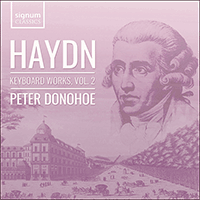

From the early Partita in G major to the dramatic B minor Sonata from the 1780s, this programme traces both Haydn’s stylistic development and the evolution of the keyboard itself. Donohoe’s clarity, rhythmic vitality and architectural insight illuminate Haydn’s invention and craftsmanship throughout.

Haydn’s keyboard works—Sonatas, Partitas, Divertimenti, Capriccios and Fantasias—span almost his entire creative life, from the mid-1750s to the 1790s, and chart both the evolution of his style and that of the keyboard itself. The harpsichord idiom predominates in many of the earlier works, particularly among the first twenty-eight of the over sixty sonatas, and its influence remains perceptible even in later compositions. Yet Haydn was a supremely practical composer. As keyboard instruments developed in Vienna, Paris, and London, he adapted his writing with remarkable flexibility, exploiting new possibilities of dynamics, colour, and expressive contrast. His long career allowed him not only to witness this transformation, but to shape it.
It is often noted that Haydn was not the virtuoso pianist that Mozart or Beethoven were. However, his keyboard music demonstrates an intimate and imaginative understanding of the instrument. The selection of keyboard works presented in this volume reveals Joseph Haydn at his most elegant, witty, and inventive. Beneath the apparent ease of this music lies a profound commitment to clarity and joy: a simplicity that is never simplistic, but is shaped through precision, imagination, and a finely honed sense of humour. This very simplicity may explain why many pianists shy away from exploring a wide range of Haydn’s piano sonatas in depth, and often opt for playing one or two works by the composer. These pieces demand discipline, transparency, and restraint, as well as a balance in which elegance and wit coexist with emotional depth and an improvisatory spirit.
Peter Donohoe brings precisely these qualities to this programme. Known for the breadth and integrity of his musicianship, Donohoe combines intellectual clarity with a powerful physical command of the keyboard. His playing illuminates Haydn’s architecture without smoothing away its edges, and his rhythmic vitality brings the composer’s humour and energy vividly to life. Donohoe’s approach allows the music’s apparent simplicity to emerge naturally, revealing the depth and variety beneath.
Several of the works presented draw on Haydn’s fascination with folk material and comic expression. The Capriccio in G major (1765), an early but already mature work, is based on the Austrian folk song Acht Sauschneider müssen sein (“Eight hog-castrators must there be”), a tune whose rustic humour would have been immediately recognised by the audiences of the eighteenth century. Haydn treats this simple melody with rhapsodic freedom, spinning it into a capricious, unpredictable composition. Silence itself becomes a comic device, heightening surprise and timing. Although written when Haydn was in his early thirties, the work already displays the fully formed simplicity of his mature voice.
A related spirit animates the Fantasia (Capriccio) in C major (1789), based on another popular song, Do Bäuren hat d’Katz verlorn (“The farmer has lost their cat”). Here Haydn combines comic material with greater formal sophistication, including playful fugatos that heighten the irony of a rustic tune by incorporating counterpoint. The opening Presto is virtuosic and light, followed by sudden dynamic contrasts, harmonic detours, and quasi-concerto cadenza passages that exploit the expressive resources of the fortepiano rather than the harpsichord. Haydn delights in the unexpected: abrupt outbursts, hemiolas, and adventurous modulations, such as shifts by thirds that anticipate later composers.
Sonatas of the mid-1760s present the early Haydn, full of grace, joy and refinement. The Partita in G major (Hob XVI:6) features a more expansive four-movement form. Its opening Allegro is playful and buoyant, followed by a Rococo-inflected Menuet whose Trio introduces a sense of transition and uncertainty. The Adagio in G minor offers a pensive and melancholic contrast, revealing Haydn’s capacity for expressive depth within a fundamentally joyful work. The virtuosic final movement (Allegro molto) restores brightness and momentum. A closely related work, the Sonata (Partita) No 15 in E major (Hob XVI:13), exemplifies Haydn’s galant style in its most refined form. The elegant, witty opening movement unfolds like a conversation, followed by a poised Menuetto and a mysterious Trio. The Finale is more overtly virtuosic and humorous, bringing the sonata to a close with light-footed brilliance.
Although Sonata No 30 in D major (or Divertimento, Hob XVI:19) was written in 1767, it deviates significantly from the composer’s early period and reflects Haydn’s engagement with the Sturm und Drang aesthetic. Here, heightened emotional contrast and dramatic intensity enter his keyboard writing. The opening movement’s lyrical sonata-allegro form contains an unusually turbulent development, while the Andante combines lyrical simplicity with a darker expressive palette of timbre. The concluding Allegro assai restores balance with its exuberant virtuosic energy.
Sonatas of the mid-1770s mark a period of extraordinary richness. Sonata No 45 in A major (Hob XVI:30) departs from convention by replacing a traditional slow movement or minuet with a theme and variations marked Tempo di Menuetto, demonstrating Haydn’s formal inventiveness. The Sonata No 37 in E major (Hob XVI:22) occupies a middle ground between early charm and later sophistication. Its opening movement combines lyrical elegance with strong dynamic contrasts, revealing cultivated wit rather than drama. The poised second movement, Andante in E minor, maintains a thoughtful inward character, while the Finale (Tempo di Menuet) gives the sonata an overall warmth that recalls Haydn’s earlier idiom, albeit with greater refinement.
Sonata in B minor (Hob XVI:32) stands as one of the most dramatic and accomplished works of the decade. Its tightly worked motivic writing, contrapuntal textures, and harmonically rich language create sustained tension across all three movements, culminating in a driving Presto finale. Similarly, the Sonata in E major (Hob XVI:31) reveals a delicate balance of elegance and sorrow. A restrained opening movement leads to a deeply expressive slow movement, before a virtuosic Finale full of ornamental turns brings the work to a spirited close.
Works from the late 1770s and 1780s show Haydn at the height of his power. Sonata No 53 in E minor (Hob XVI:34) reveals the breadth of Haydn’s expressive world: from a rhythmically charged, brooding opening through a lyrical, fantasia-like Adagio that recalls Baroque rhetoric, to a Finale marked Innocentemente, whose apparent simplicity carries an undercurrent of melancholy. The Sonata No 54 in G major (Hob XVI:40) is a rare two-movement work, the sophisticated innocent quality of which echoes the previous sonata in its first movement (Allegro Innocente). The final movement (Presto) is full of virtuosic flair, joyous forward-driving motion and unexpected silences typical of the composer. One of Haydn’s most remarkable works is the Sonata in D major (Hob XVI:37), written in 1780 and dedicated to the gifted Auenbrugger sisters, which combines brilliance with depth. Its coquettish and joyful outer movements frame a dark, introspective slow movement of striking emotional weight.
Taken together, these works present Haydn not as a genial precursor to greater geniuses, but as a composer of inexhaustible imagination. In Peter Donohoe’s hands, their wit, depth, and vitality emerge with striking clarity, reminding us that Haydn’s simplicity is among the most sophisticated achievements in the history of keyboard music.
Salomé Chitaia © 2026




