Welcome to Hyperion Records, a British classical label devoted to presenting high-quality recordings of music of all styles and from all periods from the twelfth century to the twenty-first.
Hyperion offers both CDs, and downloads in a number of formats. The site is also available in several languages.
Please use the dropdown buttons to set your preferred options, or use the checkbox to accept the defaults.
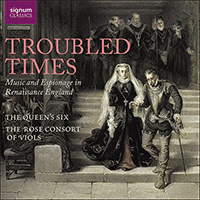

During the religious and political upheavals of the English Renaissance, composers found many ways of coping with challenging times and changing allegiances. From recusancy (Wilbye, Peerson) and moving abroad (Philips, Dering), to suspected espionage (Bull, Morley, Ferrabosco I), these historical figures managed to keep writing music, often with hidden (and not-so-hidden) meaning. Only the most highly favoured (Byrd) were able to continue writing music as practising Catholics.
Starting with composers writing at the time Henry VIII split from the church in Rome (Taverner, Sampson), The Queen’s Six and The Rose Consort of Viols explore this period with a collection of works that tell a story of the ways in which these composers managed to survive troubled times indeed.

After decades of convulsions, existential theological debates seemed settled by Elizabeth I’s Parliament’s passing of the Act of Uniformity in 1558. However, could Catholics, with their adherence to the authority of the Bishop of Rome, truly be considered loyal English subjects? Suspicion of treachery would dog the Catholic community, driven by events such as the excommunication of Elizabeth by Pope Pius V in 1570 and wars against Europe’s Catholic powers (most famously the Spanish Armada in 1588).
In this turbulent religious landscape, composers faced great challenges in adapting their music to suit the requirements of the day’s authorities, often battling with their own religious convictions. Florid polyphony had been denounced by the Reformers and henceforth religious music must be in the vernacular English with textual intelligibility paramount. If a composer’s music seemed implicated in undermining the authority of the Anglican Church or if they themselves were associated with the Catholic community, the penalties might be severe.
Most famous among Catholic musicians in Protestant England was William Byrd. Appointed a Gentleman of the Chapel Royal in 1572, he led something of a double life, serving the Anglican monarch’s spiritual needs in the heart of power, yet also composing motets in Latin that seem thinly veiled ventriloquizations of the struggles of the English Catholic community. He and his family were cited for Recusancy, and he later retired to the Essex village of Stondon Massey where he wrote music for clandestine Catholic services. Only his standing in the eyes of Elizabeth (a music lover) seems to have saved him from severe punishments.
Similarly, Martin Peerson managed to maintain an eminent position in the Anglican establishment yet clearly harboured Catholic sympathies, rising to be Master of the Choristers at London’s St Paul’s Cathedral despite convictions of Recusancy and composing music in Latin. By contrast, John Wilbye was not a church musician but spent his life in the service of the wealthy Kytson family in Suffolk, an area of the country known to be rife with Recusant households. As such, he too aroused suspicion that he held Catholic sympathies. Likewise, Thomas Morley’s own beliefs are difficult to decipher at this distance, having secured the position as Organist of St Paul’s Cathedral, yet still composing Latin texted-music with potential double meanings. It has even been suggested that he was an informer on the Recusant Catholic community, such was the atmosphere of distrust.
Earlier in the century, however, it was Protestants who suffered persecution in England. John Taverner wrote in the highly decorative Pre-Reformation English polyphonic style and when in 1526 he took up the post of Director of Music at Thomas Wolsey’s new Cardinal College, Oxford (today Christ Church), he was considered the finest living English composer. However, he seems to have been interested in Lutheran Theology and was investigated by the authorities, but no charges were brought against him because he was 'but a musician'. After Cardinal Wolsey’s fall from grace, Taverner left the college and by the end of his life had returned to his native Lincolnshire, where his Protestant inclinations became more fervent.
Richard Sampson, Dean of Windsor in the 1520s and composer, also dabbled with Reforming ideology, being instrumental in arranging Henry VIII’s divorce and accepting Royal Supremacy over the Church. But with the English Reformation gathering pace and his preference for the retention of traditional liturgies, he was briefly imprisoned in the Tower of London in 1540, before being released and was later made Bishop of Lichfield and Coventry.
Once Protestantism had been fully established in England, others chose to move abroad to lands more tolerant of Catholicism. Both Peter Philips and Richard Dering were born in England but spent most of their careers in the Spanish Netherlands, on account of their faith. Philips himself had been ordained a priest and spent time in gaol following accusations of treason from one of Elizabeth’s Continental agents. Philips defended himself admirably in court and was subsequently released without charge.
Other travelling musicians include John Bull, though his activities are shrouded in mystery. Apart from brief appearances in the Spanish Netherlands he is absent from the historical record for some 18 months in 1601-2 and has led to suggestions that he was engaged in spying for Elizabeth (he certainly enjoyed the monarch’s favour). Indeed, a musician’s proximity to the heart of power at a court might make them the ideal spy. It seems likely that this was the case for the Italian composer Alfonso Ferrabosco I, a musician in Elizabeth’s service who may have been sent on espionage missions: he was unusually well-paid for a musician and his son, Ferrabosco II, appears to have been held in London as collateral during his time away.
Bull (1562-1628) – Almighty God, which by the leading of a star
Bull’s Epiphanytide verse anthem is probably his best-known sacred work. 'The Star Anthem', as it quickly became known, follows the typical format of this genre, alternating solo and tutti, but great structural weight is given to the text 'through Christ our Lord', accompanied by a change of tutti scoring to two equal shimmering highest voices.
Taverner (1490-1545) – Quemadmodum
Stylistically this is Taverner’s most mature work, with more closely-knit imitation than his earlier music. Apart from the opening word, all the sources are textless, though the lines are clearly conceived vocally and the text of Psalm 42 can be easily underlaid. Perhaps this is a manifestation of Taverner’s desire to 'repent him very much that he had made songs to popish ditties in the time of his blindness'.
Sampson (d1554) – Quam pulcra es
This setting of verses from the Song of Songs is the earliest work recorded here and is found in a manuscript made in 1516 to celebrate the union of Henry VIII and Catherine of Aragon. Though written in the sonorous and dense Pre-Reformation style, it is notable for its seemingly rhetorical division of the text as the two lovers court each other (all the more tragic given the later events of the century).
Byrd (c1540-1623) – Cunctis diebus
Published in 1591, this motet plumbs the depths of despair, with frequent harmonic shifts, and is conceived on a grand scale. The arresting tutti at 'Dimitte me' ('send me away') seems portentous as Byrd would shortly depart London for a more private life in Essex.
Ferrabosco I (1543-1588) – Vias tuas (viols only)
This dark and sonorous piece is found in a scorebook compiled by John Baldwin, a songman of St George’s Chapel, Windsor, and later a Gentleman of the Chapel Royal. It is actually the second part of Ferrabosco’s Latin motet ‘Vias tuas Domine’ (Psalm 25) which sets the text ‘Conserva me’. Baldwin was clearly only interested in the music for its own sake, leaving out the words and getting the wrong title: moreover, performing vocal pieces without their texts was a common practice for Tudor viol consorts.
Peerson (1571-1651) – Who will rise up?
Though rhythmically straightforward, Peerson responds to the text of Psalm 94 with immediacy, ascending chromatically in the opening point and using silence rhetorically. The Psalmist’s petition for justice may have satisfied both the Anglican authorities’ desire for divine sanction and also the composer’s own conflicted conscience.
Wilbye (1574-1638) – O God the rock of my whole strength
This short sacred-texted work would have been intended for domestic music making, appearing in a printed tablebook in 1614. Wilbye’s Madrigalian instincts can be seen in the setting of the word 'faint' to a descending 6th and there are passing harmonic resemblances to his most famous madrigal Draw on sweet night.
Morley (1557-1602) – Out of the deep
In Morley’s only verse anthem a lone soloist is employed in dialogue with the choir, evocatively setting the opening cry to God by covering virtually the singer’s entire vocal range. By setting the whole Psalm with few textual repetitions, it seems likely this was intended for liturgical use, rather than personal devotion.
Morley – Eheu sustulerunt - Domine Dominus noster
Morley’s Latin motets are curious pieces since they had no liturgical use during his lifetime. Eheu sustulerunt appeared in Morley’s teaching manual A Plaine and Easie Introduction to Practicall Musicke (London, 1597), whilst Domine Dominus noster seems to be an early work, written under the tutelage of William Byrd and even quoting his Libera me Domine. It seems the ancient prestige of composing Latin motets outweighed the risk of angering the authorities in the late 16th century.
Bull – In nomine (viols only)
In the uniquely English ‘In nomine’, one part, usually the altus, holds the plainsong ‘Gloria tibi Trinitas’ in slow notes (taken from the Benedictus of Taverner’s Mass of the same name), while the other voices weave intricate counterpoint around it. Bull’s only surviving version takes the first three notes of the chant as its basis, gradually adding more flowing melodic lines that build inexorably towards the final cadence.
attrib. Ferrabosco I (1543-1588) – Laboravi in gemitu meo
attrib. Ferrabosco II (1575-1628) – Fuerunt mihi lacrimae
Scribes often did not distinguish clearly between father and son Alfonso Ferrabosco I & II, as is the case for these two pieces. Regardless of authorship, these introspective Psalm settings are fine examples of their sacred music: short but tortured motets making use of aching suspensions and pained semitonal inflection.
Byrd – O salutaris hostia (à 6)
In this experimental early work, Byrd pursues a 3 in 1 canon relentlessly, resulting in some of the strongest dissonances to be found in Renaissance music. It was never published in his lifetime and survives thanks to later scribes’ antiquarian interests, including John Baldwin.
Philips (c1560-1628) – Beata Agnes
This antiphon for St Agnes is found in Philip’s first book of sacred music published in Antwerp in 1612. It serenely depicts the calmness with which she was martyred in Rome in AD302, a scene sadly familiar to the people of Renaissance Europe. He chooses to elaborate on the words 'quem semper optavi', seemingly reassuring himself of his chosen life in exile.
Dering (1580-1630) – Factum est silentium
Dering’s music embraces the nascent Italian Baroque style, which he encountered on his travels to Venice and Rome. Printed in 1618, this motet dramatically narrates the battle between St Michael and the dragon with declamatory homophony and canzonet-style imitation.
Byrd – Teach me, O Lord
Despite a similar construction to a verse anthem, this setting of verses from Psalm 119 is in fact designated as a festal Psalm, to be sung after the Preces, and probably dates from Byrd’s years as Organist of Lincoln Cathedral (1563-72). The gently lilting metre enunciates the text clearly and shows Byrd adept in composing in whatever style was required of him.
Gareth Thomas © 2026