Welcome to Hyperion Records, a British classical label devoted to presenting high-quality recordings of music of all styles and from all periods from the twelfth century to the twenty-first.
Hyperion offers both CDs, and downloads in a number of formats. The site is also available in several languages.
Please use the dropdown buttons to set your preferred options, or use the checkbox to accept the defaults.
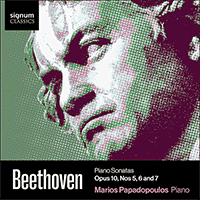

This album presents Ludwig van Beethoven’s Piano Sonatas Nos 5, 6 and 7 and forms part of Marios Papadopoulos’s complete cycle of the Beethoven piano sonatas. The three works recorded here illustrate Beethoven’s early mastery of contrasting character and structure, from the dramatic C minor to the lighter F major and the expansive D major. Papadopoulos brings clarity, stylistic awareness and thoughtful musicianship to these landmark works of the classical piano repertoire. Recorded in 1995, this album continues Papadopoulos’s Beethoven sonata cycle re-release on Signum.

Well, two diminutive works eventually resurfaced in a much later publication—Op 49—some ten years later in 1805. That year was quite fallow and Beethoven was obviously looking through past works to make some much-needed income. While, in chronological order of publication, these small G and G minor sonatas (indeed ‘sonatinas’) seem very much out of place, when seen with their compositional contemporaries—between Op 2 and 7—they make more sense. There was also a C major sonata that Beethoven had been composing since about 1791. This only exists in part in two movements and was published posthumously, completed by Beethoven’s friend Ferdinand Ries as WoO51.
Following the single publication of Op 7, Beethoven reverted to the norm of the time and bundled up his next three, typically contrasting, sonatas in one package, thus following his earlier practice in the Op 1 piano trios, Op 2 sonatas and Op 9 string trios from around the same time. In the first two—the C minor and F major sonatas—he changed tack and, instead of adopting the four-movement structure of each of the Op 2 sonatas and that of Op 7, he reverted to the more Mozartian or Haydnesque model of three movements (it should be noted that the Op 49 sonatinas are actually pared back to two movements).
Only in the leap ahead encompassed by the third, D major, Op 10 sonata, does he return to the bigger-boned four-movement style. The C minor Sonata was the first of three in that key. The ‘Pathétique’ followed soon after, while a quarter of a century later it became the key for his very last piano sonata, Op 111. In the meantime, proving that it was one of his most personal of keys, expressing intense anguish, he used C minor for the fateful Fifth Symphony, his Third Piano Concerto and the Overture Coriolan.
Clearly Beethoven was inspired by Mozart’s sonata K457 in this same key (as he was by the C minor concerto K491). The sonatas’ first movements follow a similar structure, with robust upwardly mobile dotted figures to start and a turn to C major in the development. Rather enthusiastically, in the recapitulation Beethoven brings the second subject back in an odd key (foreshadowing the Waldstein), before correcting himself and abruptly ending with two chords.
The Adagio, in A flat major, is in two lyrical sections separated by only a single bar, while the hectic, sonata form finale has its own surprises, not only the second theme resurfacing late on in D flat as the music slows before the end, but also a hint of the C minor fateful tapping from the Fifth Symphony making an early appearance in the few bars of development Beethoven allows.
After the drama of Beethoven’s first C minor sonata, comes a lighter touch in the F major, with even a touch of comedy. This is the key of the later ‘Pastoral’ Symphony and it seems to have imbued in Beethoven a bucolic attitude if not, in the opening allegro, a downright impish streak, with its stop/go trajectory and sudden changes of tack and dynamics.
Indeed, if its earlier bedfellow looked to Mozart, this sonata looks to Haydn and such is its bonhomie that it dispenses with a slow movement proper. Flanked by two F major movements comes the F minor Allegretto, more flowing so still contrasting, with an even smoother trio with an added flat to the key signature, producing a highly unusual amalgam between slow and minuet movements. The sonata is topped by mock-fugal finale, with a repeated chugging tread that will stick long in the memory (perhaps annoyingly so!). There is no let-up as the theme is reintroduced across the keyboard so that each entry tumbles over the previous one, until both hands agree on a unison quaver pulse and, fortissimo, emphatically choose to bring the sonata to a close.
Turning to the third sonata in D major, it may be that Beethoven, having completed the unusually termed Largo e mesto (literally slow and mournful) slow movement, recognised that he needed an additional gentle movement before launching into the finale. Certainly the depth of feeling in the slow movement is unsurpassed in any of his earlier works, which has led to the suggestion that it was a response to his encroaching deafness. Beethoven’s secretary Anton Schindler reported that the movement was meant to signify the full gamut of melancholy and, although it is very difficult to pinpoint exactly when Beethoven first was aware of his deafness, it seems that he could well have been quite seriously ill in the summer of 1797 at the time of composition, which would certainly explain the mood of this movement.
This sonata marks a major step forward. The kernel of the Presto is contained within the first four notes of the piece and, some argue, the inspiration of the finale are to be found in the following three notes.
The downward trajectory tracing a fourth (or half the octave), first heard staccato then followed by legato repetitions, can be traced to every other theme apart from one, which first appears in B minor. The overall harmonic plan of the sonata is intriguing, as it is the only one in which Beethoven retains the tonic, major and minor, throughout all four movements.
The slow movement, with its unusual marking Largo e mesto (Slow and mournful), is in D minor, where Beethoven contrasts the dark, sonorous chords (often using the diminished seventh) with a higher-pitched single discursive voice. Even a brighter F major development cannot detract from the note of tragedy and the coda, with the main theme repeated in the bass, sees a powerful upward rise through the octaves to lead to the final pages, thematic fragments rejoining the musical fabric.
After such depths, Beethoven eases us back into D major with the lyrical Menuetto, classically cast, and its fleet-footed and witty trio, before the Haydnesque finale, which seems more of a game of tag than a full blown rondo. Perhaps more hesitant than the finale to the F major sonata, it is so mercurial that some have wondered whether you can actually detect the real theme at all!
Nick Breckenfield © 2026
