Welcome to Hyperion Records, a British classical label devoted to presenting high-quality recordings of music of all styles and from all periods from the twelfth century to the twenty-first.
Hyperion offers both CDs, and downloads in a number of formats. The site is also available in several languages.
Please use the dropdown buttons to set your preferred options, or use the checkbox to accept the defaults.
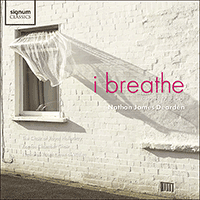


Nathan James Dearden is an award-winning Welsh music creator whose work has been performed by the BBC Singers, the Philharmonia Orchestra, the City of Birmingham Symphony Orchestra, Welsh National Opera and more. Performed with evident affection, this album focuses on his substantial choral output, conventional liturgical texts sitting contently alongside excursions altogether more experimental.

I breathe brings together choral music written over the past decade, tracing the evolution of a compositional voice shaped by people, places and enduring artistic relationships. Together they form a portrait of a composer whose musical language has grown from within the choral tradition, first as a singer and later as a composer working closely with choirs and performers.
Alongside his work as Associate Professor in Music Composition at Royal Holloway, University of London, he has cultivated a musical voice that balances intellectual curiosity with emotional directness. He is as fascinated by the inner workings of harmony as he is by the communal act of music-making, and his compositions reflect both impulses: rigorously crafted yet deeply attuned to the singers who bring them to life and the audiences who receive them.
Everything about us (2022), a work in two parts, sees Dearden explore ideas of ritual, initially giving each performer ultimate autonomy. Premiered by the National Youth Choir of Wales, the work was written to illuminate the power of young voices and their collective expression in the aftermath of the pandemic. In the opening ‘instillation-style’ section, performers enter one-by-one and ‘take up space’ with small fragments of song, reciting text/poetry, or simply by being. The choir then comes together in a series of homophonic chords growing with intensity, exclaiming ‘now it’s my time’ embedded in a E flat major with a continuous flow of suspended and extended sonorities. It’s a work that explores the extremes of textural and harmonic transition in the context of a wideness of sound and scale. Also rhythmically, in spite of being unaccompanied, it reflects joyously Dearden’s interest in underground trance music.
Suo (2020) is a work dedicated to his mother and written as part of the National Youth Choirs of Great Britain Young Composers Scheme which Dearden took part in from 2019-2020. The work is a response to Suo Gân—a traditional Welsh lullaby—with words from the Welsh folklorist Robert Bryan (1858-1920). Often sung to children at bedtime, this lullaby reflects the deep cultural heritage of Wales and beauty of the Welsh language—a culture Dearden feels deeply connected to. In Suo, Dearden has placed the lullaby’s melody on top of oscillating hummed harmonies, as well as soft wind sounds which move between different voice parts. Never reaching above a mezzo piano, suo brings out a lilting, reflective side of Dearden’s voice which ends, ultimately, with a solo soprano holding the melody as the accompanying voices die beneath.
Full of sweet days (2021) is from a set of three George Herbert settings commissioned by the Presteigne Festival—a festival that has frequently premiered Dearden’s work. In Full of sweet days, Dearden splits his choir in two and sets Herbert’s vivid words largely syllabically, having the effect of a slow, harmonised chant. Let all the world in ev’ry corner sing, the third of the three settings, re-imagines words of Herbert’s that are known from the Vaughan Williams hymn setting. Dearden’s realisation fragments the text and delays the full opening line, building up to a bell-like call and response for ‘sing’ and ‘my God and king’.
The Three Motets (2024) were also commissioned by the Presteigne Festival. Written for SATB choir and cello, former BBC Young Musician finalist Maxim Calver joins the Choir of Royal Holloway for these three motets which are reflections on words both old and new that honour sacred spaces. Dearden wanted to return to the origin of the motet form, which began in the early 13th century as an application of a new text to existing or old music. Rather than quoting medieval material directly, Nathan James Dearden adopts the motet’s spirit: voices that overlap, echo and illuminate one another, while the cello acts as both commentator and companion.
Locus iste brings an atmosphere of ethereal stillness, with the cello emerging as if from nowhere, building to a great pause before dying away. Ecce sacerdos magnus or ‘Behold, the high priest,’ takes the text from Ecclesiasticus, or the Book of Sirach. If Locus iste contemplates sacred space, Ecce sacerdos magnus inhabits it with ceremonial confidence. Dearden immediately overturns the stillness of the first motet with sharply articulated rhythmic figures and emphatic declamation. The final motet, Virga Jesse floruit, offers the cycle’s most intimate and personal response. Opening with solo soprano and alto above delicately coloured cello harmonics, it creates an atmosphere of extraordinary tenderness. Individual voices emerge with conversational freedom, while the cello’s shimmering timbre evokes something both fragile and luminous.
Morals and Interludes (2020) explores our relationship with memory, identity, and the digital traces that shape contemporary life. Created in collaboration with the singers of the National Youth Choirs of Great Britain Fellowship during the pandemic, completed during a residency at The Red House, Aldeburgh, the piece comprises five short choral ‘postcards’, each inspired by virtual memories drawn from the participants’ own lives. The first, ‘How are you?’ takes a 60-second video montage of a singer’s trip to Sweden and recontextualises the reflections into a work that builds from soft suspensions into exclamatory phrases, before a gear change, dying down again. The text for ‘norm’ was taken from a choral singer’s blog, starting with octave leaps before lower voices enter with lower voices singing,‘They should get a real job’, demonstrating what Dearden describes as ‘millennial gaslighting’.
‘This was mine’ combines echoed repeated phrases from the upper voices with a foundational, homophonic underpinning from lower voices, singing in a different time signature. It represents our perspectives of home and belonging, based on a video recording of two choir members visiting their old family homes. ‘stay away from clocks’ imitates the contrast between a life at full speed brought to a halt by time dramatically stopping. Dearden contrasts scalic staccato quavers with tenuto, hemiola rhythms, creating a syncopated, driving motion, not unlike the independent hands of a clock. ‘Without’ focuses on the human experiences of loss and grief, and how community and family hold us close through adversity. It combines text from thoughts from a choir member with Aristotle’s observation that without society, ‘we are as solitary as the birds’.
My joy (2023), commissioned by Whiddon Autumn Festival, sees Dearden set his own text in a work that explores joy not as a constant state, but, as he writes, ‘as a multifaceted and evolving sensation’. J S Bach’s motet BWV227 ‘Jesu, meine Freude’ was an initial starting point—a work Dearden has performed many times as a singer. Dearden approaches Bach less through quotation than through reflection—although quotations to the motet do subtly appear. Like Bach’s motet, the work is built around a single recurring phrase—‘my joy’—whose repetition becomes both musical foundation and spiritual meditation. Voices imitate, overlap and interrupt one another, while different layers proceed at contrasting speeds, creating textures that remain transparent even at their most intricate.
I breathe (2021) is a work of Dearden’s that has gained significant international momentum. Commissioned by the National Youth Choirs of Great Britain in 2021 for Greg Beardsell and the National Youth Training Choir, I breathe is a meditation on landscape, stillness and the act of listening. Dearden weaves together three short poems by Ken Jones, Paul Chambers and Arwyn Evans, whose spare, haiku-like texts evoke hills, mountain paths, deepening skies and flowering valleys. Breath lies at the heart of the work, both literally and in use of pause. Whispered Welsh murmurs, soft exhalations and unpitched vocal sounds become as expressive as sung melody, blurring the boundary between speech and song. The recurring phrase ‘These hills have nothing to say, and go on saying it’ provides the work’s structural anchor, while fragments of the remaining poems surface and dissolve within richly layered textures.
Hattie Butterworth © 2026
Textures that envelop you like a hug. Simple moments of collective singing that pack a punch, the way those famed Welsh hymns I grew up with in the Valleys do. Ideas of ritual. Communities. What home means to us. The act of humans coming together. Our breath.
These threads come from real places. I was a teenager in the National Youth Choir of Wales, and that experience made choral music available to me, not something distant or othered but as a home. As Composer-in-Residence with the Choir of Royal Holloway, I learnt my craft by being allowed to make mistakes and to grow. And my recent work with Kantos has shown me how my music lives in the big wide world, carried by voices who owe me nothing yet give everything.
I breathe is a decade of that living and learning. Recorded with the choirs who shaped me, and released with gratitude to every singer who taught me that music is never made alone.
Nathan James Dearden © 2026


