Welcome to Hyperion Records, a British classical label devoted to presenting high-quality recordings of music of all styles and from all periods from the twelfth century to the twenty-first.
Hyperion offers both CDs, and downloads in a number of formats. The site is also available in several languages.
Please use the dropdown buttons to set your preferred options, or use the checkbox to accept the defaults.
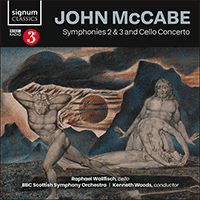


This album brings together three major orchestral works by John McCabe, composed between 1970 and 2007, and reflecting key strands of his musical thought. Symphony No 2 unfolds as a tightly integrated single span, notable for its rhythmic energy, luminous orchestration and structural clarity. Symphony No 3, Hommages, acknowledges McCabe’s lifelong engagement with the music of Haydn and Nielsen, blending quotation and allusion within a vibrant, tonal framework. The Cello Concerto Songline traces a continuous musical journey, combining virtuosity with introspective lyricism and a finely balanced orchestral palette.


That First Symphony adopted a relatively conventional three-movement design, slow-fast-slow, with quicker sections animating the outer Prelude and Elegy. In the Second Symphony (1970-1), McCabe arranged his five sections (none independent enough to be considered a standalone movement) Bartók-like in an arch within a single span, fast-slow-faster-slower-fast. Much has been made of McCabe’s comment that the “main impulse behind the work came from seeing Sam Peckinpah’s film The Wild Bunch … the extraordinarily satisfying, thoroughly musical shape of the [film], with an exposition, lengthy development, and recapitulation.” McCabe made no attempt to represent the film’s action (especially not the violence, which he felt was “greatly overstressed by critics at the time”) with the musical developments arising for purely musical reasons although the symphony’s design does owe something to Peckinpah, from the initial statement at the start of the opening Vivo of the “crucial” core material, for 3 flutes supported by harp and a quiet tattoo for the percussion over a held string chord. These two main elements galvanise the rest of the orchestra into rapidly evolving variants, each more excitable than the previous one yet spaciously, lightly scored so that each component is clearly audible—whether chattering woodwinds, rapidly chiming percussion, or ostinati in the bass—all building tension inexorably to a climax, topped by violent percussion, and a varied reprise of the flutes’ opening gesture, transferred more urgently to the strings. The Andante second section opens without pause in an atmosphere of mystery with a desolate high flute melody over a roll on the tom-toms alternating with a countermelody for the clarinet and bassoons. This material is varied and enhanced as it moves through the orchestra, the textures changing like waves softly breaking—mostly—on a beach. (There is a lovely oboe d’amore solo along the way.) The mood lightens as the Allegrissimo steals in, picking up the threads of the opening Vivo. Quiet, softly dancing figures in the woodwinds alternate with a more static variant for muted trumpets and trombones in a passage that foreshadows the Edward II ballet (1993-5). McCabe’s scoring throughout this scherzo-like section is a model of luminosity, even when more instruments are added, the mood darkens and the dance becomes more circular. The squall passes as suddenly as it appeared in the Lento , with its evocative, rather wistful opening horn call. Three horns take up this theme over a quietly swirling background of multiple divided strings, each member playing as a soloist rather than in section, and it is the strings who effectively shoulder the main burden of the symphony’s progress to a brief tutti climax, closing the Andante with a threnody. The final Vivo again opens quietly but rapidly gains momentum in a freewheeling, intoxicating dance (not for nothing was this score adapted, with additional passages from McCabe’s Variations on a theme of Hartmann for the ballet Shadow-Reach by the Irish Ballet Company in 1978). This culminates in the final, violent climax, and brief quiet epilogue where a chastened version of the opening flute passage returns.
The Second Symphony, the only one of McCabe’s orchestral symphonies without a subtitle, is scored for a standard orchestra of triple woodwind, including doublings, a standard complement of brass (4 horns, 3 trumpets, 3 trombones, tuba) and strings, plus piano, celesta, harp, and a substantial arsenal of percussion. It was commissioned by the John Feeney Trust for the City of Birmingham Symphony Orchestra and their then Principal Conductor, Louis Frémaux, who premiered it at the Birmingham Triennial Festival on 25th September 1971, recording it along with the wonderful cantata Notturni ed Alba (1970) shortly afterwards.
The Third Symphony was completed in 1978 to a commission from the Royal Philharmonic Orchestra, who premiered it under Charles Dutoit at London’s Royal Festival Hall on 11 July 1978. Scored for a very similar orchestra to its predecessor, it dispenses with the doublings of oboe d’amore, bass and E flat clarinets, and contrabassoon used in No 2. In a note prefacing the score, McCabe explained that:
The title of this symphony Hommages, derives from two specific areas of homage which are encountered in the music. The more overt of these is a direct quotation from two composers of the past—Haydn, the slow movement of whose String Quartet, Op 76 No 6, forms the basis of the central Adagio, and Nielsen, from whose Suite for Piano, Op 45, two chords are used in this piece as material of considerable importance.
Haydn, Nielsen: composers well known for their orchestral symphonies whose keyboard works McCabe the pianist recorded to great acclaim; indeed, his complete survey of the Haydn Sonatas has never gone out of print and set the benchmark for all subsequent surveys. McCabe also drew attention to two other ‘areas of homage’ “more as a matter of allusion”, noting that “some of the orchestral textures owe their provenance to the example of Szymanowski, and so on.” The final ‘homage’ was “to the continued fascination of tonality”; while never a serial or twelve-note composer per se, McCabe did at times deploy elements of Schoenbergian technique in some earlier works but in 1976, while composing his Stabat mater (a rare excursion into religious music) he decided that he should be deciding the order of the notes, not someone else! Hommages opens and closes in the key of E but the first of its three movements (fast-slow-fast, playing continuously) alone touches on all the other tonal centres in its coruscating flow.
In contrast to the spare textures at the start of its predecessor, Hommages’ opening Flessibile begins for the orchestra tutti without preamble with a theme “related to” a theme in the Haydn Quartet (though sounding purely McCabe) over a busily undulating texture, This is punctuated by the two chords derived from Nielsen’s Suite (Den Luciferiske—The ‘Luciferian’), with a distinctively insistent rhythm that recurs throughout the symphony. These contrasting ideas take on many forms and variants, always differently scored, providing textural variations as much as thematic ones. The soundworld at times evokes, at some distance, that of Tippett in The Midsummer Marriage, another composer—and work—McCabe admired. A weird passage with prominent timpani, bongos and tom-toms leads to a climax, ushering in the central Adagio, subtitled like that in Haydn’s Quartet, ‘Fantasia’, which opens with an enchanting roulade on the flutes. McCabe likened this movement as a “commentary” on Haydn’s, which is largely present as part of the phantasmagorical texture, before reaching a climax in the brass based on the Nielsen chords and rhythm. A reminiscence of the flutes’ roulade sounds again before the final Moderato, subtitled ‘Fugue-Variations’, emerges with a piccolo solo . This swiftly becomes a duo with the principal flute, then a trio. Brass and other winds provide support as the pace slowly quickens, with many contrapuntal variants along the way, building towards the restatements of the symphony’s opening theme, culminating—after a brief percussion tattoo—in one of the most glorious musical apotheoses in McCabe’s output which, once uttered, fades quickly into silence.
The Cello Concerto “Songline” (2007) is the last but one of McCabe’s two dozen concertante works (only the Trumpet Concerto La Primavera succeeded it, in 2012). At first sight, it might also appear to have a last musical association with Australia, given its connection to Bruce Chatwin’s book The Songlines concerning, as per McCabe’s note on the concerto, “the invisible pathways of the Australian aboriginals, routes that they sing into life, naming or relating to everything they see or encounter”. However, the songlines are not only physical paths through the actual landscape but “psychological routes by which they trace their culture.” The composer added that it had “for a long time seemed to me that we all do something like this anyway, when we travel anywhere, revisit old haunts, encounter old friends, and so on, and this Cello Concerto “sings” its journey through the exploration of its material – though the use of the singular ‘Songline’ indicates that this is just one of many possible routes through the music.” As such—as the composer’s widow, Monica, pointed out to the present writer in December 2025—it is linked expressively to his seventh and final symphony, Labyrinth, written that same year.
The concerto opens softly but Allegro vivace with rapid repeated semiquavers from the solo cello accompanied lightly by xylophone alone (which instrument has a prominent role in the concerto). Slowly, other notes and instrumental lines (beginning with flutes, the other winds, strings) are added though the pace does not falter. Subtle thematic refinements and alternatives come and go, the orchestration remarkably limpid, almost chamber-musical in character, except that the instrumental palette is that of a standard orchestra with double winds and the usual brass complement. The cello is always centre-stage front, never overwhelmed, always supported. A substantial orchestral interlude gives way to the cello unaccompanied and, after some interplay with the brass, a pastoral Adagio section opens up like a pleasant memory where the cello duets with small groups of instruments from individual sections, especially divisi strings. Brief reminiscences of the very opening punctuate an otherwise hushed musical landscape (or it is a peaceful recollection?), initiating the central cadenza, a passage which—in hindsight—seems the conclusion of what has gone before and the springboard for what follows. The concluding half of the concerto is a further exploration of these musical paths of memory, sometimes pleasant, sometimes pained, in shifting tempi like a set of whirling symphonic variations. The concerto concludes abruptly, as if waking from a reverie, reality once more intruding.
Commissioned once again by the Hallé Concerts Society, the first performance was given in the Bridgewater Hall, Manchester, on 17 January 2008 by Truls Mørk with the Hallé Orchestra conducted by Mark Elder.
Guy Rickards © 2026
Despite other deep-held interests, such as cinema and literature, not to mention cricket, John McCabe was undoubtedly born to be a musician. He started composing even before learning the piano, although he later threw away these juvenile scribbles, saying that he had not known what he was doing, but was fascinated by music. Though born in England, and devoted to music of this country, in fact he had very little English blood. His mother was German, while his father was of mainly Irish descent. He studied the piano from an early age with the great teacher, Gordon Green, and he fell in love with the music of Haydn, then almost totally neglected, after hearing Sviatoslav Richter play a sonata. Thereafter Haydn was a mainstay of his immensely wide repertoire. Nielsen also was virtually unknown in this country when John discovered his beautiful Chaconne for piano. In time he was to record, with deep understanding, all of the solo piano works of both composers. These recordings still stand as exemplars after half a century. John’s total devotion to music was selfless, as may be shown by his recordings and performances of works by other composers, male and female, including his contemporaries from Britain, America and Australia.
Monica McCabe © 2026