Welcome to Hyperion Records, a British classical label devoted to presenting high-quality recordings of music of all styles and from all periods from the twelfth century to the twenty-first.
Hyperion offers both CDs, and downloads in a number of formats. The site is also available in several languages.
Please use the dropdown buttons to set your preferred options, or use the checkbox to accept the defaults.
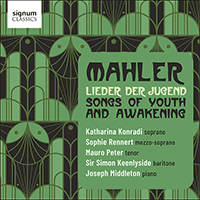


Twenty of the glorious songs Mahler wrote in the early 1880s, their quasi orchestral textures and often-thrilling responses to the chosen texts here brought fully to life by this most accomplished group of performers.

Mahler’s focus in these two spheres creates a kaleidoscope of interesting questions for any pianist approaching Mahler’s songs. We must grapple with writing that, although conceived for the keyboard, is shaped by a fundamentally orchestral imagination. This is less anomalous than it may seem. The Lied evolved as a piano genre precisely because the instrument is uniquely capable of suggesting a wide range of instrumental colours and textures. From Schubert to Wolf, song composers absorbed lessons from the operatic stage, allowing orchestral thinking to inform even the most intimate keyboard writing. For us song pianists, this habit of what we might call “thinking orchestrally” becomes second nature after much study. In Mahler, an awareness of his symphonic sound-world can guide the creation of equivalent pianistic colours—whether evoking translucent string textures, distant calls, or muffled sonorities—without literal imitation. Indeed, Mahler inscribes instructions to aid the pianist’s imagination and choice of colour, e.g. “wie ein Schalmei” (“like a shawm”), “wie fernes Glockenläuten” (“like the tolling of distant bells”), “In allen diesen Trillern ist mit Hilfe des Pedals der Klang gedämpfter Trommeln nachzuahmen” (“In all these trills, with the help of the pedals, imitate the sound of muffled drums”). Listeners familiar with the orchestral versions of Mahler’s song cycles may initially sense the absence of orchestral colour. Yet performance with piano offers compensations of its own: an enhanced intimacy and textual clarity that can bring a particular delicacy and immediacy to the songs, allowing voice and poetry to speak with unmediated directness.
Mahler famously remarked to Jean Sibelius in 1907, “The symphony must be like the world. It must embrace everything.” Song was one of the principal means by which he learned how to construct such a world. Brief passages from Lieder find their way into the symphonies, entire songs are transformed into orchestral movements, and, just as significantly, symphonic ideas often surface first in song. Though Mahler wrote only around fifty songs—modest beside Schubert or Schumann—the porous boundary between Lied and symphony is one of the defining features of Mahler’s art, and it is already fully apparent in the early works gathered in this programme.
Lieder der Jugend—Songs of Youth and Awakening reveals a composer discovering his voice: literary, emotionally volatile, ironic yet earnest, and preoccupied with the tension between innocence and experience. The songs presented here span Mahler’s Lieder und Gesänge aus der Jugendzeit (Songs and Airs of Youth) and culminate in Lieder eines fahrenden Gesellen (Songs of a Wayfarer), his first fully integrated song cycle. Together they trace a psychological arc from youthful awakening and wonder, through desire, irony, and disenchantment, toward the bittersweet self‑knowledge of the solitary wanderer. While these songs are rooted in folk poetry—much of it drawn from Des Knaben Wunderhorn (an anthology compiled by Achim von Arnim and Clemens Brentano and published in three volumes between 1805 and 1808)—Mahler transforms these simple texts into complex inner dramas. Even in his earliest works, he is less interested in naïve songfulness than in the instability of feeling, the fragility of joy, and the sudden intrusions of loss or alienation. It’s fascinating that Mahler makes no use of existing folk melodies in his songs. Their distinctive character derives instead from the manner in which the texts are presented as immediate and contemporary, while retaining an aura of historical distance. A tension emerges between imagined folk past and present experience, a quality reinforced by Mahler’s acute dramatic sense and his sensitivity to texts that are largely free of literary ornament. The effect is one of apparent simplicity underpinned by considerable compositional sophistication.
Youth, Nature, and Awakening
The album begins in nature and a spirit of awakening with a Schumannesque Lied, to a text by Leander: Frühlingsmorgen (Spring Morning). This evergreen song finds Mahler painting the acoustic imagery of Spring—birdsong in piano trills—and the anticipation of new birth. Nature is not merely a pastoral backdrop; it is an active participant in human emotion, often mirroring or intensifying inner states. The freshness of spring, with its birdsong and gentle motion, evokes a world newly alive, suffused with anticipation. Yet even here, Mahler resists pure idyll. The lightness of the music is tinged with restlessness, suggesting that awakening brings not only joy but longing.
In Ablösung im Sommer (The Changing of the Summer Guard), Mahler sets a characteristically Wunderhorn image: the cuckoo, harbinger of spring, is replaced by the nightingale. What might seem a whimsical observation becomes, in Mahler’s hands, a meditation on transience. Seasonal change implies displacement; beauty is fleeting, and joy is subject to replacement. The music’s playful surface conceals an early awareness of impermanence. A few years after its composition this song re-emerges as the basis of the Third Symphony’s scherzo, originally entitled “What the animals in the forest tell me.” In Mahler’s words: “the animal piece is at once the most scurrilous and the most tragic that ever was—in the way that music alone can mystically take us from one extreme to the other in the twinkling of an eye. In this piece it is as if Nature herself were pulling faces and putting out her tongue.” The transformation from song to symphonic movement is quite a feat: 67 bars for the song, 590 for the scherzo and its trios.
The reverse process—symphonic thinking condensed into song—is evident in Im Lenz (In Spring), which quotes a prominent theme from Mahler’s early cantata Das klagende Lied. The song’s broad sweep, dramatic contrasts, unifying ostinato rhythms, and horn-like evocations all point toward the symphonic horizon. Im Lenz and Winterlied further sharpen a contrast between seasons as emotional metaphors. Spring, traditionally associated with renewal, is already shadowed by uncertainty, while winter is not merely cold but existentially isolating. Winterlied continues Mahlerian themes of isolation and alienation, exploring emotional numbness and distance, using spare textures and restrained lyricism to evoke inner frost. The young composer shows an instinctive grasp of how to align musical economy with psychological stillness.
Love, Separation, and Irony
Love, in Mahler’s early songs, is rarely stable. It is experienced as yearning, anticipation, or loss, often infused with irony. Scheiden und Meiden (Farewell and Parting) encapsulates this ambivalence: separation is not merely painful but strangely necessary, as though closeness itself carries danger. Mahler’s sensitivity to the emotional subtext of simple verse is already striking.
Several songs in this programme draw on narrative or ballad traditions, most notably Zu Straßburg auf der Schanz (At Strasbourg on the Ramparts). This dramatic song tells of a soldier condemned to death, separated forever from his beloved. Here Mahler’s gift for musical storytelling comes to the fore. The starkness of the fate described is mirrored in the song’s grim tread and emotional directness. The voice becomes a conduit for collective tragedy, foreshadowing Mahler’s later ability to universalize individual suffering.
Ich ging mit Lust durch einen grünen Wald (I Walked with Joy Through a Green Wood) begins with apparent innocence, but the joy of wandering through nature gives way to emotional disillusionment. The green wood, a traditional symbol of freedom and renewal, becomes a space of self-realisation rather than escape. Mahler repeatedly uses such reversals to undermine expectation, revealing the instability beneath pastoral imagery.
Inner Life and Self‑Reflection
A remarkable group of songs in this programme turns inward, focusing explicitly on memory, imagination, and selfhood. Starke Einbildungskraft (Strong Imagination), Erinnerung (Memory), and Selbstgefühl (Self-assurance) form a loose triptych of introspection. These songs are among Mahler’s most psychologically revealing early works. Rather than external narrative, they explore the mind’s capacity to create, distort, and relive experience.
In Starke Einbildungskraft, imagination is both creative force and potential burden, blurring the line between reality and inner vision. Mahler’s music responds with subtle harmonic shifts that destabilize the tonal centre, suggesting a consciousness in flux.
Erinnerung begins in G minor and ends in A minor. We start in one place and arrive somewhere fundamentally different, as demanded by the text. Elsewhere, Mahler avoids conventional harmonic resolution, favouring ambiguity and displacement as expressive tools. It is a song suffused with nostalgia, yet it avoids sentimentality. Memory is fragile and incomplete, a source of both comfort and pain.
Selbstgefühl, one of his finest comic songs, confronts the question of identity itself. The narrative of a fool, here we have a satirical portrayal of human triviality and absurdity, where Mahler uses comedy to mock a character that is “too big for his boots”.
These songs reveal Mahler’s early preoccupation with subjectivity, a theme that would later find monumental expression in his symphonies. Even here, the seeds of his later existential questioning are evident: Who am I? Where do I belong? How does one reconcile inner feeling with the external world?
Childhood, Play, and Cruelty
Mahler’s relationship with childhood is complex and deeply ambivalent. On the one hand, he evokes children’s worlds of play and innocence; on the other, he exposes the cruelty and arbitrariness that often underlie them. Hans und Grete appears, at first glance, to inhabit the realm of fairy tale, complete with yodelling and a performance direction of ‘keck’ (cheekily). Yet Mahler’s musical treatment hints at unease beneath the surface, suggesting that childhood fantasy is never entirely safe. The following account is from his childhood friend, Fritz Löhr, in the early 1880s and gives a taste of his experiences in Bohemia at the time:
There in the height of summer we would go for walks lasting half the day … to villages where the peasantry was in part Slav … to where authentic Bohemian musicians set lads and lasses dancing in the open air … There was the zest of life, and sorrow too … all of it veiled by reserve on the faces of girls, their heads bowed towards their partners’ breast, their plump, almost naked limbs exposed by the high whirling of their many-layered bright petticoats, in an almost solemn, ritual encircling.
This darker perspective is explicit in Um schlimme Kinder artig zu machen (To Make Naughty Children Behave). The song’s ostensibly moralistic tone is undercut by a sharp edge of satire. Mahler captures the frightening logic of discipline and punishment, revealing how easily authority becomes oppressive. Childhood, in Mahler’s world, is not an untouched paradise but an early encounter with fear, injustice, and power.
Aus! Aus! continues this theme of abruptness and rejection, its emphatic gestures conveying finality and emotional rupture. The brevity and decisiveness of the song heighten its impact, demonstrating Mahler’s instinct for compression and dramatic focus.
Theatre, Seduction, and Disillusionment
Mahler’s early career in opera houses left a deep imprint on his song writing, and several songs in this programme reveal his theatrical instincts. Serenade aus ‘Don Juan’ and Phantasie aus ‘Don Juan’ draw on the legendary seducer as a symbol of desire, bravado, and illusion. Rather than glorifying Don Juan, Mahler presents him as a figure of restless compulsion, driven by fantasy rather than fulfilment.
These songs shimmer with irony. The serenade’s seductive gestures are exaggerated to the point of instability, while the Phantasie suggests a mind caught in self‑generated illusion. Mahler’s treatment of Don Juan anticipates his later fascination with masks and roles—how individuals perform desire rather than truly experience it.
Nicht wiedersehen! (Never to Meet Again!) brings this section to a poignant close. The finality of the title is uncompromising, and Mahler’s music embraces the pain of irrevocable separation. There is no consolation here, only the stark acknowledgment of loss. The emotional directness of the song foreshadows the intensity of Mahler’s later farewells.
Lieder eines fahrenden Gesellen: The Wayfarer Emerges
The programme culminates in Lieder eines fahrenden Gesellen (Songs of a Wayfarer), Mahler’s first great song cycle, and one that sets his own words. It is a turning point in his creative life. The cycle draws on autobiographical experience, particularly Mahler’s unrequited love for the soprano Johanna Richter, and was originally conceived as a cycle of six Lieder. The final version is of four songs composed between 1883 and 1885. In a narrative that shows an influence stretching back more than half a century to Schubert’s Winterreise, the cycle explores a topic of universal appeal: the first two songs proclaim love; the latter two confront its dissolution. The cycle ends with a lyric funeral march and this pessimism permeates the whole piece—not one of the songs frees itself from sorrow.
The wayfarer is a quintessential Mahlerian figure: solitary, wounded, and perpetually in motion. His journey is both literal and emotional, traversing landscapes that reflect his inner turmoil. Nature, once a source of awakening and joy, becomes a mirror of pain and resignation. Yet the cycle is not merely confessional; Mahler universalizes personal grief into a shared human experience.
Musically, Lieder eines fahrenden Gesellen marks a significant step forward. Motifs recur across songs, binding the cycle together, harmonic vocabulary defies hard and fast classification, and themes later reappear in Mahler’s symphonies, most notably the First Symphony. The overall shape of the cycle achieves a result not unlike late Beethoven String Quartets in the ability to place a song of great beauty (Die zwei blauen Augen von meinem Schatz) next to a song of real harshness (Ich hab’ ein glühend Messer). The beauty is manifest precisely because of the juxtaposition.
Conclusion: Youth Transformed
Lieder der Jugend—Songs of Youth and Awakening presents Mahler not as the monumental symphonist of later years, but as a young artist intensely attuned to emotional nuance and psychological depth. These songs reveal how early Mahler developed the themes that would define his life’s work: the interplay of nature and emotion, the fragility of joy, the omnipresence of loss, and the restless search for meaning.
Far from being mere juvenilia, these songs are essential to understanding Mahler’s artistic evolution. They show a composer already wrestling with the contradictions of existence—innocence and experience, irony and sincerity, belonging and isolation. In their immediacy and emotional honesty, they speak directly to listeners, inviting us to recognize our own awakenings, disillusionments, and journeys within Mahler’s youthful voice.
Joseph Middleton © 2026