Welcome to Hyperion Records, a British classical label devoted to presenting high-quality recordings of music of all styles and from all periods from the twelfth century to the twenty-first.
Hyperion offers both CDs, and downloads in a number of formats. The site is also available in several languages.
Please use the dropdown buttons to set your preferred options, or use the checkbox to accept the defaults.
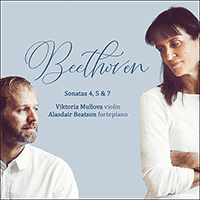


Celebrated violinist Viktoria Mullova and duo partner Alasdair Beatson here perform the gnomic fourth violin sonata, the ever-popular fifth (‘Spring’), and conclude with the C minor drama of the seventh.

And so here we play three sonatas, the most considerable of which is Op 30 No 2, in (and very much belonging to) the 'Beethovian' key of C minor. Revolution is in the air, and particularly in the outer movements we are carried on a thrillingly wild and unpredictable current
The other two sonatas, though consecutive in opus number, contrast vastly. Op 23 is for the most part terse, anxious and unhinged, Its unusual three-movement structure depriving us of any traditional 'slow' movement. It is truly a breathtaking work, though its sibling sonata, the so-called 'Spring' Sonata Op 24, makes for more amiable company—playful, abundant In invention, famously lyrical, and gifting us an Adagio of the utmost tenderness and profundity.
We present these sonatas on instruments appropriate to the early 1800s: a 1750 Giovanni Battista Guadagnini violin, strung with gut and played with a classical bow (made by Ralph Ashmead), and a replica of an 1805 Viennese Walter fortepiano built by Paul McNulty. Compared with their modern counterparts, might we feel a heightened intimacy between the instruments, with their shared subtleties of articulation and colour so intrinsic to the repertoire? And might we dare to feel a heightened closeness with Beethoven too, as we delve into the richness of his musical, emotional and spiritual worlds?
Alasdair Beatson © 2026


