Welcome to Hyperion Records, a British classical label devoted to presenting high-quality recordings of music of all styles and from all periods from the twelfth century to the twenty-first.
Hyperion offers both CDs, and downloads in a number of formats. The site is also available in several languages.
Please use the dropdown buttons to set your preferred options, or use the checkbox to accept the defaults.
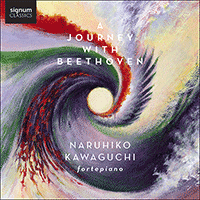


On this fascinating album we get to hear not only some of Beethoven’s finest miniatures, but also three rare surviving instruments of the period: a Rosenberger from circa 1795 which has a natural affinity with Beethoven’s early pieces; a Clementi square (c1825), full of playful charm; and finally a Graf (c1826) whose tone hints at the budding Romanticism of the time.

Of Beethoven’s 11 Bagatelles, Opus 119, the first five were sketched between 1800 and 1803, whereas the remainder were completed in 1820. With the rather contradictory marking of Vivace moderato, the ninth piece in the set, graceful and waltz-like, is in A minor. Though based on simple arpeggios, it is a curiously haunting miniature.
Catalogue number WoO55 represents a Prelude in F minor. Its Bachian style strongly suggests that this piece dates from Beethoven’s mid-teens.
The Presto in C minor, WoO52 (entitled Bagatelle or, strangely, Intermezzo in some editions) is a fiery, scherzo-like piece with a lyrical trio section in C major. Originally Beethoven intended it to be the fourth movement of his C minor sonata, Opus 10 No 1 (late 1790’s). His final revision of this free-standing Presto dates from as late as 1822, suggesting that he valued this early piece.
The composition catalogued as WoO61a is an Allegretto quasi Andante in G minor. Dating from 1825, this extremely brief, fugal work has the dedication “Comme un souvenir à Sarah Burney Payne”. As Ms Payne was the granddaughter of the eminent music scholar Charles Burney, a familiar name to Beethoven, he talked to her freely and amiably, spontaneously presenting her with this miniature.
The second of the two Rondos Opus 51 is a graceful piece in G major, marked Andante cantabile e grazioso. Probably dating from 1798, this was Beethoven’s gift to Countess Giulietta Guicciardi, a lady with whom he was in love. However, he then asked her to return it, giving her in its place the dedication of the celebrated “Moonlight” Sonata, Opus 27 No 2. The elegant Rondo has a flourish in bar 2 which becomes a prominent feature, usually in the right hand but sometimes in the bass. A trill heralds a middle section—Allegretto in E major—which includes a substantial passage of semiquavers requiring fluent articulation.
Opus 129, entitled Rondo alla Ingharese quasi un capriccio in Beethoven’s manuscript, has an inscription attached by the composer’s biographer Anton Schindler: “Rage over a lost penny, vented in a Caprice”. Imbued with infectious energy and wit, this Allegro vivace in G major is one of Beethoven’s most popular short pieces. Its rondo form has contrasting episodes in E major and B flat major. The late opus number belies its early composition of 1795. Left unfinished, the piece was probably completed for publication by Diabelli and Co. Schumann commented: “It would be difficult to find anything merrier than this whim … It is the most amiable, harmless anger.” So, we may well conclude that the piece joins the multitude of misleading or downright silly nicknames in music, including Mozart’s “Jupiter” Symphony, Chopin’s “Raindrop” Prelude and Tchaikovsky’s “Polish” Symphony.
The “Easy” Sonata in C major, WoO51 comprises an Allegro and an Adagio. Beethoven wrote to Eleonore von Breuning, who is believed to have been the teenaged composer’s first love, apologising for not finding time to send her this promised sonata. She eventually received the manuscript in 1796, but the copy sent to the publisher had the last eleven bars missing, so these were completed by Beethoven’s student Ferdinand Ries. One would confidently assume that a third movement was intended, but this has never been discovered. The Allegro is charming and gentle, whereas the gracious Adagio has particularly beautiful embellishments to its melodic line.
The Creatures of Prometheus, Opus 43 is Beethoven’s only major ballet score (his early Ritterballet was composed for a masked ball.), commissioned by the Italian balletmaster Salvatore Viganò and composed in the winter of 1800-1. The music comprises an Overture, an introduction and sixteen other movements. Its scenario is based on Greek mythology. The Titan Prometheus stole fire from Zeus in order to create two human figures from clay. He then leads them to Parnassus, where they are taught artistic and scientific appreciation by Apollo, Bacchus and the Muses. Beethoven arranged the complete ballet score for piano in 1801. The music from Act One, Scene 3 is characterised by an elegance somewhat belied by its tempo marking of Allegro vivace.
Although in the style of a Scottish country dance, hence its name, the Écossaise is of French origin. In 2/4 time, it is danced in two lines, the women opposite the men. Beethoven’s six écossaises, dating from 1806, are miniatures in the simplest form, all in E flat major and to be played without a break. Though far from significant and lacking any distinctive hallmarks of the composer, these pieces are nonetheless appealing.
Bagatelles Opus 119, No 1 is an Allegretto in 3/4. This G minor piece has a middle section in E flat major, marked dolce. There is a 4-bar link which leads back to the opening section, and a short coda. In common with all the bagatelles in the Opus 119 set, this one is very brief. The Peters publishing house complained about the first six: “I asked for kleinigkeiten but these are really too small, and in addition most of them are so easy …” Beethoven quickly approached the London-based publisher Clementi, who published them as “Trifles for the Piano Forte, Consisting of Eleven pleasing pieces Composed in Various Styles by L Van Beethoven.”
The Polonaise in C major, Opus 89 dates from 1814. Beethoven’s physician-friend Dr Bertolini suggested that he might compose a polonaise for the Empress of Russia. Initially reluctant, Beethoven did decide to write the piece and presented it to the Empress Elizabeth Alexeievna, one of the many crowned heads attending the Congress of Vienna. He was rewarded with a generous fee of 50 ducats. The Polonaise—his only keyboard example of this Polish dance—begins with a cadenza-like flourish, giving way to the captivating main section, its melody marked dolce. After a central episode in C minor, Beethoven touches on D flat major and A major, before a teasingly drawn-out passage leads back to the polonaise melody. Anticipating Chopin, this delightful piece is generally untypical of Beethoven, but one in which, nevertheless, his wit and sense of fun are tangible.
Opus 77 is the Fantasy in G minor, an extraordinary masterpiece which, although notated throughout, epitomises Beethoven’s phenomenal skill in improvisation. Of this skill Carl Czerny observed “… he knew how to produce such an effect upon every listener that frequently not an eye remained dry, while many would break out into loud sobs; for there was something wonderful in his expression in addition to the beauty and originality of his ideas and the spirited style of rendering them.” The first part of the Fantasy is fragmented and unpredictable in a manner reminiscent of C P E Bach, though Beethoven’s volatile imagination makes his predecessor’s seem less eccentric. Beginning with rapid, disconnected scales, alternating with brief, lyrical phrases marked poco adagio, the work continues with an expressive melody in D flat major, though this is interrupted by a further rapid scale. A further flourish—descending then ascending—leads to a new melody in B flat major, marked Allegro, ma non troppo. Preceded by a cadenza-like passage, a further tempo change (Allegro con brio) brings a turbulent episode in D minor. The latter half of the Fantasy brings solace after the preceding restlessness—a set of variations in B major. Even here Beethoven interrupts with more scales and this element even has the last word, now in contrary motion between treble and bass. The piano, his own instrument, was always the medium in which Beethoven showed most freedom, but nowhere is his boundless imagination more fertile than in this Fantasy.
The Geistliche Lieder von Gellert are a group of six songs, dating from 1802, in which Beethoven sets texts by Christian Fürchtegot Gellert, dedicating them to Count von Browne after the sudden death of his wife. Bitten is in E major, a key which in Beethoven’s music is usually associated with an elevated, even religious character, exudes a simple piety. Liszt transcribed nineteen of Beethoven’s songs, including the cycle An die ferne Geliebte.
At the first performance of Beethoven’s Seventh Symphony, the audience demanded an encore of the Allegretto, which soon became phenomenally popular. The pianist and prolific composer Friedrich Kalkbrenner (1785-1849) transcribed all nine of Beethoven’s symphonies, published between 1842 and 1844. Liszt, who also arranged Beethoven’s symphonies for piano (the full set was published in 1865, but three of them had appeared in 1837), wrote to his publisher Breitkopf and Härtel, probably in 1837: “I had spoken … about the Beethoven symphonies, of which I have undertaken the arrangement. The recent publication of the same symphonies, arranged by Mr Kalkbrenner, makes me anxious that mine should not remain any longer in a portfolio.”
Bagatelle No 25 in A minor, WoO59 is the piece universally known as Für Elise, dating from 1810. However, there is a strong theory that this name was a misreading of Therese, because the manuscript was found among the possessions of Therese Malfatti, to whom Beethoven had proposed marriage that year. Our over-familiarity with the piece should not blunt our realisation of its haunting character. The version performed here is Beethoven’s 1822 revision, completed by Mario Aschauer. This rarely played revision, which has not replaced the first version in popularity, is surprisingly different from the original.
Phillip Borg-Wheeler © 2026
Since its birth around 1700, the piano has undergone dramatic transformations. Among these, the changes that occurred during Beethoven’s lifetime—spanning the Classical to the Romantic era—were especially profound. For many fortepianists, performing Beethoven’s works stirs a deep curiosity and a sense of artistic adventure. Personally, I am also deeply moved by Beethoven as a human being—his resilience in the face of immense hardship and suffering resonates with me as much as his music does. That is why I was truly delighted to realize this recording project with Signum Records in anticipation of the 200th anniversary of Beethoven’s death in 2027.
For this album, I wanted to approach Beethoven from a perspective quite different from his 32 piano sonatas. I envisioned a “journey of the heart” woven through a selection of his shorter character pieces. Along this journey, one encounters not only a rich palette of affects, but also glimpses of Beethoven’s humor and spirituality. His fascination with foreign cultures—such as those of Scotland, Hungary, and Poland—also comes through. The program includes arrangements by Liszt and Kalkbrenner, as well as a completion by Ries. The well-known Für Elise is performed using a version based on an 1822 draft included in the critical edition by Beethoven scholar Mario Aschauer (published by Bärenreiter).
The instruments used in this recording are three fortepianos from the renowned Finchcocks Collection in the UK. These include a c1795 Rosenberger, which I also used for some of the later works and which I feel has a natural affinity with Beethoven’s early pieces; a c1825 Clementi square piano, full of playful charm; and a c1826 Graf, whose tone hints at the budding Romanticism of the time. It was a rare privilege to engage with three such distinct personalities, and each instrument added its own color to this journey of the heart. I am deeply grateful to Katrina Burnett and everyone at the Finchcocks Collection for generously providing these wonderful instruments.
A journey that begins and ends in A minor—I hope each listener will enjoy this musical path in their own way, guided by their own sensibilities.
Grand piano by Michael Rosenberger, Vienna, c1795
Compass: FF - c’’’’ Viennese action. Kneelevers for dampers and moderator
Bavarian by birth, little is known about Rosenberger’s life, but it is believed that he settled in Vienna in the late 1780s and trained with Anton Walter, the maker of one of Wolfgang Amadeus Mozart’s pianos. In most respects, this instrument is typical of Viennese pianos of the late 18th century, possessing many of the features peculiar to that school of building, including knee-operated levers for raising the dampers and for interposing a moderator (a strip of cloth or leather) between the hammers and the strings to soften the tone. The elegant case is veneered in un-stained cherry—a wood often coloured red in imitation of fashionable mahogany, which was not widely imported into Austria during the period. The relatively robust construction of the instrument suggests innovation on the part of its maker, contributing to a bolder and more assertive sound, and reflecting a general trend towards the improvement of an established form.
Square piano by Clementi and Co., London, c1825
Compass: FF - c’’’’ Geib’s escapement action. Pedal for dampers
An arbiter of taste and quality, Clementi’s instruments reflect the expectations, both material and musical, of the composer himself. The firm’s pianos achieved international acclaim due in part to Clementi’s tireless promotion of all the products that bore his name, but were also famous for their excellent craftsmanship and reliability. This instrument, with its solid mahogany case and plain inlaid lines, is rather sober in appearance compared with many of its surviving contemporaries and is representative of a range of instruments produced by the firm that were designed to appeal to different budgets. Nevertheless, the use of choice materials, together with the presence of John Geib’s escapement action, a six-octave compass and a sustain pedal, render the instrument no less useful and versatile in supporting the music of the period.
Grand piano by Conrad Graf, Vienna, c1826
Compass: CC - f ‘’’’ Viennese action. Pedals for due corde, faggotzug (bassoon effect), moderator and dampers
A testament to Graf’s renown is the inscription on the enamel nameboard etiquette fitted above the keyboard of this piano that styles him as piano maker to the Imperial Court. Helped, no doubt, by royal patronage, Graf’s success was probably more the result of well-regulated manufacturing processes and a specialised division of labour. Whilst his workshop practices might have been of the moment and his attitudes towards his employees comparatively progressive, his instruments are surprisingly conservative in design, retaining something of the traditional sound characteristics of the earlier Viennese instrument. An innovative approach, however, to the wooden structure and casework of his instruments allowed for greater string tension without the addition of metal reinforcement, providing the increased power and sonority demanded by contemporary music, without compromising a bell-like clarity. Beethoven, Liszt, Chopin and Clara Schumann all played Graf pianos and this instrument retains a number of rare period, or possibly even original, strings.
Information about each piano is kindly provided by Ben Marks, from the Finchcocks website. More information can be found at https://www.finchcocks.co.uk/
Naruhiko Kawaguchi © 2026



