Welcome to Hyperion Records, a British classical label devoted to presenting high-quality recordings of music of all styles and from all periods from the twelfth century to the twenty-first.
Hyperion offers both CDs, and downloads in a number of formats. The site is also available in several languages.
Please use the dropdown buttons to set your preferred options, or use the checkbox to accept the defaults.
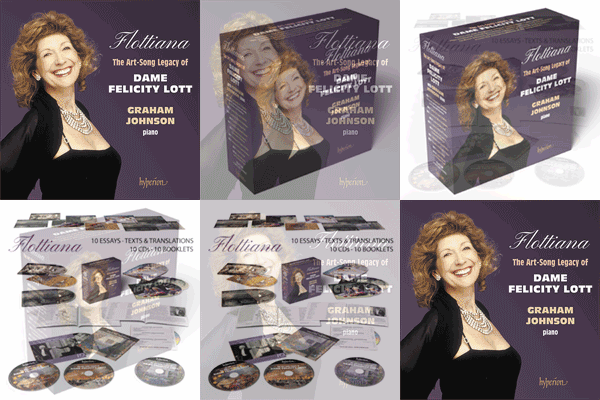


Dame Felicity Lott was one of Britain’s best-loved sopranos. In opera, her portrayals of the Strauss and Mozart roles in particular led to critical and popular acclaim worldwide. Her concert engagements took her to the major orchestras, working with Rattle, Haitink, Mehta, Previn, Masur, Welser-Möst, Sawallisch and Sir Andrew Davis.
A founder member of The Songmakers’ Almanac, Felicity appeared on the major recital platforms of the world and in June 2005 she celebrated the 30th anniversary of her recital debut at Wigmore Hall with which she had a particularly close association, receiving the Wigmore Hall Medal in 2010.
This boxed-set—issued in collaboration with Champs Hill Records and Wigmore Hall Live—celebrates Felicity Lott’s legacy as a brilliantly versatile art-song exponent: 10 bespoke programmes curated by long-time collaborator Graham Johnson.

As an accompaniment student at the Royal Academy of Music, my apprenticeship was served playing for the singing teacher Flora Nielsen, a pupil of the legendary Elena Gerhardt. One day in the spring of 1971, a vibrant blonde in her early twenties breezed in for a lesson. This stroke of divine good luck brought the beautiful Felicity Ann Emwhyla Lott into my life, a meeting that swiftly evolved into a musical partnership. When Flora turned 75 in 1975 (she died soon afterwards) we organized a celebration at the Purcell Room on the South Bank and invited the baritone Richard Jackson to join us—we had both admired his vivid singing in French-song masterclasses given in London by Pierre Bernac.
The success of Flora’s birthday concert, Wolf’s Italienisches Liederbuch astonishingly well-reviewed by the legendary critic Desmond Shawe-Taylor in The Sunday Times, precipitated a search for two more singers to make up an SATB team. Fate smiled on us. Ann Murray, an Irish mezzo whose vocal accomplishments were already the talk of the town, agreed to join us, as did that blissfully voiced tenor, the late Anthony Rolfe Johnson whom I had met in 1972 when playing for Peter Pears’s first masterclasses at Snape Maltings. What I had in mind was something new: not a choral ensemble but a flexible repertory company of art-song soloists. The formation in 1976 of The Songmakers’ Almanac led to pioneering thematic song recitals in London and elsewhere. These were presented under the group’s banner for the next twenty-five years, and with many guest artists. Subsequently, groups of solo singers dedicated to the performance of the art-song repertoire (with their recital-series usually curated by accompanists, empowered in a new role) sprung up all over the world.
This box-set might be subtitled, with some justification, Frauenleben und -lieder: A Woman’s Life and Songs. And what a woman Flott was.
She was famous in opera and oratorio, but her humanity and intelligence shone out especially radiantly in the song repertoire. There were a number of composers (Debussy and Ravel among them) whose music Flott recorded for labels other than Hyperion. On occasion her recitals or recordings were accompanied by Geoffrey Parsons, Roger Vignoles, Pascal Rogé, Malcolm Martineau and composer-pianist Jason Carr as well as a younger generation of accompanists who benefited from her encouragement. But it is Flott’s recordings for Hyperion that represent an unbroken chronicle of her development as a singer of song and of a partnership on the concert platform and in the recording studio that lasted for over fifty years.
The Songmakers' Almanac (1981) – Pioneers of the art-song anthology
I first encountered Ted Perry in 1978 when I accompanied the tenor Martyn Hill in an album of French songs recorded for the Meridian label. The ever-generous Ted, now recognized as a giant of the record industry, became a supportive friend and attended our Songmakers’ Almanac concerts in London. He invited the group to record for his recently established company, Hyperion Records; Ted’s only reservation was that recitals such as ours, with many different composers and more than one singer, were a difficult sell. Where would one file a thematically based LP in a record store with its alphabetically arranged stacks? These stacks were the odds laid against us, but those emporia, once ubiquitous, have now all but vanished. In these days of streaming, song collections in all vocal genres and on countless themes, perhaps too many of them, are available everywhere.
Voices of the Night, an anthology of nocturnal ensembles and solos by Brahms and Schumann, was recorded at the Art Workers’ Guild in Queen’s Square, London, in 1981. The producer was Martin Compton and the engineer Antony Howell. The redoubtable Mrs Doreen Perry, then still a co-owner of the company, insisted on providing us with time-consuming gourmet lunches, to Martin’s exasperation. These sessions were intense and magical, and we were all somewhat in awe of each other’s work. When all four voices sang together in the Brahms quartets the blend was spellbinding—these singers were willing to sacrifice vocal individuality in favour of creating a chamber-music ensemble. The programme’s coupling of Schumann and Brahms, mentor and mentee, provided a rich backdrop of cross-references, both musical and personal. For example, the young Brahms set Eichendorff’s Mondnacht as a tribute to Schumann’s immortal setting of the same text from Liederkreis, Op 39; when composing his vocal duets, both simple and complex, Schumann provided Brahms with a template that he emulated and audaciously broadened.
In Nachtwandler Flott demonstrated an instinctive mastery of the Brahms style, a more expansive approach than is required for Schumann’s moto-perpetuo for Philine, the flighty and promiscuous actress in Goethe’s Wilhelm Meisters Lehrjahre. There was a lot of laughter and fun around the edges of this very serious recording enterprise. Ann Murray’s performance of Schumann’s treacherously demanding Mondnacht was recorded in one take—while her singer colleagues listened admiringly, and on tenterhooks. There was an equally arresting performance, by Anthony Rolfe Johnson, of Mein schöner Stern! in which Schumann’s almost abject devotion to his Clara brings tears to the eyes. Once the LP had been released and played on the radio, Tony received a phone call of approval, out of the blue, from Sir Peter Pears, no less. The collaboration between Lott and Murray in the hair-raising Walpurgisnacht duet was prophetic of the many starry duet recitals they were later to give together all over Europe.
It seems fitting that this LP, shared with three dear singing colleagues, was Felicity Lott’s debut for Hyperion forty-five years ago. Her whole career was built on her genuine and unfettered joy in sharing and making music with her peers; she was a team player, both inspired by, and inspiring, the work of those around her—whether on the recital platform or the opera stage.
Lieder by Franz Schubert
If Shakespeare is the Everest to be conquered by aspiring actors, Schubert is, the pinnacle of lieder-singing ambitions. It was after my Damascene conversion to this composer’s songs (a life-changing Winterreise at Snape with Peter Pears and Benjamin Britten in 1971) that Flott and I began prospecting in the Schubertian foothills. Every day we discovered a new golden seam, hardly believing our beginners’ luck. Songs like Nachtviolen and Frühlingsglaube were nuggets unearthed near the surface, but deeper explorations followed. The second Songmakers’ Almanac recital in London ended with Der Hochzeitsbraten a comic trio inspired by Mozart’s Le Nozze di Figaro. The Count, Susanna and Figaro morph into Kaspar, a lascivious gamekeeper (Richard Jackson), and the lovers Therese and Theobald (Flott and Tony). The couple are apprehended after poaching a hare for their wedding breakfast the following day. Therese fools Kaspar into releasing them with hints of sexual favours on the morrow. This trio appeared on a Hyperion double-album, The Songmakers’ Almanac Schubertiade, released in 1985 when we were all featured on the cover of The Gramophone.
Despite her later affinity for sumptuous composers like Strauss and Poulenc, rigour, discipline and pudeur were always an essential part of Flott’s artistic personality: she was a wonderful Bach and Handel singer and a natural Mozartian in many operatic performances. When the classical contours of the Mozartian century yielded to a new era, Schubert, looking back to Mozart and up to Beethoven, harvested the flowers and fruits of early romanticism and distilled a potion so magically powerful that the world has remained under its spell ever since. The heart-breaking Wehmut seems even sadder now that Flott has left us, and Auflösung more hair-raising. (Enthusiasm sometimes carried us away and we rushed ahead, audaciously adventurous, for better or worse.) Licht und Liebe with Anthony Rolfe Johnson is one of only two duets composed by Schubert for voices and piano.
In 1992 Flott contributed to the Hyperion Edition of the complete Schubert songs. There were some deeply touching yet little-known lieder on this disc, such as Im Haine, Nach einem Gewitter and Abendlied. The famous Lachen und Weinen is oriental in inspiration, as are the two extraordinary Suleika songs in which Schubert celebrates those long-distance imaginary lovers, Suleika and Hatem, protagonists of Goethe’s middle eastern anthology, West-östlicher Divan. Schubert’s almost uncanny ability to identify with female emotion, as in the immortal closing pages of the first Suleika—and to do so more convincingly than any other lieder composer—is one of many things that affirm his Shakespearian stature. In the composer’s time no one knew that these poems were indeed the work of a woman—Goethe’s secret epistolary paramour, Marianne von Willemer.
Boating on the lake, the widower poet of Auf dem Wasser zu singen is entranced by the beauty of a sunset on the water and longs to be swept up by the wings of time so he can be reunited with his beloved wife. Schubert’s barcarole is a comingling of melancholy and metaphysical ecstasy. The sinuous vocal line is shadowed by undulating sextuplets in A flat minor which break out and stretch upwards into rapturous A flat major, piano solos that cascade between the verses of a poem that praises the beauties of nature and ends by looking forward to the soul’s release and transfiguration. In 1823, the year of the song’s composition and the low-point of Schubert’s existence, he rose above his terrible illness to create exalted music such as this, inspiring and consoling others. In the closing months of Flott’s life, joyful gratitude triumphed over pain and fear in like manner. In many conversations and letters, she rejoiced in her love for family, friends and colleagues, offering us consolation when it was our role to console her. She had already given us so much, and then came the final page of her own song in which the minor key was vanquished by such selfless radiance that it seemed worthy of Schubert himself.
Lieder by Robert Schumann
Once he had achieved his ambition to marry Clara Wieck, and after exhausting his enthusiasm for lyrics by the famous Heine and Rückert, Schumann began to explore the gifts of more obscure writers, setting neglected and little-known poets like Titus Ulrich (Herzeleid) and the child-prodigy Elisabeth Kulmann (a member of the German diaspora living in Russia). The style of the Kulmann duets, Op 103, as well as those of Op 43 shows Schumann’s lifelong admiration for his friend Mendelssohn, the most famous composer of duets for women’s voices at the time. As an indulgent father of seven (Schubert, Brahms and Wolf were childless), Schumann lavished a great amount of attention on a substantial Lieder-Album für die Jugend, Op 79.
Recordings of miscellaneous solo lieder by Schumann on this disc (settings of Rückert, Ulrich, Kerner and Hoffmann von Fallerleben) are taken from My Garden, a floral anthology issued by Hyperion in 1997. Erstes Grün is from the Kerner Liederkreis, Op 35; Die Blume der Ergebung and Mein Garten were composed in 1850, gentle and beautiful harbingers of the melancholic uncertainty and diffidence that increasingly infiltrated the composer’s psyche. (The brief melodic quote from Beethoven’s An die ferne Geliebte in Mein Garten is an indication that Schumann felt at a distance from others, including, at this stage, Clara.) In the haunting Herzeleid from 1851, Ophelia’s fate seems linked to Schumann’s suicide attempt in the Rhine in 1853.
In 2003, I devised a duet recital for Felicity Lott and the Austrian mezzo, Angelika Kirchschlager—Schumann and Loewe’s Frauenliebe und -leben cycles were interwoven and expanded to make a whole evening of song in the manner of an intricately devised Songmakers’ Almanac programme. From the Hyperion recording of this recital, Women’s Lives and Loves, Flott sings three famous songs from Schumann’s Frauenlieben und -leben. Another item depicting domestic bliss, an 1849 duet without opus number, Sommerruh (with Ann Murray) is a magical evocation of hot and lazy summer days.
The children’s songs from the Lieder-Album für die Jugend, Op 79, were written in 1849, a bumper year for Schumann songs, second only to 1840. The composer’s Album für die Jugend of 1848 was written for young pianists, but most of this vocal collection, despite its youthful subject-matter, was meant to be sung by grown-ups. Of the twenty-nine songs and duets in this Op 79 collection, we hear thirteen on this disc. Apart from seven soprano solos there are four duets with Ann Murray, and three ravishing solos from this great mezzo. The independent fame of some of the songs towards the end of this collection has obscured their origins in Op 79: Er ist’s to a poem by Mörike is a delicate delight, very different from Wolf’s larger-scale setting that opens Disc Four, while Mignon, a setting of Goethe’s famous ‘Kennst du das Land?’ from his Wilhelm Meister, is a tour de force. This version is one of many settings of an immortal lyric in which the most famously tormented teenager in German literature sings of her longing for her Italian homeland. While Schumann’s Mignon is not as world-famous as Wolf’s, in a riveting performance like this one, it achieves the intensity that the composer surely intended.
All in all, in this Op 79 set of lieder, the composer offers us an astounding combination of artless simplicity and sophistication … completely suited to the mix of interpretative instinct and musical talent apparent in the performances of Mesdames Lott and Murray.
Lieder by Hugo Wolf
The first group of songs by Hugo Wolf on this disc constitute a whistle-stop tour of essential Wolfian terrain. Featuring the poetry of Eduard Mörike, there are four lieder, each a masterpiece and each inhabiting a different musical world. Er ist’s with its rippling harp-like accompaniment and triumphant postlude is a virtuoso outburst that dies away to a delicate conclusion, the fragrance of spring’s imminent arrival left hanging in the air. A poor, lovestruck gardener, Der Gärtner, worships a princess from afar as she canters on her fairytale pony. In Im Frühling the operatic grandeur of Wagnerian chromaticism is scaled down to befit the intimate musings of a young poet grappling with his memory-filled solitude; Erstes Liebeslied eines Mädchens might have been a case-study for Sigmund Freud: the convulsions of its orgasmic piano writing crash through the pent-up barriers of nineteenth-century repression in a manner more tonal than Schoenberg’s, but just as lacerating.
And then, a very different setting of a poem by Eichendorff, that great lyricist of nature and the outdoors: in Nachtzauber we hear the abundant nocturnal flowerings of nature in their glistening F sharp major effulgence. Frühling übers Jahr switches to the Olympian detachment of Goethe, a springtime evocation of Weimar circa 1816 and a hymn of praise to the gardening skills of Christiane, the poet’s dying wife. In his imaginary discovery of Anakreons Grab Goethe imagines the ancient Greek poet rewarded, after a notoriously hedonistic life, with a restful burial place in the sun-blest Sicilian landscape. In the final song in the group from the Spanisches Liederbuch, a daughter begs her mother to intercede with a young man on her behalf in passionate music of Iberian impetus and atmosphere.
When Flora Nielsen turned 75 at the RAM, we were determined to perform the whole of Wolf’s glorious Italienisches Liederbuch in her honour. A week before the advertised London performance I received a telephone call from that most legendary (and most feared) of all Wolfians, Walter Legge. He had proselytized on behalf of this composer, his musical hero, for half a century, not least in programming recitals for his wife, Elisabeth Schwarzkopf. He invited himself to coach us and arrived on my doorstep the next morning, a cigar in one hand and a metronome in the other. Flott, Richard Jackson and I worked for seven hours without a break. I played the opening of Auch kleine Dinge seventeen times before Flott was allowed to sing the first note. After that baptism of fire, scrupulous respect for this composer’s markings and dynamics, so necessary to achieve what Wolf had envisaged, became second nature in our many performances of this work over the years.
There is no space here properly to describe the multitudinous musical glories of the Italienisches Liederbuch, forty-six songs to Italian rispetti—anonymous texts translated into German by Heyse and Geibel. A generous selection of them is offered here, more than half of Wolf’s entire songbook, including performances by the great German tenor Peter Schreier whom I had accompanied, on and off, for many years and who joined us in Bristol to record these songs. He was already a veteran but still sang beautifully in his perfectly enunciated German. This last of Wolf’s great songbooks teems with different young couples in love. The work unfolds as a kaleidoscope of their amorous exchanges, mostly in the piazza of a small town somewhere in Tuscany, each vivid little incident captured in a couple of pages of music dense in nuance and emotion. These exquisite miniatures embody the concept of multum in parvo in music. At the opening of the cycle, we hear Auch kleine Dinge—‘Even small things can delight us’. Wolf is said to have chosen this text as a kind of motto because he was self-conscious about being very short in stature. He was, nevertheless, a musical giant.
Lieder by Richard Strauss
Felicity Lott often found herself singing the operas by Richard Strauss—who can see the video of her as the Marschallin in Der Rosenkavalier, conducted by the great Carlos Kleiber, without being aware of the shared musical understanding and chemistry sparking between them? She excelled as the Countess Madeleine in Capriccio, but also as Arabella and the fiendish Christine in Intermezzo. After singing these roles, the lieder of Strauss, so often the by-products of his operatic activity, came as second nature to her. We were rewarded with the accolade of an all-Strauss lieder recital in Garmisch-Partenkirchen, invited to the Strauss villa by the composer’s grandson Christian and his wife Susan, who became our hosts and friends.
Eric Sams used to say that Strauss was at the top of the list of great lieder composers of the second rank. Whatever the truth of this, the success of a Strauss song in performance oftens seems to depend on who is singing it. If indifferent productions of Donizetti and Bellini leave us cold, music by these same composers, when sung by Maria Callas, strikes us as world-beating. In the same way, Felicity Lott was instinctively able to bring a glamour and depth to Strauss lieder which went beyond anything written on the printed page. To make his best impression this composer had always been dependent on great artists; the opera stars of Munich had sung and promoted his lieder from the early years of his precocious career. Strauss was a devotee of the voice, perhaps more concerned with a singer’s timbre and Ausstrahlung than with ensuring that his songs plumbed the depths of a poem’s meaning. He would no doubt have written lieder for Flott, and accompanied her, had she been born in a different place at a different time.
On this disc we experience various Straussian Felicities: the spinning of a long and languid vocal line, so typical of this composer, is evident in the opening track, Waldseligkeit. A singer of Strauss needs terrific breath-control (also in the vast vistas of Der Dichters Abendgang). It is at the heart of Strauss’s unique style that the voice should float effortlessly, leaving the pianist to weave a skein of support undulating gently between the staves (Leises Lied and Meinem Kinde), or rippling in the background with seraphic legerdemain (Ständchen and Wiegenlied). At times an accompaniment will gently but determinedly energize the singer into a feistier approach, as in Ich wollt’ ein Sträusslein binden, Einerlei and Muttertändelei. In songs such as these, the vocal line overflows with saucily enchanting vocalism and touches of coloratura bravura.
Of course, there are also far less frivolous moments when songs like Allerseelen, Zueignung and the rampant Cäcilie come to the boil and erupt in passion. Strauss-Zarathustra could also encompass the philosophical brooding of Ruhe, meine Seele!. There are songs with a sharper edge and touches of parody and acerbic comedy (Schlechtes Wetter) and the outrageously coquettish Ach, was Kummer, Qual und Schmerzen. The psychological depths in the Drei Lieder der Ophelia are seldom evident elsewhere. Nevertheless, an early masterpiece like Morgen! unfolds with an almost cosmic inevitability. The half-Scottish Berlin poet John Henry Mackay wrote the lyric in 1890, imagining a better life for homosexual couples in a distant tomorrow that was free from persecution. Even if the very conservative Strauss ignores this aspect of the poem, or was unaware of it, even if it is true that Schubert Schumann and Wolf, also Brahms, took more care than Strauss in examining texts and subtexts, Morgen! reminds us that Strauss was indeed a great a composer of songs, albeit differently wired from other masters of lieder. And to see and hear Flott singing this music, blissfully disporting herself in a stream of sound to the amazement and delight of her listeners, was to experience her in her element.
Mélodies by Charles Gounod, Ernest Chausson and Emmanuel Chabrier
In the musical life of the Second Empire, Charles Gounod was a dominant and idolized figure and his best mélodies showcase his originality. Où voulez-vous aller?, to a poem by Gautier (set very differently by Berlioz as L’île inconnue), has considerable charm. Le soir demonstrates Gounod’s trademark skill at spinning a seemingly endless melody with an eloquence and noblesse typical of him at his considerable best. Venise is a restless Venetian barcarolle suggesting intrigue, mystery and danger. The words of the final verse refer to the detested Austrian occupation of Venice until 1868. In 1870 Gounod left his wife for a romantic adventure in London which turned out to be a disaster. Before returning home he composed both the poem and music for L’absent as a plea for forgiveness. Like Liszt, Gounod was not quite as saintly as the ostentation of his favoured clerical garb suggested.
Ernest Chausson, on the other hand, was genuinely religious and well-to-do, a kind family man and a great supporter of hard-up musicians like Debussy, a friendship later shattered by what Chausson regarded as the younger composer’s amoral treatment of women. In Chausson’s music the influence of César Franck is detectable, also Wagner, even Brahms. Despite dying in a bicycling accident aged only 44, he left some highly original works. Le temps de lilas is an extract from one of the best-known of these, Poème de l’amour et de la mer. The song cycle Serres chaudes, to the poems of Maeterlinck (chiefly renowned as the playwright-author of Pelléas et Mélisande), is an intense and little-known excursion into Belgian-influenced symbolism.
Debussy, Ravel and Poulenc were all ardent fans of the music of Emmanuel Chabrier. There was a humour, a raciness, a warmth of emotion that seemed to flow from this mischievous little man from the Auvergne; plump with sparkling eyes, wearing a beret and sporting a Van Dyck beard, he was nicknamed ‘l’ange du cocasse’ (‘the angel of the comical’). Tes yeux bleus is mischievously modelled on Wagner’s Isolde-esque Träume. His alternative setting to Duparc’s famous L’invitation au voyage boasts a bassoon obbligato. Toutes les fleurs is Rostand’s very cheeky metaphor for unbridled sexual excess with women of every floral variety, thus Chabrier’s self-parodying and ridiculous musical hyperbole. He wrote to the tenor Van Dyck instructing him to sing it with ‘crazy passion and hell-for-leather slobbering’. The extraordinary rubato of the piano writing in L’île heureuse was copied by Reynaldo Hahn who had heard Chabrier himself playing the song. When Hahn recorded it (singing and accompanying himself), that 78-rpm disc was studied by Poulenc before he accompanied Bernac. It was the latter’s famous performance on LP that I studied thirty years later. The stylistic idiosyncrasies of Chabrier, who had never been anywhere near a microphone, were thus indirectly, and fortunately, preserved by the gramophone. In the unashamedly and deliciously suggestive Lied, the rampant Berthe is ravished by a moustachioed elf in a strawberry patch. Our barnstorming finale and knees-up—the over-the-top and vocally ridiculous transcription of the composer’s symphonic rhapsody, España—reminds us that Flott was always game for a laugh, even if the vocal writing was as far-fetched as this. She was a dream singer for this cherished composer, a born Chabriériste.
It seems an ‘embarras de richesse’ that such a fine lieder singer should also have given audiences such pleasure in the realm of French song. Flott studied French at university (Royal Hollaway College and Grenoble) and, as her career progressed, she forged ever closer ties across the Channel. She eventually bought a flat in the Marais, which remained her beloved Parisian pied à terre. In terms of music also, France became her second home.
Mélodies by Gabriel Fauré and Reynaldo Hahn
On this disc, groups of mélodies by Fauré, a grand maître, are contrasted with songs by his much younger admirer, Reynaldo Hahn, a petit maître perhaps, but a maître even so. Hahn was a pupil of Jules Massenet at the Conservatoire—he was thirteen when he composed Si mes vers avaient des ailes. Many of his earlier mélodies, like L’heure exquise, were composed with the Massenet affectation of a ravishing cadence on the song’s final page where the singer floats a high note on a languid fermata.
Though fond of Hahn, Fauré detested Massenet, the vastly successful note-spinning Strauss of French song. Fauré was more like Schubert with a pudeur, not to mention an architectural concision, that prohibited a ‘let it all hang out’ approach. His salon songs like Au bord de l’eau have a shape that brooks little interference—after all, a running stream cannot engage in rubato. Even Les roses d’Ispahan with its gently swaying lilt is essentially tamper-proof. Hahn indulged his performers with far more latitude. His setting of a famously anguished Verlaine text, D’une prison, is merely gently melancholic. The chiming clock tells us that it is three o’clock on a sybaritic afternoon.
Fauré’s discovery of Verlaine’s poetry, in contrast, ushered in a rigorous and invigorating phase in his creative life. Clair de lune is a masterpiece in the composer’s madrigal style, the vocal line an obbligato to piano writing of exquisite grace and subtlety. The Cinq melodies «de Venise» are not about Venice but were composed there when the composer, badly in need of a holiday, was a guest of the Princesse de Polignac. Verlaine’s poems evoke Watteau’s paintings of the Fêtes galantes at Louis XV’s Versailles. The formality and logic of Fauré’s cyclic construction, a rare attempt at this kind of unity in his songs, finds parallels in the complicated disciplines of eighteenth-century court etiquette. Le parfum impérissable is saturated with such subtle harmonic richesse that even Marcel Proust struggled to find words to express his gratitude to Fauré for this phial of precious perfume rendered into music.
Hahn’s Proustian heyday was as a teenager; his personal tragedy was to have become stuck in a glamorous past while fighting off the advances of his modernist rivals. The three Banville Rondels on this disc bear witness to the passion and elegance he could muster when composing ornate period-pieces drenched in ecstatic nostalgia for the Belle Époque. Historical pastiche also became his favoured refuge. With its line ‘Pour la Félicité des cieux’, it seems appropriate to have included À Chloris, here sung by Stephen Varcoe, an old friend and colleague since Songmaking days. Hahn also went in for evocations of the music of the ancients, as in Tyndaris from his Études latines, a counterreaction to Debussy’s quasi-archaic Bilitis settings. In contributing to recording song collections for Hyperion, it was always Flott’s pleasure to work with, and welcome, the collaboration of remarkable younger talents, like Sue Bickley and Ian Bostridge on this disc.
Discouraged by failures in opera, Hahn embarked on a brilliant new career writing operettas and musicals. In Mozart, with the celebrated singing-actress Yvonne Printemps as Mozart en travesti, the composer reads aloud a letter from his wife, Constanza. The operetta Ciboulette with C’est sa banlieu and Nous avons fait un beau voyage (the latter here sung by Susan Bickley and Stephen Varcoe) was a huge hit and at least made the composer lots of money. La dernière valse, once taken up by that great singer Ninon Vallin, seems like a luscious and nostalgic last hurrah for a vanished epoch. Busby Berkeley would have filmed it with a chorus of hundreds of handsome young men, immaculate in tails, and Hahn would probably have been delighted.
Mélodies by Francis Poulenc
Felicity Lott’s connection with the mélodies of Poulenc goes back to the earliest days of our duo. Together we discovered a Decca recital LP of Régine Crespin and were mesmerized by her singing, particularly of Hôtel with its languid final phrase ‘je veux fumer’. Soon we were taking lessons with Pierre Bernac, the baritone for whom Poulenc had written ninety-eight of his songs. Later we both became close friends in Paris of Rosine and Jean Seringe, Poulenc’s niece and her husband, and their family. The high point of our association with Les Amis de Francis Poulenc was a recital devoted to Poulenc’s mélodies at the Théâtre des Champs-Élysées in honour of his centenary in 1999.
Voyage à Paris was an all-Poulenc recital recorded in 1984 by Hyperion as part of a Songmakers’ Almanac series of four LPs, one for each of the founder singers. This was Felicity Lott’s album, apart from four brief appearances from Ann Murray, Tony Rolfe Johnson and Richard Jackson—all included here. The poems of Guillaume Apollinaire, sometimes merry, often profound, are at the heart of Poulenc’s œuvre. After the joyride of Voyage à Paris, there is a masterly meander through Apollinaire’s early memories of Montparnasse, that famous Left-Bank quartier and at that time the world capital of avant-garde art. In the poignant Bleuet (Anthony Rolfe Johnson), Poulenc’s only song for tenor, a rookie soldier of World War I faces senseless death in the trenches. When Tony sang this in a Bernac masterclass, the response of this great artist, usually a pernickety teacher, was simply ‘My God, what a singer you are’. Voyage is a farewell to a beloved friend who takes a train ride, a modernist, post-Dante journey across the Styx. Listening to Flott’s recorded performance is unbearably moving: ‘C’est ton visage que je ne vois plus’—and there is such music to go with these bereft words, tenderness to break the heart.
Paul Éluard was Poulenc’s other dearly favoured poet, and the composer credited him with bringing true lyricism into his work. The song cycle Tel jour telle nuit is a cornerstone of the repertoire. A hymn to the male-female divide, Nous avons fait la nuit lists the contrary views and opinions of the poet’s beloved muse, Nusch, a polarity that was at the heart of their enduring relationship. Tu vois le feu du soir, a lofty love song, mystical and visionary, is also addressed to Nusch. On a lighter note, the poetry of Louise de Vilmorin provides the texts for the enchantingly diaphanous little cycle, Métamorphoses. Colloque (with Richard Jackson) is the composer’s only song for two voices. The first of the Deux poèmes de Louis Aragon is C, a poignant affirmation, after the low point of the 1940 invasion, of Poulenc’s love of his temporarily wounded country. Fêtes galantes is a madcap depiction of the helter-skelter exit from Paris after the arrival of Les Bosches. Priez pour paix (Ann Murray) and À sa guitare, composed for Yvonne Printemps, are potent miniatures, time-travelling stylizations as befitted their period poets. In Toréador (Richard Jackson) we get a taste of the Cocteau-inspired music-hall bravado of Poulenc’s adolescence. The four songs written for children in music-hall manner are taken from a later Hyperion recording. Flott and I were bringing our recitals to a close with Les chemins de l’amour long before it became a recital-ending commonplace.
In 2020 I dedicated my book Poulenc: The Life in the Songs ‘To Flott, the recital partner of a lifetime’. There is a picture of her standing and looking out of the window of Poulenc’s music room at his Loire Valley home at Noizay, near Tours. They were both free spirits: both incorrigibly naughty at times, yet pure of heart and ‘comme il faut’ when necessary. Music simply poured out of both composer and singer—songs ancient and modern, sacred and profane. Poulenc would have been enchanted by Flott; had he been alive, he would have nudged me off the piano stool and insisted on playing for her himself.
English Songs
English song is a vast and still largely unexplored treasure trove. Masters of the genre include such world-class figures as Purcell, Elgar, Vaughan Williams, Walton and Britten. There is also a large number of middle-ranking composers who wrote significant works apart from their songs, such as Parry, Delius, Bridge, Ireland and Bax. And then there are any number of composers known mainly, or only, for their songs—Lehmann, Quilter, Warlock, Finzi, Bush.
Felicity Lott had a vast repertoire of music from her own country. This disc includes only highlights of her work in this field. Benjamin Britten, whose operas Flott sang, published his own piano-accompanied versions of the songs of his seventeenth-century hero, Henry Purcell while aiming to preserve that composer’s ‘mixture of clarity, brilliance, tenderness and strangeness’. Always dismissed—if not derided—by early-music experts, these highly crafted arrangements are nevertheless a fascinating means of viewing seventeenth-century music through the eyes of a great modern composer, himself a master of song composition and a supreme accompanist. The arrangement of the song by Arne is my own, mostly improvised on the spot because the printed accompaniments usually available for music of this kind are Victorian—terribly staid and uninspiring.
A few composers from France have been frequent visitors to England and composed charming, if slight, songs in English. These include Saint-Saëns and Hahn (who at least alighted on a good contemporary poet in Robert Louis Stevenson). Gounod, during his two-year sojourn in London, set the texts of many fine English poets (including Shelley). Initially published in England, these songs were later furnished with French texts and sold all over again (with typical Gounodian legerdemain) as new. The late Victorians and Edwardians were very song-oriented, and Elgar composed a number of songs in his uniquely elevated and nostalgic style. Many women wrote songs—it was considered a suitable métier for them. Maude Valérie White, for example, was a talented and prolific woman composer, as was Liza Lehmann. They produced several songs that could be labelled masterpieces. Parry, with his twelve books of English Lyrics, also belonged to this period.
Following on from the roses mentioned in Purcell, a gardening theme binds together a floral bouquet of songs: Stanford’s Red rose, Haydn Wood’s famous World War I ballad Roses of Picardy and the outrageously full-blown comic roses of Lord Berners. These lead to Maud’s rosy mouth in Bridge’s famous setting of Tennyson and Quilter’s setting of Waller’s roseate Elizabethan text. Having already heard Gounod’s version, we admire the zest and energy of Quilter’s Love’s Philosophy as well as that composer’s famous song of a sleeping crimson petal. These are followed by Delius’s chromatic daffodils, and two trellises of very different kinds—one required for romantic privacy by Ireland and one by Walton, gilded stage-dressing for a Hispanic façade.
Night and dreams now intervene as the theme of two of the three songs of Warlock, the third being the divinely touching My own country. The white peace by Bax, also nocturnal, was once very celebrated. Shakespeare, greatest of all English poets for song, rounds off this disc: firstly, Parry at his most fresh and interesting, and an early and a beguiling setting by Vaughan Willliams. From the late 1950s come twinned settings, by Poulenc and Britten, of the same little Shakespeare poem and commissioned for the same book of children’s songs. The disc concludes with a gloriously energetic Shakespearian finale by Geoffrey Bush.
Fallen Women and Virtuous Wives … Live at Wigmore Hall
This disc is a performance that was recorded live at Wigmore Hall on 6 June 2005. The programme, Fallen Women and Virtuous Wives, is a collage of female characters which we assembled in Songmakers’ Almanac style. This pot-pourri format released us from the need to obey the imperatives that govern the programming of most conventional recitals, although the evening had been most carefully planned in terms of moods and contrasts.
We begin in Berlin-cabaret mode. Kurt Weill’s Nanna is a prostitute and a cynic, the epitome of the fallen woman. We then jump all the way back to Joseph Haydn’s time when a mother finds her daughter in flagrante delicto. As she has arrived just too late to prevent the deed, her continuing presence is pointless, as her daughter points out. Mozart’s hypocritical old woman bemoans the deficiencies of present-day morals. Schumann’s blushing bride begs for her mother’s permission to marry the man she loves. Brahms’s lonely spinster spins in vain, a mini tragedy on two pages. Hugo Wolf’s Tuscan is the most unashamed of girls: apart from the boyfriend with whom she currently lives in Casentino, she boasts of twenty other lovers, ten of them in Castiglione alone. The piano’s postlude expresses her glee and her casual disregard for all of them. Admittedly, her outspoken confessional may simply be a ruse to put off a boring suitor, or to provoke jealousy in someone she really cares about. With Wolf’s Italian women one never knows.
Strauss’s Ophelia is betrayed, bereaved, misunderstood, but she is clearly virtuous in her madness. The calm and determined girl in the Hughes folksong will marry the man with whom she is in love, whatever anyone thinks. In a vignette from Hogarthian London, Walton’s Molly may be a woman of easy virtue, but she is loyal to her abusive sailor boyfriend and seems somehow virtuous, even in her fallen state. In Arthur Bliss’s setting of Edna St Vincent Millay, a happily married American wife may momentarily admire someone good-looking, but she is very happy with where she is. Britten’s valiant Polly Oliver disguises herself as a man and enlists as a soldier to tend her ill lover. Weill’s war widow bp has been faithful to her Nazi husband but loses our sympathy as a recipient of the stolen spoils of brutal conquest; all was hunky-dory for her until Hitler went into Russia.
Roussel’s high-born lady from ancient China wisely rejects an affair outside marriage, shedding a pearl-like tear while doing so. Fauré’s Mathilde is saint-like, a medieval paragon of virtue, as well as being Verlaine’s disastrous future wife. Duparc’s medieval heroine also inhabits a tower, forever awaiting the return of her husband, a knight in the wars. Noël Coward’s three women are a) a mock-medieval spinster, b) Alice, incorrigibly corrupted, and c) Mrs Wentworth-Brewster who rejoices in her widowhood and demonstrates that a steep descent into high camp in an Italian gay bar may be as good a way as any of becoming a fallen woman.
Poulenc and Cocteau provide a substantial portrait of a decrepit old gambler, cheating in the casino at Monte Carlo and having nowhere else to go. She ends her life by jumping into the sea. Hahn allows a woman to offer an argument, convolutedly, to justify her unfaithfulness cn. An Oscar Straus character does the same thing in German—Sally Bowles could have sung this one. Murray Grand provides a showstopper for a woman who is surprised to find herself in a predicament with too many historical precedents. Heuberger’s seductive charm in a private room is the subject of the first encore, but Britten has the last word with O waly, waly in which a woman has been let down and betrayed. As in so many other stories in this programme, men and male perfidy can largely and usually be blamed for a woman falling—whether on hard times, or in any other way.
Epitaph
Among Flott’s very many concert encores there was a small song by Offenbach, from his La Belle Lurette, which was only ever sung at the very end of a recital that had gone so well that quite a number of encores of different kinds had already preceded it. Recitalists know that the stage will belong to someone different on the following night. However much she adored her audience—and she did—it was time to go.
It was the way she sang this simple little valediction for ‘les amis’ who had come to hear her and were now loath to leave, that always brought tears to my eyes—she had the great singer’s way of making the simplest music unbearably moving.
On s’amuse, on applaudit,
Pendant que dure la pièce,
Et puis le rideau s’abaisse
Et quelqu’un vient qui vous dit:
Demain, affiches nouvelles,
Aujourd’hui, plus rien à voir.
Adieu, les amis, adieu, bonsoir,
On va souffler les chandelles.
The audience is entertained, the audience applauds
As long as the play lasts
And then the curtain falls
And someone says to you:
Tomorrow—there’ll be new posters,
Today, that’s all past.
Farewell, friends, farewell, good night,
Time to blow out the candles.
Adieu et bonsoir chère Flott.
Comme on vous aime!
Farewell and Goodnight dear Flott.
How much we all love you!
Graham Johnson © 2026