Welcome to Hyperion Records, a British classical label devoted to presenting high-quality recordings of music of all styles and from all periods from the twelfth century to the twenty-first.
Hyperion offers both CDs, and downloads in a number of formats. The site is also available in several languages.
Please use the dropdown buttons to set your preferred options, or use the checkbox to accept the defaults.


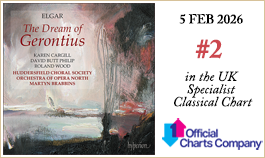
Gerontius David Butt Philip tenor
Angel Karen Cargill soprano
Priest & Angel of the Agony Roland Wood baritone
It was the Huddersfield Choral Society which made the first complete recording of ‘Gerontius’ on 8-12 April 1945; this latest chapter in the Society’s ties to the work was recorded eighty years later, virtually to the day, on 5 April 2025 and displays as deep an affinity for Elgar’s masterpiece as ever, especially with a conductor of Martyn Brabbins’s Elgarian credentials.

I had a dream; yes—some one softly said
‘He’s gone’; and then a sigh went round the room.
These lines appear in the second of the seven ‘Phases’, as Cardinal St John Henry Newman (1801-1890) described the sections of his long poem The Dream of Gerontius. Along with much else, Elgar chose not to include them in his choral setting of the poem, yet they answer a rarely asked question: what, exactly, is Gerontius’s dream?
Gerontius (sung by a tenor soloist) is an old man who lies on his deathbed, surrounded by his friends (‘Assistants’, sung by a small chorus) and accompanied by the Priest (a baritone soloist) who administers the last rites of the Roman Catholic church. Though he dies in the faith, Gerontius’s final hours are beset by fear, doubt, physical agony and moments of lucidity: realities with which all of us can identify, believers or not. He affirms with all his remaining strength the fortitude of his faith, before collapsing with exhaustion and drifting into death. This is the substance of the first Phase of Newman’s poem and Elgar set it to music in Part I of his work with very few cuts to the text.
The poem’s six remaining Phases had to be drastically condensed to form Part II of Elgar’s scheme. Here the Soul of Gerontius meets its Guardian Angel (a mezzo-soprano soloist) who accompanies it on its journey, past demonic souls crowding the entrance to the heavenly Judgement Court, past angelical souls singing a glorious hymn of praise, into the very presence of the almighty. Here, the Angel of the Agony (always taken by the same baritone soloist who sang the Priest) intercedes on behalf of Gerontius’s soul, which so far has remained blind—a crucial detail in Newman’s poem, which Elgar’s setting surprisingly omits—and has therefore witnessed all that has passed up to this point through other senses. Earlier, on hearing heavenly music, the Soul ‘cannot of that music rightly say / Whether I hear, or touch, or taste the tones’, while, on passing the snarling demons, ‘I see not those false spirits’ can be understood both as a repudiation of them and as an emphasis of the Soul’s sightless state.
‘For one moment’ the Soul is granted vision and, seared by the glance of God, begs the Guardian Angel to be taken away to purgatory to be cleansed and to await the new life. The Angel, accompanied by a Chorus of Souls and a distant Chorus of Angelicals, sings the Soul of Gerontius to sleep. Newman’s text makes it clear throughout that it is the earthly suffering of Part I that was the ‘dream’ of the title; Elgar’s setting is more ambiguous, the whole work unfolding in an atmosphere of such febrile mysticism that the boundaries between dreaming and waking, between life and death, seem blurred.
When Elgar composed his setting—which he categorically refused to call an oratorio or even a cantata—to a commission from the 1900 Birmingham Festival, such a scheme was astonishingly audacious. The English oratorio tradition was sturdily built on the retelling of biblical stories from an Anglican perspective and through a musical language that was audibly derived from those two honorary English composers Handel and Mendelssohn. Elgar’s work jettisoned all that in favour of a Wagnerian music-drama indebted to Tristan und Isolde and, yet more potently, to Parsifal, weaving a complex network of leitmotifs, articulating a text saturated with Catholic theology and attempting nothing less than the direct representation of transcendental experience, all sustained at a terrifying pitch of subjective emotional intensity through a virtuoso orchestral technique hitherto unparalleled in English music. No wonder church authorities at the staunchly Anglican Three Choirs Festival baulked at early performances, demanding substantial bowdlerization of the text; the first unexpurgated performance there was given at Gloucester in 1910 in the same concert as the premiere of Vaughan Williams’s ‘Tallis Fantasia’.
At the time of the premiere, Elgar described Gerontius as having been ‘soaking in my mind for at least eight years’, but we can trace its profoundly Catholic sensibility back much further to the large quantity of sacred music that he had composed during his late teens and early twenties for St George’s Roman Catholic Church in Worcester, where he, and before him his father William, played the organ. Neither William nor his wife Ann were Catholics, but in the early years of their marriage, Ann would come along to the Masses and she eventually converted five years before Edward’s birth. Thus Elgar was brought up a Catholic. His father remained an Anglican until his deathbed conversion in 1906.
When Elgar married Caroline Alice Roberts in 1889, to the fury of her strongly Anglican family, the newlyweds were given a curious wedding gift: a copy of Cardinal Newman’s poem, complete with copies of annotations made to the text by General Charles George Gordon, whose death in Khartoum in 1885 had sparked a nationwide obsession with the heroic military leader. The annotated copy of the poem had been found on his dead body and taken by many as evidence that Gordon was on the point of converting to Rome. The annotations circulated, and copies of The Dream of Gerontius became a popular wedding gift for Catholic couples, though Elgar already had his own copy long before he married. Around 1898, he even planned to write a General Gordon Symphony, but the project never came to fruition.
Elgar’s music for The Dream of Gerontius was an achievement that had been painstakingly prepared throughout the preceding decade with a succession of choral and orchestral projects of increasing ambition and confidence, from the overture Froissart (1890) through the cantatas The Black Knight (1889-92) and Scenes from the Saga of King Olaf (1896), the oratorio The Light of Life (1896) and, most spectacularly, Caractacus (1897-98). Only the sheer magnitude of the achievement of Gerontius and the Enigma Variations (1899), and all that followed, makes these earlier works seem preparatory, yet it is no exaggeration to say that if Elgar had died immediately after writing Caractacus, his achievements up to that point would still qualify him as the greatest British composer of the nineteenth century.
Expectations for the new work could therefore not have been higher—which made the debacle of the premiere in Birmingham Town Hall on 3 October 1900 all the more painful. When writing a large-scale work, Elgar customarily thrived on jeopardy. On this occasion, he took matters closer to the brink than usual: the chorus needed to start learning their music three months in advance, but by early 1900 Elgar had barely begun. He worked on the vocal score at speed, sending it off in batches to be printed and reaching the end by mid-June, before embarking on the mammoth task of orchestration, finishing the entire 300-page score on 3 August.
There had been an unexpected hold-up in the second half of June, when August Jaeger, Elgar’s devoted editor at Novello publishers, suggested that he look again at the climactic moment where Gerontius’s soul goes before God to be judged. Elgar’s music originally avoided this moment entirely, moving directly from the Angel’s final ‘Alleluia’ to the Chorus’s ‘Lord, thou hast been our refuge’. Jaeger found this unsatisfactory and spent two weeks arguing with, cajoling and bullying the recalcitrant composer to change it, before eventually finding the effective means of persuasion with the words: ‘You are no Wagner!’ Two days later, and with a comical lack of grace (‘here’s what I thought of at first’), Elgar sent the shattering orchestral climax, where the Soul finally meets its maker. Jaeger was right to hold out, but the pages needed reprinting and valuable preparation time had been lost.
The same month had also seen the sudden death of Charles Swinnerton Heap, the inspirational Chorus Master of the Birmingham Festival Chorus. His urgent replacement by his predecessor, the elderly and ailing William Stockley who was a man of conservative musical tastes, added a new layer of uncertainty to preparations, further compounded by the late arrival of orchestral parts and a lack of rehearsal time for such a difficult new score. The conductor Hans Richter, the man who had triumphed just over a year earlier with the premiere of the Enigma Variations, did his best to hold things together in the rehearsals and performance, despite having almost no opportunity beforehand to study the score, but the first performance of Gerontius was somewhere between a disappointment and a catastrophe, depending on which account one reads. For Elgar, it was undoubtedly the latter: ‘I always said God was against art & I still believe it … I have allowed my heart to open once—it is now shut against every religious feeling & every soft, gentle impulse for ever.’
The critics felt differently though. While acknowledging and castigating the deficiencies of the performance, they almost universally saw beyond them to the heart of the piece. The Musical Times described it as ‘a work of great originality, beauty and power; and, above all, of the completest sincerity’, while the critic of the London Musical Courier ‘left the hall throbbing with emotions that no English work has raised in me heretofore’.
Alarmed no doubt by accounts of the fraught premiere, choirs and orchestras initially took fright at performing the complete work and it wasn’t until the end of 1901 that it was played again in full, this time with unequivocal success. Tellingly, this performance took place not in Britain, but in Germany, in Düsseldorf (a strongly Catholic city), and a second performance there six months later converted success into triumph. It was on that occasion that Richard Strauss famously and publicly declared ‘Meister Edward Elgar’ to be ‘the first English progressivist’, the ultimate endorsement from the living composer whom Elgar admired above all others. News of the success rapidly travelled home and abroad, and within months Gerontius was establishing itself, not just as a classic, but as a supreme masterpiece, the venerable American conductor Theodore Thomas describing it in October 1902 as ‘the greatest [choral work] the last century has produced—I except none’.
Yet, even as the canonical status of Gerontius seemed confirmed and its musical mastery universally acclaimed, disquiet could still be heard in some quarters concerning the unwholesome nature of its religious impulses. Among the sceptics was the critic E A Baughan who in 1906 described Gerontius, a work that in many respects he thoroughly admired, as ‘almost grovelling in its anguish of remorse’ and having ‘a peculiar sentimentality that is characteristic of the Roman Catholic Church’. Baughan went on to decry ‘the hysterical prostration of the confessional’ which he detected in Elgar’s music, preferring instead ‘the human tenderness of Brahms in his Requiem’ and ‘the massive manliness of Handel’.
Here we reach the nub of the problem. Although not directly stated, the criticism ultimately revolves around gender and sex. The Roman ritualism of the Anglo-Catholic church, with its ‘smells and bells’ and all its mystical accoutrements, had been the subject of huge controversy in England during the second half of the nineteenth century, with ‘effeminacy’ considered to be one of its most dangerous effects. In setting Newman’s poem in the first place, not only was Elgar dabbling with all that, but he was doing so in an unashamedly Wagnerian manner. Wagner was still a highly divisive figure, his music frequently castigated for its sensuality, its eroticism and, according to some critics, its effeminacy. As if that wasn’t enough, Elgar poured fuel on the fire by giving the part of the Angel, who is repeatedly identified in the poem as male, to a female singer and giving her/him and the Soul of Gerontius a rapturous love duet.
Had Elgar consciously wished to provoke the British musical establishment he could not have gone about it more thoroughly. But that was not his purpose. Elgar wrote Gerontius from conviction—‘from my insidest inside’, as he put it—and with a view to posterity. In doing so, he created an imperishable masterpiece, a work that, to quote Jaeger, speaks with ‘the trumpet tongue of genius’. As he signed his name on the final page of the manuscript, Elgar appended a quote from John Ruskin:
This is the best of me: for the rest I ate, and drank, and slept, loved and hated, like another: my life was as the vapour and is not; but this I saw and knew: this, if anything of mine, is worth your memory.
John Pickard © 2026
Just over three months later, the United Kingdom and the British Empire entered the First World War.
More or less immediately, some of The Choral’s men enlisted. First to attest was 2nd Bass Frank Rushfirth from Lockwood, aged 32, a tailor employed by Messrs Denton and Lee, wholesale clothiers on Dundas Street, Huddersfield. He was a well-known and very promising bass singer, a member of several choirs, including The Choral. We can imagine his voice being very resonant as his service records note his height as 5ft 8in with an expanded chest measurement of 43in. Like many Huddersfield men, he enlisted into the 1/5 Battalion Duke of Wellington’s West Riding Regiment (Huddersfield Territorials).
Following him into doing their duty for king and country were 2nd Bass Lewis Walker of Armitage Bridge (aged 22), an electrical engineer at David Brown & Sons of Lockwood, and 2nd Tenor Benjamin Barrowclough of Birkby (33), a clerk at the borough council offices at the town hall in Ramsden Street.
Other men started to enlist: choir members of long standing, such as minister’s son 1st Bass Edward Allcock (22) into the Royal Artillery; and men who’d only joined the previous year, 1st Bass William Hodsman Richardson, a butcher aged 27, and 2nd Bass Harry Taylor, soon followed the call-up.
And, of course, there were fewer men coming forward for audition. Those who did, perhaps thinking ‘it would all be over by Christmas’, eventually too showed signs of leaving: Alto Frank Harry Cecil Solman, who moved from Lowestoft to start a new job in the town clerk’s department in Huddersfield in 1914; 1st Tenor Herbert Law; 2nd Tenor George Rhodes Jnr; and 1st Basses A Harry Buckley and George Swift Buckley, millworker (the two appear to be unrelated).
So, with all this uncertainty about what the war would bring, it’s little wonder that plans changed. On Saturday 26 September 1914, the Yorkshire Evening News carried the announcement that The Choral had abandoned its plans for the coming season, and would just perform Messiah at Christmas, with all proceeds going to the Relief Fund. Other societies changed their plans too. The Choral’s reasoning for postponing Verdi’s Requiem was the fear that its first-ever performance of the work would not meet the Society’s exacting standards with so many men missing from the choir. Perhaps things weren’t as bad as was feared. Halifax Choral Society went ahead with its performance of the work in November, but it wasn’t as new to them. In the event, The Choral reinstated its spring concert of Israel in Egypt and rescheduled the Verdi Requiem for the first concert of the following season (29 October 1915). The two concerts performed in the 1914/15 season realized a profit, helped by the conductor, organist, accompanist and soloists all voluntarily agreeing reduced fees, and enabled The Choral to divide 50 guineas equally between Local Relief and Sick and Wounded Funds.
On 15 May 1915, just four weeks after The Choral’s AGM, Lance Corporal Lewis Walker was killed, dying instantly when he was struck with shrapnel between the eyes, in the Battle of Aubers Ridge, a disastrous offensive that resulted in the loss of thousands. Three other Huddersfield men were also killed and at least six wounded—all from the same West Riding Regiment. Major G P Norton, wrote to Lewis’s parents expressing his utmost sympathy for their loss:
I want you to know that he was a fine soldier; he was picked from a large number of available men to be a lance corporal, and has been a splendid help all through. A lad of fine character and splendid physique, his loss touches us all. He answered the call of his country, and has died in order that England may live. His grave is not far behind the trenches, marked with a neat white cross, and his comrades placed a wreath of wild flowers on his grave.
He was 23.
It’s not difficult to imagine how the terrible news might have been received by The Choral members. Described in the Huddersfield Examiner as ‘a baritone soloist of great promise, over 6ft tall with a fine presence who was held in high esteem’, his loss must have brought home to them ‘the stern and stubborn nature of the great struggle in which the country is taking part’.
Ticket sales for the 1915 Verdi Requiem were good and The Choral gave ‘a most impressive musical performance worthy of so great a work’; clearly, it was worth the wait. The reviewer noted that even though it was evident that all the eligible men had gone to war, The Choral had lost none of its famous volume and richness of tone.
But more bad news was to come: Private Frank Rushfirth, well-known bass vocalist, was killed in action on 19 November. Frank was a stretcher bearer attached to ‘A’ Company of the 1/5 Battalion West Riding Regiment. Often pacifists, stretcher bearers were undoubtedly brave men who had to dash onto the battlefields to collect wounded comrades. In a letter to his aunt, with whom he lived, Frank was described as ‘a fine comrade, one who always did what was asked of him without grumbling, and was always one of the first out whenever stretcher bearers were called for’.
The loss of two friends didn’t deter other choir members from enlisting. By 1916, 2nd Basses William Ellis & Thomas Frederic Arnold, yarn salesman, 1st Bass Percy Johnson, cloth finisher, 1st Tenor Norman Holroyd, 2nd Tenor George Rhodes Jnr, Alto James Herbert Batley, wool warehouseman, and two band members, John Eagleton Jnr (son of the choir secretary) and F Walker, had all answered the call. Others enlisted later: 1st Basses, Thomas Eli Beaumont, a dyehouse bookkeeper, into the RAF; Herman Baxter, woollen weaver at John Crowther’s, Milnsbridge; and George Illingworth, pork butcher. Even The Choral’s organist, Mr E Cooper joined the ranks.
Returns on the three concerts were good in the 1915/16 season, but in The Choral’s 1916/17 season, circumstances started to go against them. Perhaps the less-ambitious programme didn’t inspire concert-goers to concert go. There were fewer subscribers, and restricted train services and poor street lighting discouraged other ticket buyers. Added to lower ticket sales was a government-imposed Entertainment Tax, a tax on bums on seats of an average of almost 15 per cent, payable from The Choral’s ticket sales revenue. (It was to fund the war effort but like many taxes, it remained in place … till 1960!) The Choral made a loss of £39 11s 4d—the first in its history.
To cut costs or to be ambitious?
Considering this ‘regrettable loss’, the committee had two choices: an abbreviated programme or an ambitious one (committing The Choral to an outlay of £750–£800) to appeal to subscribers and the wider public. It chose the latter, announcing that the first programme of the season (2 November 1917) would be a Grand Elgar Night, and include performances of The Dream of Gerontius, For the Fallen and To Women. Not only that, the conductor would be Sir Edward Elgar himself. Gerontius, composed in 1900, had been performed twice by The Choral, in 1905 and 1907, and eighteen of The Choral’s men had more recently been seconded to Leeds Choral Union to boost its war-impaired numbers in a six-night run of the same three works at London’s Queen’s Hall in May 1916, as a fundraiser arranged by Madame Clara Butt, the eminent contralto soloist. It’s interesting to note that although Elgar conducted the main concerts in London, each night the rendering of Elgar’s arrangement of the National Anthem was conducted by Dr Henry Coward, conductor of The Choral. Dr Coward was to be touched by war only eleven months later when his son, Lieutenant Henry Coward died from wounds received in action, on 20 April 1917, aged 37.
It’s likely that the singing members were also excited at the prospect of revisiting Gerontius. Prior to its first performance by The Choral, Colne Valley Guardian had reported on rehearsals for the 1905/6 season:
The programme includes one of the greatest of modern works, namely Sir Edward Elgar’s Dream of Gerontius, which will be given in Huddersfield for the first time. The work has already claimed the members of the chorus as ardent admirers, and having sat at the feet of their talented teacher, Dr Coward, they are well able to judge of the merits or faults of a new work. Such expressions as ‘I like it better every week,’ are very common amongst the members. Without at present going into detail, it will be sufficient if we say that the abandoned howling of the demons as represented in the work will prove a revelation of choral accomplishment.
Two of the soloists in the 1917 concert were the same as had performed in the Clara Butt-inspired six-night run: Gervase Elwes and Robert Charlesworth, but the part of the Angel went to 21-year-old mezzo-soprano Miss Olga Haley, granddaughter of the late Mr Joshua Marshall, The Choral’s principal conductor from 1874 to 1885.
The concert was a great success. Elgar later wrote to express his thanks to the choir for its wonderful singing, saying the performance ranked among the best he had ever heard and that he was glad to have had such a pleasant opportunity to become acquainted with the splendid society of which he had heard so much well-deserved praise.
The financial returns were good too, and the committee was able to report in the AGM of 1918 that the season (including Messiah and Mendelssohn’s Elijah) had realized a net profit (after paying £108 entertainment tax) of £178. Many thanks were due to the excellent work of the recently established Ladies’ Committee. The proceeds went to various relief funds.
With the war coming to an end, the spring concert for 1919 was late in the planning, but featured Mendelssohn’s Hymn of Praise (Lobgesang), under the circumstances probably not sung in German as it was in Huddersfield Choral’s recent appearance in the BBC Proms at Gateshead!
The men return
By early 1919, men who had served had started returning to rehearsals. Some survivors never returned. Frank Solman, who must have had high hopes when he moved to Huddersfield, married a girl from his home district of Fulham in 1916, while still serving as a soldier in the City of London Rifle Brigade. He is listed on the 1921 census as a secretary to a music society, but out of work otherwise. William Hodsman Richardson, a butcher in 1911, was given honourable discharge from the army and awarded the Silver War Badge. That he was working as a caretaker for the Ministry of Labour in 1921 suggests he was too badly wounded to return to his trade as a butcher. The impact of war had other, long-reaching, effects. Herman Baxter, who had been a well-known baritone, taking principal parts with the Huddersfield Amateur Light Opera Society in the 1920s, fell into financial difficulties in 1926 through short-time working due to downturns in trade in the textile industry. He became estranged from his wife and disabled son and sold his cello to pay for his bankruptcy costs. By 1937, it had all become too much. His job as a weaver had gone and he was working as a canvasser when he took his own life on 30 December at his home in Milnsbridge, aged 54. As the newspaper headlines declared, it was a ‘Singer’s Tragic End’.
With the war behind it, The Choral went from strength to strength. It had donated 300 guineas to good causes over the duration, but could now look ahead to more ambitious programming, with Bach’s fiendish Mass in B minor the first concert for the 1919/20 season.
The Dream of Gerontius became firmly established in The Choral’s repertoire with the Society making the first ever recording of the complete work in April 1945 with the Liverpool Philharmonic Orchestra under Sir Malcolm Sargent on HMV records. The second recording, ten years later, featured the same choir, orchestra and conductor. This latest recording of Elgar’s The Dream of Gerontius by Huddersfield Choral Society was made almost eighty years to the day since that first recording, and once more in Huddersfield Town Hall.
Gaynor Haliday © 2026