Welcome to Hyperion Records, a British classical label devoted to presenting high-quality recordings of music of all styles and from all periods from the twelfth century to the twenty-first.
Hyperion offers both CDs, and downloads in a number of formats. The site is also available in several languages.
Please use the dropdown buttons to set your preferred options, or use the checkbox to accept the defaults.
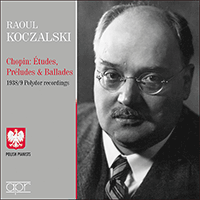


Raoul Koczalski (1885-1948) has often been regarded as a controversial figure amongst the great pianists. He began his career as a child prodigy and his most important teacher was the Chopin pupil Karol Mikuli. Mikuli regarded himself as the true heir to Chopin’s playing style and Koczalski was to go on to present himself in the same way. He was best known in Germany where he made his recordings, the most important of which are those presented here. His playing certainly fits many descriptions of Chopin’s own with its emphasis on clarity, legato touch and emotional reserve, but to the next generation he sounded old fashioned. Today we can reconsider his playing in a historical context, suspend our expectations, and consider this may well be the nearest we can get to Chopin’s own sound world.

Koczalski was born into a family whose origins were claimed to date back to 1360. The Koczala-Koczalski family originated from the village of Koczala, located in Pomerania, but later the family moved east to settle on estates in Ukraine. Raoul’s grandfather and father were lawyers and land administrators who lived in Warsaw and it was in this city, on 3 January 1885, that Raoul Armand Jerzy was born. (Though 1885 appears in several official sources—and it’s possible Koczalski himself believed this to be his birthdate (it appears in his entry in the Nazi Germany Registration of Foreigners documentation)—it may be that his father, very early on, reduced his age by one year to make his prodigy status even more impressive.)
In 1893 Koczalski, as a boy of eight, began his four-year period of studies with Mikuli on a daily basis during the summer months. At this point in his career, Koczalski was already a child prodigy having given his first public performance in Warsaw at the age of three. Obviously a child of the highest precocity, at three and a half he had begun studies at the Warsaw Conservatory with Julian Gadomski and after the success of his first recitals, as is often the way in such situations, Raoul’s father gave up his job to focus on his son’s career. Koczalski gave his Paris debut in 1889, and the following year played two movements from Beethoven’s Piano Concerto No 1 with his teacher Gadomski in Moscow. At seven he was playing in Belgium and made his London debut in 1893. The father created the son’s somewhat exaggerated publicity (including the addition of ‘von’ to the family name) and whilst on stage made Raoul wear the many medals and honours he had been given by the crowned heads of Russia and Europe. In December of 1893, when Anton Rubinstein played three recitals in Berlin, Koczalski and Josef Hofmann were two of the three guests of honour.
While the constant touring continued, the claims in the press became increasingly exaggerated. A tour of the United States, reported in 1894, never materialised, while a supposed meeting with Tchaikovsky and lessons with Anton Rubinstein and Leschetizky never happened. By 1904, and no longer a prodigy, the twenty-year-old Koczalski apparently needed a break from his constant work of performing and probably also from his father. He lived in Paris, giving very few concerts and concentrating on his compositions. His opera Rymond had been performed in 1902 and a second opera, Die Sühne in 1909. From then on, he continued his performing career, by this time specialising in the works of Chopin. The years between the Wars were not easy for Koczalski as critics invariably compared him to his former self, usually unfavourably. According to the Times, Koczalski had last appeared in London as a prodigy in 1900. He would have been 15 at the time, so hardly a child:
We went to the first of M. Koczalski’s four recitals of Chopin at the Aeolian Hall yesterday hoping all things. M. Koczalski had not played in this country for over twenty years; he is a Pole who has specialised in the greatest of his country’s masters. Now he offers us four afternoons of Chopin, and began yesterday with the Sonata in B minor, played with the book on the desk before him, with a touch which can be exquisite and an air of leisured thought which seemed to despise all the obvious devices of the bravura pianist. Hopes rose, and we thought at last we were to be given the real thing. But they fell as the performance progressed, because though M. Koczalski is a player of quite exceptional powers (he can do with a Chopin scale or ornament what only Pachmann at his best could do with it) it soon became clear that he is no more superior to the gloss on the text or the pitfalls of personal interpretation than other performers are. His are different from those of other performers, but often quite as unlike what Chopin wrote.
(The Times, 21 November 1924)
The latter part of the 1920s saw Koczalski performing in Berlin and spending time in Italy and Paris playing less in public and possibly studying musicology and philosophy at the Sorbonne. In the mid-1930s he settled in Germany, probably due to the opportunities afforded him of performance and recording. He also received excellent notices wherever he played in Germany. It was at this time that he embarked on a major recording project to set down the works of Chopin for the German Polydor company.
After the death of Vladimir de Pachmann in 1933, Koczalski became the favoured Chopin player of the time in Europe, but by the time hostilities ceased between Germany and the rest of the world in 1945, Koczalski was at the end of his career and life, and Arthur Rubinstein was already fulfilling that role in the United States and elsewhere.
Much has been written about Koczalski’s recordings as revealing the true and authentic way of playing the works of Chopin. This stems both from the fact that Koczalski studied with Chopin’s pupil Mikuli and that Koczalski’s recordings contain many of the aspects of performance detailed in the writings of the pupils of Chopin. It is true that Koczalski’s approach to Chopin reflects much of what was written, and Mikuli himself felt he carried the flame of real Chopin interpretation, passing it on to Koczalski. If we read some of these comments—particularly those by Mikuli, later published by Koczalski—and then listen to the recordings, we cannot help but hear what is described. Another Chopin pupil, Georges Mathias (1826-1910), wrote:
As to Chopin’s method of teaching, it was absolutely of the old legato school, of the school of Clementi and Cramer. Of course, he had enriched it by a great variety of touch; he obtained a wonderful variety of tone and nuances of tone.
Polish pianist, and also a Mikuli pupil, Aleksander Michałowski (1851-1938) wrote:
According to Mikuli, Chopin played with a delicate touch, avoiding strong and shrill accents. He never dazzled by pure technique, nor overpowered by sheer sonorous power. He could not bear too loud a sound from the piano and called it ‘a dog barking’.
Indeed, one could imagine Chopin wincing at some current performances of his works, if he could hear them! Author of Frederic Chopin, Life and Letters Maurycy Karasowsky (1823-1892) wrote that:
Chopin had a horror of all exaggerated accentuation, which, in his opinion, took away the poetry from playing and gave it a sort of dry pedantry.
But it is when we read what Mikuli wrote about Chopin’s playing that we find a symbiotic match with Koczalski’s style heard through his recordings:
For all the warmth of Chopin’s temperament, his playing was always measured, chaste, distinguished and at times even severely reserved. In dynamic shading he insisted on a real and exactly graduated increase and decrease of loudness.
There are similar quotes from other pupils and acquaintances of Chopin that correspond to Koczalski’s keyboard style. Jan Kleczynski (1837-1895) who met many of Chopin’s friends and pupils wrote that ‘the style is based upon simplicity, it admits of no affectation, and therefore does not allow too great changes of movement’. Adolphe Gutmann (1819-1882), a favourite pupil of Chopin, wrote that ‘Chopin played generally very quietly, and rarely, indeed, hardly ever, fortissimo’.
When we listen to Koczalski’s recordings we can readily agree that he follows many of these precepts.
There is no doubt that Koczalski absorbed all of these attributes from his teacher, and while we can hear much of it in the recordings it should be remembered that Mikuli had another important student in Moriz Rosenthal (1862-1946):
I must confess that I consider Mikuli as the most important of all pupils of Chopin. I made his acquaintance or rather was introduced to him when I was a boy of ten. I studied under his personal care and guidance for two years (1872-1874) and heard him very often. I never heard such a perfect legatissimo. It was an inheritance of his great master, and he gave me the secret, how to study it, at the beginning of his teaching.
(Rosenthal letter to Herbert Hughes, 1927)
No two pianists could sound more different than Rosenthal and Koczalski. Writers have cited the fact that after Mikuli, Koczalski had no other teachers and therefore Mikuli was the only influence on his playing. However, Koczalski received tuition from Liszt pupil Eugen d’Albert in 1896 and, on the advice of Anton Rubinstein, may have taken lessons from Ludwig Marek, another Liszt pupil and the other teacher Rosenthal’s father considered as a tutor for his son. While Koczalski claims (in his book Frederic Chopin Conseils d’interpretation) that Mikuli said ‘Use the pedal with the greatest economy’, Rosenthal stated that ‘He also failed to give me sound instructions concerning the use of the pedals.’ Also cited is the fact that, after lessons with Mikuli, Rosenthal was a Liszt pupil and therefore his style was in the Liszt tradition of performance. Mikuli was present when the twenty-two-year-old Rafael Joseffy (1852-1915; later to become a Liszt student and teacher of the young Rosenthal) played Mendelssohn’s Variations sérieuses – ‘With what precision, with what refinement he plays everything. Too bad that he plays all the passage work half-staccato, in so-called jeu perlé, and neglects the precious legato. He learned that from his first teacher, Carl Tausig, who was an infallible virtuoso but was frequently guilty of neglecting the cantilena and the art of legato.’
Perhaps if Joseffy had played Chopin, Mikuli’s response would have been less favourable. When Hans von Bülow played Chopin’s B minor Sonata in Lemberg, according to Rosenthal, ‘most everybody deplored the dry and brittle cantilena, and the remark ‘szkaradnie’ (‘execrable’) could be heard many times.’ Apparently, Mikuli could not bear it and left the concert while Bülow was still playing.
So, while we have two pianists of diverging and opposing styles, both having the same teacher, perhaps there is some other reason one upheld the ‘Chopin tradition’ and the other not. Claudio Arrau claimed that ‘in Germany, a man named Koczalski was an idol. He played only Chopin. It was awful’.
Arthur Rubinstein wrote that ‘Koczalski is a pianist of yesterday’ and there, I think, is a possible explanation. The music of Chopin as performed by Rubinstein, Ignaz Friedman, Benno Moiseiwitsch, Alfred Cortot or Claudio Arrau was of their time in the years either side of the Second World War. Koczalski’s Chopin was to them ‘old fashioned’, a style from a previous era, ‘a pianist of yesterday’ as Rubinstein put it.
While Rosenthal and Koczalski were completely different pianists, they were also completely different personalities. Rosenthal was the grand seignior of the piano, a virtuoso titan of the keyboard who swept all before him, particularly in his youth (he did not make his first recording until he was 65 years old). Koczalski, from his childhood appears shy, retiring, plays without bravura, and could be perhaps a restrained personality more like Chopin.
The critic of the London appearance quoted above was specific about what he thought were the negative aspects of Koczalski’s playing: ‘We have rarely heard a good player let the rhythm of the finale of the sonata fall to pieces as completely as it did under his hands.’ After detailing some of the other works played, he states that in the majority of them ‘some irritating distortion marred the beauty’:
The Nocturne and the Berceuse were the two most free from such blemishes, but why, one asked make the Étude in thirds sound self-conscious by just overdoing the pauses between the phrases, why give way to the prevalent habit of inventing inner parts in the Valse in C sharp, or destroy the phrases of the Valse in A flat by a trick of hesitancy? There were things like these which contradicted Chopin …Koczalski recorded these two Waltzes at sessions for Polydor in 1924, the same year as the London recital. Recorded by the acoustic process they are not included in this release, but listening to them, it is difficult to hear what the reviewer heard. Was Koczalski by now a nervous performer? – worse things have happened to child prodigies or artists that had great acclaim at the onset of their career only to find it failing later.Interestingly, the reviewer noted that ‘M. Koczalski always had some music before him, but not necessarily that which he happened to be playing. Perhaps to have it there gives him a sense of security. It cannot have been needed for any other purpose, for whatever one may think of his judgement, there can be no doubt of the thoroughness of his knowledge.’
Can the reviewer in 1924 be of the same frame of mind as Arrau and Rubinstein? He may have felt that he had been rather harsh at the first recital. At the second he was ‘favourably impressed, as before, with his touch and sensitive rhythm, although the latter does not always stand the test of a slow tempo’. He continues:
So many liberties are taken with things like the E flat Nocturne or the A flat Ballade, that we experience a difficulty in bringing them under the rubric. On the other hand, the Tarantelle and the A flat major Polonaise are brilliant object lessons. When touch, which is sensibility under the firm control of good sense, is combined, as in this case, with an ample technique, we have music which gives the greatest pleasure to listen to, and we accept the gift without question.
(The Times, 28 November 1924)Koczalski’s style can sound old fashioned to 21st-century ears, as it did to mid-20th-century ones, but we are now at a point in history where we can hear recordings made during the last 120 years and place Koczalski’s art into perspective. In addition, after reading comments about Chopin’s own approach to the piano, many from Mikuli, we can enjoy these recordings while we hold on to the possibility that we could be hearing a delivery similar to that given in the 1840s during Chopin’s lifetime.
When listening to his discs, two salient factors are evident. First and foremost is the importance of cantilena—a beautiful legato tone, tastefully produced to emulate the bel canto vocal style of which Chopin was so fond. Second is the clarity of texture achieved by sparse use of the sustaining pedal. These two factors seem to be the most important that Koczalski inherited from Mikuli and Rosenthal’s statement on the cantilena confirms this. So, in works such as the Nocturnes, the Berceuse, many of the Études and Préludes with a combination of these factors, Koczalski sounds most comfortable and delivers satisfying and revealing performances. Where cantilena is not required, as in the weightier Études and Préludes and parts of the Ballades, the performance and interpretation are often less convincing.
There is no doubt that he had an excellent technique—the Étude Op 25 No 6 reveals this while the following Étude in C sharp minor displays all of Koczalski’s finest attributes, but in the last three barnstorming Études Koczalski’s playing can sound capricious and at times perverse. The Préludes are also uneven—No 4 is played faster than usually heard with some of the left-hand chords not pedalled, but No 6 impresses with control of tone and dynamics and is also musically satisfying. The Berceuse too, has the most wonderful filigree finger work and delicacy of delivery.
The Ballades have musical freedom, but most have aspects that prevent them from being totally successful and convincing as interpretations. Unusually, the second section of the G minor Ballade is bathed in pedal, but this seems to be the best of the four with an impressive final section unlike that of the second Ballade which sounds insecure. The accelerando to the C sharp minor section of the third Ballade seems unnecessary although he does achieve an impressive peroration. The fourth Ballade is the most perplexing to modern listeners with the opening theme given an unexpectedly fast delivery. There is a general lack of grandeur throughout, though Koczalski’s poetic touch is always present and there is no lack of virtuosity in the passage work and very demanding coda. Whatever reservations we feel, it’s worth pointing out that James Methuen-Cambell in his book Chopin playing regarded this performance as a ‘near-perfect reading’.
Finally, mention should be made of perhaps his most revealing recording of all, that of the E flat Nocturne, Op 9 No 2. Many scores of Chopin’s works belonging to his pupils have been preserved and it is not uncommon for Chopin to have added some variants which elaborate his published score. No work rivals the E flat Nocturne for the number of variants though, and Mikuli himself published a version preserving a very full set of these alterations. It is this version which Koczalski recorded. It greatly adds to the bel canto decoration, taking the work from one comfortably within the grasp of the amateur pianist to one only realizable by a true virtuoso. It is a perfect vehicle for all the best aspects of Koczalski’s playing.
If we turn to Cortot, we hear the things Koczalski does not seem to have, and that modern ears want to hear—drama, excitement and bravura. Koczalski seems to play by instinct, as a prodigy does, rather than thinking and working out a cerebral conception of a work. He excels in smaller scale works and, like de Pachmann, rarely sees the big picture of larger works which often lack a sense of overall direction. He does, however, appear to uphold the traditions of legato, textural clarity and dynamic restraint taught to him by his teacher Mikuli and therefore these recordings have an important place in the history of Chopin playing.
Jonathan Summers © 2026



