Welcome to Hyperion Records, a British classical label devoted to presenting high-quality recordings of music of all styles and from all periods from the twelfth century to the twenty-first.
Hyperion offers both CDs, and downloads in a number of formats. The site is also available in several languages.
Please use the dropdown buttons to set your preferred options, or use the checkbox to accept the defaults.
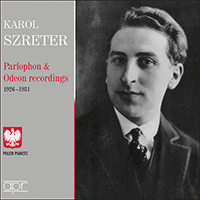


A generation before the now iconic Dinu Lipatti died of cancer at the age of 33, a much less remembered Polish pianist, Karol Szreter (1898-1933), died of the same disease at almost the same age.
A pupil of Egon Petri, his brief career began in central Europe and by the time of his death he was becoming acknowledged as a major figure in the pianistic world. His first recordings were made acoustically for VOX, and he was then taken up by the sister labels Parlophon and Odeon, the majority of whose recordings are presented here. Of note is the first electrical recording of Beethoven’s Piano Concerto No 4 and three further sonatas, and—reflecting a different side of his art—five brilliant Strauss transcriptions where he reveals his stupendous technique.

Born in Łódz on 26 November 1898 (though some sources have given 1899), Karol Szreter gave his first public concerts in 1907, but unlike many prodigies, wisely abandoned the platform at this time in order to allow his great natural gifts to mature. In 1912 he won a scholarship to that cradle of great pianists, the St Petersburg Conservatoire and studied for two years with an equally shadowy figure, one Professor Dubassoff. Szreter left Russia at the beginning of World War I and travelled to Berlin to study with the Busoni pupil Egon Petri (1881-1962), whose later pupils included Earl Wild and John Ogdon. It is highly probable, although not confirmed, that Szreter had some contact with Busoni himself during this period, and although not formally recog nised as a Busoni product, Szreter’s playing has a certain ‘family resemblance’ to others, such as Michael Zadora and Leo Sirota who were. At the end of the War, Szreter began his adult career with successful solo and chamber appearances in Germany and Central Europe, but his first tour of England had to wait until 1930. Unlike the majority of European debutantes, Szreter already had an established following in the UK due to the release of his recordings, most of which were positively reviewed in The Gramophone. Accordingly, when he made his London debut at the Grotrian Hall on 4 November 1930, expectations were high. The Daily Telegraph critic reviewed the concert and was not disappointed:
Another master pianist made his debut yesterday in the person of Karol Szreter. Thrice within the last ten days, one has listened to the Bach-Busoni C Major Toccata, and the greatest performance was undoubtedly Szreter’s. He is the artist, pur sang. His sense of tone gradation is of the subtlest, his rhythms as unfailing as his control of climaxes. Poland has sent us many fine artists and Karol Szreter must take a high place amongst them.
England obviously made as great an impression on Szreter as he had on the British public. He and his wife established a wide circle of friends and were even planning to make London their permanent home. Had death not intervened, he might well have become a keystone of British musical life, but it was not to be. Szreter had been suffering from leukaemia for some years but died in Berlin following a major operation on 20 March 1933, his last recitals having taken place in London at the end of January that year. Szreter’s series of Parlophone recordings therefore became his memorial, but within a few years, these discs had vanished from the catalogue and are now extremely difficult to locate. In the 90 years following his death, only isolated examples have ever been reissued and until these transfers, no systematic attempt has been made to evaluate his recorded legacy.
Apart from performances of major works by Beethoven, and Schumann’s Carnaval, Szreter’s recorded output consisted mainly of short genre pieces, and a series of fabulously difficult Strauss paraphrases—some of which are transcriptions by Szreter himself. Szreter’s most commercially successful discs—certainly judging by the numbers of surviving copies—are rather questionable versions of popular solo works arranged for piano and orchestra which seem to have been commissioned by his record label. Setting aside the six discs in this category and several chamber discs, this release includes Szreter’s complete recordings for the Lindström labels. Had Szreter lived a few more years things might have been different as Parlophone had planned to record Szreter in an extensive series of chamber and solo works to celebrate the Brahms centenary in 1933. As it turned out, only a few isolated movements were committed to disc, featuring Szreter with Daniel Karpilowsky, Boris Kroyt and Walter Lutz of the Guarneri Quartet. Generally, the technical quality of Szreter’s performance is very high, but he can be variable possibly owing to the precarious and worsening state of his health. It is true that some discs sound a little earthbound, but only in comparison with other recordings such as the paraphrase on Künstlerleben, a beautifully shaped and technically stupendous performance. Musically, perhaps his most interesting discs are of Beethoven, particularly the G major Piano Concerto. Szreter must be one of the few pianists on record to play Anton Rubinstein’s cadenzas, instead of the more usual ones by Beethoven.
Judging from his obituary notice, which appeared in the June 1933 edition of The Gramophone, Szreter’s personal qualities were as respected as his pianism, but praise was not universal. In his autobiography From Russia to the West, Nathan Milstein recounts a rare anecdote about Szreter concerning an encounter with Rachmaninov after a duo recital with Piatigorsky:
Berlin with the young Polish pianist, Karol Szreter. Rachmaninov was there too; after the performance Szreter wanted to approach Rachmaninov to ask for his impressions. Piatigorsky warned: ‘I don’t recommend it; Rachmaninov might tell you the truth.’ Piatigorsky knew Rachmaninov was not overly generous with praise. A simple ‘good’ was about the highest encomium one could expect from his lips, but Szreter simply had to find out Rachmaninov’s opinion. Trembling he approached him and said: ‘Sergei Vassilievich, how did I play?’ The reply was brief and to the point: ‘Very badly!’ Judging by the quality of performances featured on this disc, Rachmaninov obviously caught Szreter on an off day!
Jonathan Dobson © 2026
Before recording for Lindström, Szreter made a series of acoustic recordings for German Vox both as accompanist and soloist. As an example of these we have included one of his seven extremely rare solo discs.
Michael Spring
Producers’ Notes
Parlophone discs of the mid/late 1920s have always been difficult to reproduce well. There is a variability that is generally absent from HMV recordings of the time. Everything from speeds and recording characteristics to acoustics and groove sizes can vary within the same set of records. The Beethoven Concerto was a nightmare to transfer. Speeds varied from around 82rpm down to 76rpm and in some cases during the sides themselves. These problems have been corrected as far as possible. It was also recorded in at least two sessions with different recording characteristics and for the last side the cutter stylus appears to have been changed, hence differing surface noise between sides. Again, I have tried to equalise things as much as possible. Nevertheless, it is a splendid recording of the piano. The orchestra fares less well but then it must be realised that this was one of Parlophon’s earliest electrical recordings and ‘new’ technology for the engineers.
Of the other recordings, most reproduce the piano surprisingly well for the time. The Schumann Carnaval was recorded a little too distantly, perhaps to try and reproduce the concert-hall sound although with repeated hearing I find it rather suits the music. In a few places, particularly in the ‘Pastoral’ sonata, there is a resonance on certain chords that produces a slight metallic sound. This is likely to be a cutter-head fault or possibly a loose microphone component.
With grateful thanks to Alan Vicat Jonathan Dobson and Paul Steinson whose magnificent collections were ‘raided’ to enable this tribute to a great pianist to become a reality.
Roger Beardsley © 2001
The previous release of these re-mastered recordings on the Pearl label incorporated certain enhancements that were judged expedient at the time, but which now warrant some explanation. A small amount of stereo reverberation was added, perhaps to adapt the unusually ‘dry’ acoustic of the Concerto recording to contemporary taste. However, the effect seems to have been retained for most, though not quite all, of the other recordings too. Since it is impracticable to remove reverberation effectively, I have retained the slight stereophonic character it gives to these recordings rather than folding the audio down to mono which would only undermine the benefit the reverberation was intended to afford.
The rather distantly recorded sound of Carnaval was also adapted for the Pearl release with an attempt to dynamically augment the weakness of the piano’s low register. However, this alteration was not altogether successful and, as it introduced various untoward sonic peculiarities, I have aimed as best I can to restore the original sound balance.
Andrew Hallifax © 2026



