Welcome to Hyperion Records, a British classical label devoted to presenting high-quality recordings of music of all styles and from all periods from the twelfth century to the twenty-first.
Hyperion offers both CDs, and downloads in a number of formats. The site is also available in several languages.
Please use the dropdown buttons to set your preferred options, or use the checkbox to accept the defaults.
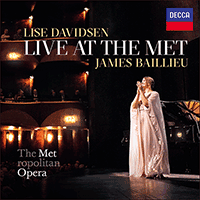

Beautifully recorded at The Metropolitan Opera in Manhattan, the programme here shows just why Lise Davidsen is so widely regarded as the soprano of the moment.


MET general manager Peter Gelb’s invitation to appear in recital was a dream come true for Davidsen. “I consider the MET my second home,” she says, “but that doesn’t mean one will be asked for something so special as this, so I was very touched when Peter asked me.”
For Davidsen, the biggest difference between performing in opera and in recital is that “you can’t hide behind a character. It’s much more naked and personal. That can only happen if one is ready for it, sharing from oneself in a direct way and being open with—and to—the audience.”
The soprano relished putting her MET program together. Singing for an audience used to full orchestra meant finding “repertoire that also worked with piano without falling through completely in a space like the MET.” Including some highlights from her MET roles was important to both Davidsen and Gelb. The soprano was eager to include a variety of song literature, plus some lighter pieces from the world of operetta and musical theatre.
Davidsen was immeasurably grateful for the warmth of the audience, and for their rapt attention. Even in the MET’s huge auditorium, she never felt alone onstage. In fact, she found it “weirdly intimate, even if I looked out at a very big audience. I worked hard to make sure we kept the intimate feeling and the personal approach, because I wanted to present a different side of me and also hope that the audience got to know me a bit more.”
Davidsen was an ideal choice for a MET recital, says Gelb, whose MET tenure to date has included numerous solo recitals by artists whose careers have been truly “in the ascendant—particularly those who either hadn’t made a New York recital debut, or if they had, were ready for the bigger stage of the MET. There are so few recitals given here, so each one is very special.”
Gelb considers Davidsen “the greatest Wagnerian talent since Birgit Nilsson and Kirsten Flagstad. Her voice in the MET’s luxurious acoustics sounds extraordinary, with incredible beauty but also amazing power.” It deeply impressed Gelb that Davidsen was “capable of wrapping her voice around the nuanced subtlety of Grieg, Sibelius, Schubert and Strauss,” but also that she could “explode with power in ‘Dich, teure Halle’”. He also greatly admired Davidsen’s “extremely elegant and composed stage presence”. Although still in her 30s, “she’s the consummate artist”.
The recital includes a souvenir of Tosca, one of Davidsen’s most thrilling MET roles. Her “Vissi d’arte” is very touchingly phrased, and stunning in its pianissimo descent from the climactic high B flat. The other operatic excerpts include not only the soprano’s radiant “Dich, teure Halle”, but also her moving performance of Amelia’s Act Three aria from Verdi’s Un ballo in maschera, displaying both her magnificent upper register and her uniquely rich lower-middle range. Let’s hope that Ballo will eventually figure in Davidsen’s repertoire at the MET, where she’s already scheduled for several other Verdi roles in future seasons.
The four Strauss songs included here have been sung by seemingly every voice type, but they really belong to sopranos. Strauss’s entire career was, in no small part, a love affair with the soprano voice! No doubt he would have applauded Davidsen’s mastery of these songs, whether in the magical combination of intimacy and expansiveness in Allerseelen and Befreit, the fervent open-heartedness of Zueignung, or the exquisite restraint and sincerity of Morgen!.
Like her Strauss group, the Schubert songs are among the most beloved pieces in recital literature. Particularly outstanding are the intense emotional commitment Davidsen brings to Gretchen am Spinnrade and her spellbinding legato control in Litaney auf das Fest Aller Seelen, where she reduces her large-scale instrument to a thread of luminous tone.
where she reduces her large-scale instrument to a thread of luminous tone. In the MET program, it was a great joy for Davidsen to include seven songs by her compatriot, Edvard Grieg. These pieces, already available on Decca in Davidsen’s all-Grieg recording, have been omitted here, with one exception: Våren, sung as an encore. She gives it a dignity and eloquence worthy of Flagstad and Nilsson, both of whom excelled in this song. “I loved singing Grieg at the MET,” says Davidsen. “It felt so unique – a once-in-a-lifetime experience.”
Surely Davidsen’s recitals internationally will continue to champion not only Grieg, but also Sibelius. For the MET program, she performs four Sibelius songs in Finland Swedish (“it’s not so far from my own language,” she notes). She revels particularly in Var det en dröm?, with her burnished tone doing full justice to the song’s flowing buoyancy (Davidsen’s exceptionally gifted recital partner, South African pianist James Baillieu, is especially brilliant here). In both Flickan kom ifrån sin älsklings möte and Svarta rosor, Davidsen offers splendid textual projection, and the latter unleashes the full force of her instrument to electrifying effect.
The soprano reveals her lighter side fi rst with the entrance song of cabaret singer Sylva Varescu, heroine of Kálmán’s much-loved operetta, Die Csárdásfürstin. Davidsen perfectly captures not only the smouldering quality of the opening phrases, but also the enormous vigour of the Hungarian dance rhythms that follow, where you’ll hear the audience clapping in rhythm. Turning to My fair lady, Davidsen hugely enjoys Eliza Doolittle’s joyous declaration that she could have danced all night (she even ends the song with an effortless interpolated high C). Judging from her listeners’ vociferous response, they surely could have listened to her all night and still begged for more!
Roger Pines © 2026