
Welcome to Hyperion Records, a British classical label devoted to presenting high-quality recordings of music of all styles and from all periods from the twelfth century to the twenty-first.
Hyperion offers both CDs, and downloads in a number of formats. The site is also available in several languages.
Please use the dropdown buttons to set your preferred options, or use the checkbox to accept the defaults.


‘All water flows down mountains. All rivers run to the sea.
If you follow the mountains and rivers, you will find the poets …
Their songs awaken the dragons, lifting mountains and rivers to the sky.’
(Wáng Píng)
Xiaogang Ye (Yè Xiǎogāng, 叶小纲) was born in Shànghǎi in September 1955. He studied with his linguist father, the gifted opera, film, theatre and symphonic composer Yè Chūnzhī (Ip Shun-Chi to British Hongkongers), going on to train in ballet from the age of six. His mother, Hé Shuǐyīng, instrumental in his early twenties for encouraging him to compose, was a singer. The turmoil of Máo Zédōng’s Cultural Revolution (1966-76), sociopolitically purging Western music and values from the landscape, scarred his teens: his father was sent to a labour farm, Ye himself to a factory. Deprived of a piano, waiting for the violence, persecution and chaos to stop, he recalls the decade and its ‘sent-down youth’ movement as a ‘boundless sea of bitterness’. Between 1978 and 1983, one of only twenty-six selected from 2,000 composition applicants, he studied with Dù Míngxīn (Moscow taught) at China’s re-opened Central Conservatory of Music in Běijīng, his peers including Tán Dùn and Zhōu Lóng, two years ahead of him, as well as Chén Yí, Chén Qígāng and Guō Wénjǐng. In 1980 he encountered the radical new-blood thinking and analytics of Alexander Goehr, the first Western composer to teach in Beijing following the Revolution. Subsequently (1987) he went to New York with a scholarship to the Eastman School of Music at the University of Rochester, studying with Samuel Adler and Joseph Schwantner, further independent input coming from the (very different) Dutchman Louis Andriessen. He returned to China in 1994, the following year, aged forty, joining the German publishers Schott Music, their first Chinese signing.
Ye has been described as ‘a quicksilver personality who laughs wryly, exudes determination and likes to dress in black’ (Didi Kirsten Tatlow, New York Times, 16 May 2012). Literary focused, he speaks and writes profusely. Conscious that there is always room to educate and enlighten, concerned that ‘today there are still people being crushed, who can’t publish their works, and not just one or two’, he’s been for some years a polarising force in China’s cultural and academic life, pursuing key educational and leadership roles with the China Federation of Literary and Art Circles and the China Musicians Association as well as Standing Committee membership of the 11th-13th Chinese People’s Political Consultative Conferences (2008-23). Founding Dean of the School of Music, The Chinese University of Hong Kong, Shēnzhèn (2021), he’s held a number of high-profile professorial positions and honorifics at home and abroad, including a Guggenheim Fellowship (2012), vice-chair of UNESCO’s International Music Council Executive Committee (2019-21), and election to the American Academy of Arts & Sciences (2020). In 2002 he established the Běijīng Modern Music Festival, supported by the Ministry of Education and the Ministry of Culture and Tourism hosted by the Central Conservatory. This was followed in 2017 with the diverse, crossover Shēnzhèn ‘Belt and Road’ International Music Festival connecting Asia with Europe in the ‘treasure ships and friendship’ (Xí Jìnpíng) spirit of the old ‘Silk’ trading routes—the October 2025 edition comprising 21 productions, 29 concerts and ‘high-end’ soloists and ensembles small and large from around 30 countries (upwards of a thousand performers in 2023) with over 60% of the repertory featuring premieres. Since 2013 his ‘China Story’ concert series has promoted contemporary Chinese music, the Chinese message, worldwide.
‘First, you must have a sympathetic and kind heart; second, you have to be highly skilled and well trained; third, you have to be able to capture very delicate inspirations.’ Ye’s eclectic catalogue is industrious. Seven symphonies, of which the 85-minute Fifth for soloists, narrator and orchestra (encompassing, like the Second, traditional instruments), subtitled Lǔ Xùn (2017), references the pen name of the iconic Chinese writer Zhōu Shùrén (‘the greatest Asia produced in the 20th century’ in Ōe Kenzaburō’s estimation) whose short stories ‘fascinated’ and nourished Ye during his Cultural Revolution period. Various concerto-type statements, most celebratedly Starry Sky for Láng Lǎng, commissioned for the opening ceremony of the 2008 Běijīng Olympics with additional electronics (omitted in the concert version) by Zuǒ Háng, Ye’s student at the Central Conservatory—a choreographed occasion that reached a global television audience of billions. Chamber music. Award-winning film and television scores. Ballet, dance. Vocal works, including The Song of the Earth for soprano, baritone and ethnicised orchestra (2004), setting the Táng Dynasty poems Mahler used for Das Lied von der Erde but in their original Chinese. Opera, notably Song of Farewell—addressing LGBTQ issues and inspired by the 1993 ‘Fifth Generation’ Chinese film Farewell my Concubine based on the novel by Lilian Lee—premiered at the 2010 Běijīng Music Festival.
‘Music is meant to be heard, rather than studied.’ Post-Cultural Revolution, China’s young composers, Alex Ross reminds, ‘Westernised themselves at high speed, consuming serialism, chance procedures, and other novelties. In so doing, they came up with fresh and vital combinations of sounds, especially when they added to the mix the clear-cut melodies and jangling timbres of traditional Chinese music’ (‘Symphony of Millions’, New Yorker, 30 June 2008). Study in Europe and the United States expanded horizons further still. Patriot, civic messenger, neo-Romantic epitomises Ye. Sentiment and imagery, spiritual dreameries, course through his work. Casting medallions of sound and high-carat melody in kaleidoscopically scenic succession, quasi tone/mood-poem-like, he bridges and blends the Euro-Asian cultural divide with elegance, knowing when to stop, rarely outstaying his welcome or indulging gesture, inhabiting a world where the order of the hour is integration rather than imposition. On the one hand, ‘postcard’ echoes of Stravinsky, Debussy, Ravel, Respighi, Richard Strauss, the Caucasian, northern European and Albion folklorists, Copland-ish frontiersmen, backcloth his invention, clothed in opulent, richly veined orchestration, finely inked solo lines calligraphed into the canvas; on the other, a core Chineseness rooted in harmony, philosophy, nostalgia, folksong, instruments, legend and landscape, the open grasslands of the Great Steppe, a passion for descriptive titles, compacting the bedrock.
‘The curiosity human beings have for the ancient, yet still unknown, things in this new century, the concern for the inter-dependent relationship between human beings and Nature, and humans’ longing for beauty’ (Maureen Buja, ‘Tropical Plants: Some Music by Yè Xiaogang’, Interlude, 6 October 2025) occupies him. Irrespective of era, the Chinese poets of his heritage, he’s pointed out, ‘have always taken inspiration from Nature. No matter how hard their life is, for example, they were always very civilised people. They wanted to serve the people, as court officials and so on. Most of them failed—when they cannot do what they wanted, they always used poetry to express their feeling. But they don’t say “my life is hard” they just say, “the rivers still flow, it’s still dark” … They used words very subtly, very beautifully, to express deeper meanings. People in China understand this. When they say “the cloud is wide, the moon is rising high,” they know their lives are not good. Like Chinese painting, they leave so much [whiteness]. It gives space for your own imagination. That’s the way it’s done.’ (Maureen Buja, ‘Tropical Plants: Some Music by Yè Xiaogang’, Interlude, 6 October 2025) Melodically, he’s sensorially modal, his vocabulary gravitationally polarised. ‘In my compositions,’ he says, walking in Janáček’s footsteps, ‘I emphasise certain syllables based on the logic of the Chinese language, using variations in dynamics, note duration, register, and range to convey emotion.’ (Keynote speech, 2nd Liángzhù Forum, Hángzhoˉu, November 2024) The particularised rhythms and rituals of Chinese/Beijing Opera have also influenced him.
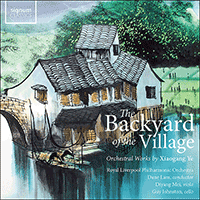
‘Music inspirations come from life observations.’ The Backyard of the Village (2019), written in a week, was commissioned by the Qiántáng River Culture Festival, their proposal calling for a ‘representation’ of the scenery and ‘transformed’ local villages around Hángzhōu, Zhèjiāng Province, additionally ‘the new spirit of today’s Chinese farmers in the area’. Incorporating folk elements from the East China Sea Háng-Jiā-Hú coastal plain, with which the composer had been familiar in childhood, helps characterise this ‘assigned task’. Fingerprints abound: the rhythmic and metric liberty of the germinal opening flute solo (each bar unpredictable); the deployment of long pedal-points; the sharp contrasts of lyric poise and communal zest; the distinctive corporate timbre of piano, celesta and harp within the orchestra. Variation patterns, largely but not exclusively timbral or dynamic in substance, determine the foreground of the music, the ‘reprise’, placed at the Golden Section of the whole, dissolving in a magical sunset. Premiere: 23 July 2019, Běijīng, China National Symphony Orchestra, Shào Ēn conductor.
The Memories of Mount Jing Gang (2019) was commissioned by the China National Orchestra. The ridges and ravines of the Jǐnggāng massif, eastern China, lie in the border region of Jiāngxī and Húnán Provinces. Here, during the first days of the Chinese Civil War, Máo Zédōng led his newly formed Chinese Workers’ and Peasants’ Red Army against the forces of the ruling Guómíndǎng party (See Péng Déhuái, Memoirs of a Chinese Marshall [1898-1974], autobiographical notes, Beˇijīng, 1981), penning a poem in the autumn of 1928 (Jǐnggāngshān): ‘Below the hills fly our flags and banners,/Above the hilltops sound our bugles and drums./The foe encircles us thousands strong,/ Steadfastly we stand our ground./Already our defence is iron-clad,/Now our wills unite like a fortress. From Huángyáng jiē roars the thunder of guns,/ Word comes the enemy has fled into the night’. In his programme note, Ye writes that the work ‘showcases the great history of Mount Jǐnggāng, eulogizes the unwavering faith of the Jǐnggāng Spirit, and projects an image of the ideal monument that the forefathers built with their lives and efforts, expressing a firm and resolute spirit that echoes the saying “an insignificant cause can have a massive effect”’. His conception is lyrical and broad-paced, in the form of a predominantly contemplative 118-bar concert-piece for viola, but with a closing chapter (again at the Golden Section) that’s initially militaristic before dying away in a forest twilight stabilising F major save for the frost of an enharmonic minor-third suspended high in the solo part. Filtering the music are transpositions/segments of a wistful pentatonic melody in the shāng mode. Premiere: 13 November 2019, Běijīng, Méi Díyáng viola, China National Symphony Orchestra, Tán Lǐ Huà conductor.
‘In Memory of the 300,000 Chinese ordinary people massacred by the invader’s army in Nánjīng in 1937’, My Faraway Nanjing (2005) was published in 2018. Prominent throughout Chinese history, dynastic to modern, Nánjīng, in the Cháng Jiāng (Yangtze) Delta region, was the scene of harrowing atrocities during the early stages of the Second Sino-Japanese War (1937-45)—the ‘Asian Holocaust’ for many. Arriving in January 1938, the American vice-consul James Espy chronicled a ‘reign of terror … unlimited depredations and violence … the breaking into and looting of property and of the burning and destruction of houses and buildings [around a third of the city laid waste] … men, women and children killed in uncounted numbers …’ A significant contribution to the cello repertory, Ye’s concerto has been described as ‘an important imprint of the Chinese nation’s spiritual history’ (China Now Music Festival, ‘Facing the Past, Looking to the Future’, New York, October 2018) From the onset, it establishes a tenebrous atmosphere. A lone bassoon prefaces pizzicato cellos and double-basses. Minor thirds, fourths and tritones decide the melodic intervals. The solo entry picks up on a (progressively cyclic) minor triad. Though in one movement, the work divides essentially into five sections. I, crotchet 94; II, Più mosso crotchet 100 (ponticello tremolando solo writing); III, crotchet 114 (agitated); IV, crotchet 96 (espressivo molto cantabile); V, crotchet 42 (rubato, including a brief cadenza of dynamically nuanced rising and falling glissandos). Ye leaves specifics—apprehension, attack, annihilation—to the listener’s perception. Only in the last nine bars, preceded by the silence of a Mahlerian luftpausa, does he drive the horror home: a screaming, chilling minor-ninth from the cello, fff; five axe blows from timpani and two bass drums; five solo pizzicato quadruple stops; emptiness; ‘whipping the bow in the air’—scything action, the flight of the soul—creating an enduring sonic and visual impact. Premiere: 22 October 2005, Běijīng, Zhū Yì-Bīng cello, China Philharmonic Orchestra, Yì Zhāng conductor.
‘Drawing inspiration from the natural environment,’ The Loquat in Five Colors (2024) is an overture for large orchestra including triple woodwind, quadruple brass, five percussionists, harp and piano. Commissioned by the Central Conservatory of Music, it upcycles an earlier work, the folkloristic Hebe Rhapsody, Op 84 (2018)—Héběi being a province of the North China Plain, north of the Yellow River, including within its borders part of the Great Wall (Míng Chángchéng). A note in the score tells us that ‘the loquat tree [pípá], with its graceful form, stands as a unique sight in nature … vividly conveying the composer’s vision of untamed, vibrant [exuberant] life forms’. The piece is ternary in design, optimistic outer sections (exposition, recall) flanking a central episode endowed with ‘big screen’ panoramas. Premiere: 20 October 2024, Vienna Konzerthaus, Central Conservatory of Music Symphony Orchestra, Chén Lín conductor.
Ateş Orga © 2026
The Memories of Mount Jing Gang: The composer once visited the Jinggang Mountains in the southeastern part of China, where fascinating legends have taken place and where young people have been inspired to step forward and strive for social advancement. Instead of recalling the excitement and splendor of history, this work expresses a heartfelt warmth and esteem.
For the final work on the album The Loquat in Five Colors, the composer travels to the north of China. The province of Hebei is filled with the legends of Chinese history and is the only province in China that is simultaneously blessed with sea, grasslands, mountains, rivers, lakes, countless royal gardens, majestic cities, and pastures. The composer expresses his own experiences and feelings in this overture.
Le Yu © 2026
