
Welcome to Hyperion Records, a British classical label devoted to presenting high-quality recordings of music of all styles and from all periods from the twelfth century to the twenty-first.
Hyperion offers both CDs, and downloads in a number of formats. The site is also available in several languages.
Please use the dropdown buttons to set your preferred options, or use the checkbox to accept the defaults.

Movement 1: Cantilene
[2'54]
|
||
Movement 2: Eglogue I
[2'21]
|
||
Movement 3: Eglogue II
[3'06]
|
||
Movement 4: Gigue
[4'27]
|
||
Movement 5: Dithyrambe
[2'54]
|
||
Movement 1: Allegro
[6'36]
|
||
Movement 2: Lento
[6'43]
|
||
Movement 3: Allegro
[5'04]
|
||
Movement 1: Andante assai
[6'50]
|
||
Movement 2: Allegro brusco
[6'59]
|
||
Movement 3: Andante
[6'49]
|
||
Movement 4: Allegrissimo
[7'20]
|

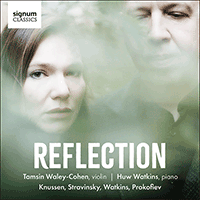
Knussen’s own musical universe was just as distinctive. Every note was carefully chosen, every colour perfectly tinted. He laboured for years over even the smallest pieces. Reflection, for violin and piano, would turn out to be Knussen’s penultimate completed work, and he offered his own thoughts on its creation:
This lyrical “morceau de salon”—written for Tamsin Waley-Cohen and Huw Watkins and dedicated to them—is made up of various kinds of musical reflection: melody reflected in its inversion; a six-note mode reflected in its complement; and between the three main parts of the piece, which are in a way varied reflections of each other.
There are some reflections in water, too: the main melody began as a response to Gauguin’s painting of a Breton woman swimming; and there is also, perhaps, an echo of the lonely underwater world of an ondine, eventually breaking the surface at the end of the piece.
Reflection, which lasts around eight minutes, was written at my home in Suffolk in August and September of 2016 and was first performed by the dedicatees on October 3rd of the same year at Town Hall, Birmingham.
Like many of Knussen’s later compositions, Reflection is small only in its duration.
Stravinsky Duo Concertant
Stravinsky met the Polish-American violinist Samuel Dushkin over dinner in Wiesbaden in October 1930. They’d been introduced by Stravinsky’s German publisher Willy Strecker, who was keen to obtain a Stravinsky violin concerto, and who assured the composer (in the words of Stravinsky’s biographer Stephen Walsh) that Dushkin was no prima donna virtuoso, but a “cultivated and dedicated musician of intelligence”. It was a shrewd move: Stravinsky was temperamentally allergic to old-style romantic violin virtuosity. “I had been a little doubtful” he recalled in his autobiography:
I was afraid of Dushkin as a virtuoso. I knew that for virtuosi there were temptations and dangers that they were not all capable of overcoming … Dushkin is certainly an exception in this respect among many of his fellow players, and I was very glad to find in him, besides his remarkable gifts as a born violinist, a musical culture, a delicate understanding and—in the exercise of his profession—a self-abegnation that is very rare.
In short, they clicked; first socially, and then musically. Stravinsky’s Violin Concerto (1931) was the result, and soon afterwards the two started to consider suitable material for a joint recital tour, with Stravinsky as pianist. Stravinsky began to assemble a duo programme (or as he jokingly called it, “un joli Kammerabend”), based largely around transcriptions of Pulcinella and Le Baiser de la fée, as well as brand-new, wholly original work for Dushkin: the Duo Concertant, completed in July 1932.
Stravinsky, by this stage, had an aversion to the routines of classical sonata form that was almost as strong as his dislike of romantic notions of the violin. The Duo, he said, was an attempt to resolve the problem of “the blend of strings struck in the piano with strings set in motion by the bow”. More tellingly he cited Petrarch and Virgil. The Duo, he said, was “a lyrical composition, a work of musical versification”: five musical poems that add up to a single whole, inspired by the ideals of classicism in its Greek sense. The opening Cantilène instantly redefines the title’s suggestion of songfulness; the two Eclogues that follow are pastorals, moving with eloquent poise between bright sunlight and dappled shade. The playful, Italianate Gigue provides a temporary release before a final Dithyrambe whose quiet ecstasy is all the more conclusive for being so superbly controlled.
Watkins Violin Sonata
When Huw Watkins’s First Symphony was premiered by the Hallé Orchestra in April 2017, it seemed to achieve the impossible: uniting classical form with an unmistakably modern voice to create music that gripped audiences, performers and critics alike. But it was wholly typical of Watkins’s musicality: his formidable imagination and his uncompromising desire to write music that lives, breathes, and makes its own way in the world.
“I’m aware that, on the one hand you’ll always get somebody in the audience who thinks it’s just horrendously modern and, on the other hand, you have your critics and other composers who think the opposite—that it’s too old-fashioned” he says. “So you can’t communicate with everybody but, yes, communication is absolutely important for me”. That communication extends to the concert hall, where—like Prokofiev and Stravinsky—he performs regularly as a pianist, both as a soloist and in partnership with fellow-musicians whose artistry he respects. His recording partnership with Tamsin Waley-Cohen extends back to 2013; together, they’ve explored the musical worlds of Mendelssohn, Elgar, Janačék, Beethoven and many other composers. In his own words:
My Violin Sonata (2019-2020) was written for Tamsin Waley-Cohen, one of my most long-standing duo partners; we gave its first performance at Wigmore Hall in November 2020. Its character and mood are influenced by some of the qualities I most cherish in her playing. Although each movement has some kind of cathartic climactic passage, the prevailing mood is often one of calm and introspection.
The first movement has, not too far in the background, a traditional sonata form structure. The first subject features many sustained fifths in the violin against which the piano plays more filigree figuration, reluctant to move away from pure, white-note harmony. The violin becomes more lyrical in the second subject, and the mood becomes more turbulent in the development.
The second movement alternates the sonata’s slowest and fastest music—a kind of slow movement and scherzo combined, perhaps in the manner of the second movement of Brahms’s A Major violin sonata. The piano is almost entirely in the treble clef, not going any lower than the violin’s G string until the movement’s climax.
The last movement, despite its tranquil ending, contains the most exuberant and earthy music of the sonata. Although it begins ethereally—the violin playing fragments in 5/8 over the resonance of the piano’s harmony—it quickly wakes up, the violin building energy with gritty minor seconds and brusque triple-stops.
© Richard Bratby
Prokofiev Violin Sonata No 1 in F minor Op 80
Prokofiev’s second violin sonata was actually his first. He had begun a violin sonata in F minor in 1938, before breaking off work, telling his fellow-composer Nikolai Miaskovsky that it was proving “difficult”. By the summer of 1946, he’d already completed a very different violin sonata: a transcription for violin of his Flute Sonata, Op 94, of 1944, published as his Violin Sonata No 2, Op 94b. That had been made at the instigation of the great Soviet violinist David Oistrakh, now, Oistrakh pressed him to return to the unfinished F minor Sonata. Working swiftly, Prokofiev completed it in time for a premiere by Oistrakh and the pianist Lev Oborin at the Moscow Conservatoire on 23 October 1946. The “difficulty” seems to have evaporated.
As well it might. By now, Prokofiev was the acknowledged leader of Soviet music; the wartime triumphs of the Fifth Symphony and the ballet Cinderella had left him in official favour to the extent that he’d even been able to buy a comfortable dacha at Nikolina Gora, in the woods west of Moscow. There he wrote the Sonata, with Oistrakh and Oborin visiting to play through the work-in-progress, which was developing into a four-movement piece in Prokofiev’s preferred, baroque-inspired (he cited Handel) slow-fast-slow-fast form. Prokofiev’s own description suggests a certain detached assurance:
The first movement is severe in character, and represents a sort of extended introduction in sonata form to the Allegro which constitutes the second movement; this Allegro is impetuous and wild, yet with a broadly-flowing secondary theme in the lower parts which constantly accompanies the principal melody. The third movement is slow-moving and mellow. The finale works up to a frenzied pace in a complex rhythm.
So far, so clear, and official critics at the premiere duly hailed a new masterpiece, with one claiming to hear in it “the meditation of an ancient bard on the fate of the Motherland”. Perhaps more meaningfully, Prokofiev’s colleagues were impressed too. “I don’t like prescribing overdoses” declared the composer Gavriil Popov on the night of the premiere, “but the sonata is truly brilliant”. And while modern listeners might struggle to hear anything of state-sanctioned optimism in this intense, muscular Sonata, it continues to leave a powerful impression—prompting some listeners to hear it as a musical commentary on the experience of war and Stalinism.
Prokofiev’s published words give no grounds for such an interpretation. His notes, however, tell their own story: whether the funereal tread of the first Andante, the coarse, biting down-bows of the Allegro brusco, or the dying fall of the final bars. Or, indeed, the eerie whispered scales that swirl, over tolling piano chords towards the end of both first and last movements. Prokofiev marked them freddo (cold), and privately compared them to an “autumn evening wind blowing across a neglected grave”. The Soviet state awarded the Sonata another Stalin Prize, but Oistrakh paid a very different tribute: seven years later he played its first and third movements at the composer’s funeral.
Signum Classics © 2026
Huw and I deliberated a great deal over how to record it. With works which inspired it, except we had already recorded many of those, or with other concert pieces by composers Olly loved, but no programme sat quite right with us and we kept on turning it over without conclusion. Finally, when Huw and I premiered his own spectacular sonata in November 2020, just before the long winter second Covid Lockdown, live-streamed from an empty Wigmore Hall, I knew that this was a companion work for the album. I count myself very fortunate to work with Huw.
The Prokofiev is a piece that Huw and I have toured extensively and the storytelling veering between the harshest realities and blackest humour juxtaposed with luxuriant beauty converses naturally with Olly’s sound world. The Stravinsky in its wilful strange humour and endless aural games is another piece that felt like a natural fit to us, and both are composers that Olly and Huw love, and I do as well.
I’d like to thank my sister Freya for planting the seed for Reflection, and this album, by suggesting we ask Olly to write us a piece for our ECHO Rising Stars tour.
Tamsin Waley-Cohen © 2026
