Welcome to Hyperion Records, a British classical label devoted to presenting high-quality recordings of music of all styles and from all periods from the twelfth century to the twenty-first.
Hyperion offers both CDs, and downloads in a number of formats. The site is also available in several languages.
Please use the dropdown buttons to set your preferred options, or use the checkbox to accept the defaults.


| Janine Jansen (violin), Boris Brovtsyn (violin), Amihai Grosz (viola), Maxim Rysanov (viola), Torleif Thedéen (cello), Jens Peter Maintz (cello)» More |
It was composed in just three weeks in September 1899, and took as its inspiration a poem by German poet, Richard Dehmel (1863–1920) from his collection Zwei Menschen. (Co-incidentally, Dehmel’s daughter Ilse married Korngold’s brother-in-law, Paul Sonnenthal, and Richard was a close friend of both composers.)
All of this is conveyed by the music in a sustained outpouring of rich, polyphonal, densely scored string-writing, maintaining an unremitting tension.
The work falls into five sections which roughly correspond to the five stanzas of the poem. The slow introduction in D minor sets the mood as in the first stanza of the poem. The ‘moonlight’ theme, a descending chromatic figure, is reminiscent of the opening of Liszt’s B minor Sonata which in its one-movement form may have provided Schoenberg with a blueprint for this work. After only twenty bars the harmony takes on a decidedly Wagnerian character—note the ambiguous chordal progressions which recall the opening of the famous Tristan Prelude.
An agitated and extremely tense accelerando leads to the woman’s speech (bar 29) ‘I carry in my womb a child, but he’s not yours …’, heard in the first viola. The music is dominated by a mood of guilt and self reproach, centred firmly in minor keys. At bar 50 the music changes, to prepare for the sudden introduction of a new, ardent theme in E major at bar 100 (‘now I have met you, ah you’).
The third section of the music is a spectral, grotesque scherzo (bar 124, ‘She stumbles on’), and graphically depicts the uncertainty of the woman as she wonders how her companion will respond to her confession. To reflect this sense of ‘walking blindly’, the harmony becomes even more ambiguous, almost tenuous, while the metre swings to 9/8 with the marking ‘Drängend etwas unruhiger’ (‘Hurrying on somewhat restlessly’). This marvellous, almost symphonic passage leads to the fourth section which introduces the male character. His first words—after the intensity which has gone before—are dramatically stated in a radiant D major (bar 230, ‘Let the child you have conceived be no burden on your soul’).
Schoenberg’s wonderful colouristic writing to reflect the lines ‘You are floating with me on a cold sea, yet between our two hearts there flickers some special warmth, from you to me, from me to you, that will bear that child to me, by me’ (bars 251–265) brings a glittering, transcendant quality to the music which alters the entire mood. The modulation to the rarely used, highly chromatic and brilliant key of F sharp major at this point ‘uplifts’ exactly, as in the manner of the poem.
The final section (bar 370), in the tonic major, presents the ‘moonlight’ theme, now ‘transfigured’ and accompanied by a colouristic,. bass, ever more yearning (bar 391, ‘Their breaths were joined in the air as they kissed’) and the delicate final coda is exquisite, as the earlier ethereal arpeggiatura (from the fourth section) is reprised. The work ends molto pianissimo, in D major.
Although scored deliberately for string sextet, the music palpably cries out for greater forces. Schoenberg recognized this and later re-scored it for string orchestra in 1917 (revising it in 1941); it is by this version which the work is best known.
The thematic material described above is sparse, economic, and used in the manner of the Wagnerian Leitmotif. The one-movement form is tightly constructed and there is no sense of waste or excess. ‘In music there is no form without logic, there is no logic without unity’, Schoenberg once observed, and it is nowhere more apparent than here. In his liking for the one-movement form (he exploited it particularly well in his monodrama Erwartung from 1909, which has certain plot similarities with Verklärte Nacht) Schoenberg unwittingly shared a compositional trait with Korngold, who also showed preference for condensing his ideas into a single unbroken movement: as well as a symphonic poem Sursum Corda, a Cello Concerto, the symphonic poem Morgen and the late Theme and Variations, Korngold composed a one-movement Piano Concerto for the left hand (for Paul Wittgenstein in 1923) which manages to encompass an astonishing range of mood and expression in a tautly constructed scenario that has been described (by pianist Gary Graffman) as a ‘keyboard Salome’. Innovative use of form and harmony then, was a striking characteristic of both of these remarkable composers throughout their careers, in spite of their differing views on how each should be used.
Verklärte Nacht owes much to the tone poems of Richard Strauss in the way it is developed, although a conventional analysis can be applied. Some scholars believe it to be set in a massive double sonata form, with the third section acting as a bridge between the two. I suspect that Schoenberg’s motivic scheme and thematic development is much more subtle than that, and is probably unconsciously done. In other words the entire work was composed without a preconceived plan and, like all great works, obeys an inner logic which conforms to a variety of analyses.
One of the most remarkable aspects of early Schoenberg is his mastery of harmony after such rudimentary training. It is known that his instruction under Zemlinsky was short-lived and that he was largely self taught. The earlier D major Quartet (written under Zemlinsky’s guidance in 1897) was a sort of ‘trial run’ for Verklärte Nacht, and would seem to have provided him with enough knowledge of instrumentation to attempt this large-scale and innovative work (although he had played cello in the Fröhliches Quintet in the early 1890s with Fritz Kreisler, and he also started an earlier Sextet ‘Toter Winkel’, a fragment of which still exists, running to 31 bars).
He admitted, in his Harmonielehre (first published in 1911) that when he wrote whole-tone passages (in Verklärte Nacht and later in Pelleas und Melisande) he was unacquainted with the use of the scale by Liszt, the Russians, or Debussy, or that he was even aware that he was doing it. By 1900, the finest examples in the String Sextet repertoire were by Brahms, and here in Verklärte Nacht we find Brahmsian elements too. The angular melodic leaps and the delicate frisson of the coda seem to suggest late Brahms. Did Schoenberg therefore unconsciously attempt to reconcile the famous conflict between Brahms and Wagner in this work?
Schoenberg was unable to attend the first public performance of Verklärte Nacht. He was in Berlin where, to support his wife and daughter, the struggling young composer was working at the Buntes Theater, as musical director of the Überbrettl, a kind of cabaret, which influenced his early cabaret-style songs and ultimately Pierrot Lunaire.
The conservative Viennese public and critical fraternity gave the work a rowdy reception. Schoenberg retreated, and started in new directions. His developments beyond the restrictions of tonality did not mollify the opposition however; as he once put it cynically, ‘I am a conservative who was forced to become a radical’. Later on, when asked why he no longer composed as he did when he wrote Verklärte Nacht, he replied: ‘I still do compose in the same way, but it is not my fault if people do not realize it.’
from notes by Brendan Carroll © 1990
Quelle influence le «récit» eut-il sur la sensation presque physique que j’ai éprouvée quand j’ai entendu pour la première fois le merveilleux sextuor à cordes Verklärte Nacht d’Arnold Schoenberg? J’ai été ensorcelé par la musique, sans connaître l’histoire derrière cette œuvre extraordinaire. J’ai été fasciné par la mélodie sobre, mais impressionnante, et par la délicate sonorité des cordes, qui tiennent l’auditeur en haleine du début à la fin. Sur le papier, cette œuvre, avec son atmosphère oppressante, est divisée en cinq parties; mais tous les interprètes la perçoivent comme une entité unique. On y entend des échos de Wagner et même de Brahms—l’espace et le temps semblent se rencontrer dans une tranquille harmonie. Il ne fallut que trois semaines à Schoenberg (1874-1951), qui était autodidacte, pour composer cette œuvre. Il avait alors vingt-cinq ans. Après la Première Guerre mondiale, quand il commença à être considéré comme le fondateur de la musique «nouvelle», il dut expliquer sans cesse pourquoi il ne s’en était pas tenu au style de sa jeunesse, préférant se lancer dans les aventures troubles de l’atonalité. Il répondait très sérieusement qu’il écrivait toujours dans le même style, mais que ses œuvres ultérieures étaient plus «mûres», et donc supérieures. Des générations de mélomanes ne partagèrent pas son avis. Ils aimaient le sextuor à cordes, et, plus encore, l’arrangement pour orchestre à cordes qu’en avait fait le compositeur lui-même.
L’«histoire» est du reste loin d’être superficielle. C’est un poème de Richard Dehmel (1863-1920), où deux amants marchent dans la forêt. La femme dit à l’homme qu’elle est enceinte de l’enfant de quelqu’un d’autre, mais qu’il sera néanmoins «leur» enfant. Si leur amour est assez grand, l’enfant sera transfiguré (c’est le sens du verbe allemand «verklären») en leur enfant. Nous revenons à l’idée de la musique à programme: les pas des amants sont audibles au début, et, ensuite, quand la musique n’utilise que le registre aigu des cordes, j’imagine qu’on peut entendre les sonorités argentées de la lune. Schoenberg lui-même disait qu’il n’avait pas tant essayé de raconter l’histoire que d’exprimer la puissance de la nature et des sentiments humains. À l’époque postromantique, la religion naturelle et les cultures spirituelles associées étaient très en vogue.
Avec une belle histoire et une musique magnifique, Dehmel et Schoenberg reflétaient donc l’esprit de leur époque dans Verklärte Nacht.
extrait des notes rédigées par Paul Witteman © 2012
Français: Dennis Collins
Wie sehr hat die “Geschichte” meine nahezu physische Empfindung beim erstmaligen Hören des wunderbaren Streichsextetts Verklärte Nacht von Arnold Schönberg beeinflusst? Ich war wie verzaubert von der Musik, ohne die Geschichte hinter diesem außergewöhnlichen Werk zu kennen. Ich war fasziniert von der gedämpften, aber beeindruckenden Melodie und dem delikaten Streicherklang, der den Hörer von Anfang bis Ende fesselt. Im Notentext gliedert sich dieses Werk mit seiner beklemmenden Stimmung in fünf Teile; doch alle Interpreten erleben es als eine Einheit. Man kann darin Anklänge an Wagner und sogar Brahms hören—Raum und Zeit scheinen in ruhiger Harmonie zusammenzufließen. Schönberg (1874-1951), der Autodidakt war, brauchte nur drei Wochen für die Niederschrift dieses Werkes. Er war 25 Jahre alt. Als er nach dem Ersten Weltkrieg als Begründer der “Neuen” Musik angesehen wurde, musste er immer wieder erklären, warum er nicht dem Stil seiner Jugend treu geblieben war, sondern sich in die trüben Abenteuer der Atonalität begeben habe. Er erwiderte darauf ernst, dass er praktisch immer noch im gleichen Stil schreibe, sein späteres Schaffen aber ”reifer” und daher besser sei. Generationen von Musikliebhabern stimmten dem nicht zu. Sie liebten das Streichsextett und sogar noch mehr Schönbergs Fassung für Streichorchester.
Übrigens ist die “Geschichte” selbst alles andere als oberflächlich. Es ist ein Gedicht von Richard Dehmel (1863-1920), in dem zwei Liebende durch den Wald gehen. Die Frau sagt dem Mann, dass sie mit dem Kind eines anderen schwanger sei, dass es aber dennoch “ihr” Kind sein werde. Wenn ihre Liebe hinreichend stark ist, wird das Kind zu ihrem Kind “verklärt” werden. Zurück zur Programmusik: Die Schritte der Liebenden sind am Anfang zu hören und später, wenn nur die oberen Lagen der Streicher verwendet werden, meine ich den Silberklang des Mondlichts zu hören. Aus jedem Ton geht der Adel der hier dargestellten Liebe hervor. Schönberg selbst meinte, er habe nicht so sehr versucht, die Geschichte zu erzählen, als vielmehr die Macht der Natur und der menschlichen Gefühle auszudrücken. In der Spätromantik waren Naturreligion und eine damit verbundene spirituelle Kultur sehr in Mode.
So spiegelten Dehmel und Schönberg in Verklärte Nacht mit einer wunderbaren Geschichte und der großartigen Musik ihren “Zeitgeist” wider.
aus dem Begleittext von Paul Witteman © 2012
Deutsch: Christiane Frobenius
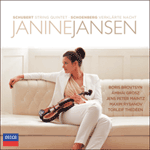 Schubert: String Quintet; Schoenberg: Verklärte Nacht Schubert: String Quintet; Schoenberg: Verklärte NachtStudio Master: 4783551Download onlyStudio Master FLAC & ALAC downloads available  Dutch violinist Janine Jansen is amongst friends in two of chamber music’s most important and influential works.» More |