Walton’s
Passacaglia was written—of course—for Rostropovich; has any player in history done as much to expand the repertoire of their instrument? The two men met, appropriately, at the Aldeburgh Festival. Walton reportedly asked Slava why he hadn’t played his concerto (one of the greatest of all cello concertos, incidentally). Slava’s response was typical: ‘You write me new work, and I play new work and old work.’ He didn’t keep his word about playing the old work, as far as I know, but he did play the
Passacaglia—eventually. Although written in 1979/80—Tony Palmer’s moving film portrait of Walton,
At the Haunted End of the Day, screened in 1981, shows the composer working on the piece, and playing the theme, very beautifully, on the piano—the
Passacaglia did not receive its premiere until 1982. The delay this time was not because Rostropovich was stuck in the Soviet Union, but because he was too busy rushing around the rest of the world; there were even newspaper articles printed at the time in which Lady Walton complained that, having composed this work for Rostropovich, Walton couldn’t get it to him! But eventually Slava did play it—twice—at a concert in London’s Royal Festival Hall on 16 March 1982, less than two weeks before Walton’s eightieth birthday. Again, I was there; unlike the Britten suite, this work made little impression on me—nor did it appeal particularly when I received the music some time later. But—awful though it may be to contemplate—I was wrong! More recently, I decided to try again—and was (gradually) captivated. It is not a sensuous work, but it has a strength and directness that is truly, unusually satisfying. The theme—somewhat reminiscent of
Theme for a prince in its wide intervals and open fourths—is succeeded by nine variations, Nos 1-6 growing in intensity, the seventh more lyrical (and featuring some very uncellistic left-hand pizzicato, some of which, I have to confess, I alter slightly). From that brief oasis, the energy resumes, the momentum building up to an exciting climax. Walton is reported to have considered the
Passacaglia as unsuitable for public performance, better suited to a private gathering—but then he said the same of the Bach suites, apparently. I beg to differ on both counts.
from notes by Steven Isserlis © 2021
Walton rencontra Mstislav Rostropovitch durant l’édition 1970 du Festival d’Aldeburgh lorsque celui-ci donna la
Sinfonia Concertante de Prokofiev durant le concert où les
Improvisations on an Impromptu of Benjamin Britten de Walton recevait sa première britannique. Ils se lièrent d’amitiés après un échange de plaisanteries au cours duquel Walton demanda à Rostropovitch quand il allait enfin jouer son concerto pour violoncelle, et ce dernier de répondre par un défi – si Walton lui écrivait une pièce nouvelle, non seulement il jouerait celle-ci mais aussi le concerto. Quasiment une décennie plus tard, en 1979, Walton s’attela à la composition d’une courte pièce pour violoncelle seule destinée à Rostropovitch, mais les progrès étaient désespérément lents car, avec l’âge, il lui était de plus en plus difficile de composer.
Intitulée Passacaglia, l’œuvre fut achevée l’année suivante. Durant sa composition, Walton avait gardé à l’esprit les œuvres pour violoncelle seul de Bach, si bien qu’il considérait que cette pièce convenait mieux à une exécution privée que publique. Rostropovitch donna la première audition à Londres le 16 mars 1982 au sein des festivités marquant les quatre-vingts ans du compositeur. La Passacaglia comprend un thème sombre suivi de dix variations. Les trois premières sont situées dans le registre grave de l’instrument tandis que la quatrième s’élance pour atteindre les sommets les plus aigus. Les variations cinq et six sont plus rapides, et dans la septième, des accords pizzicato accompagnent la ligne mélodique expressive. Les huitième et neuvième unissent leurs efforts pour réaliser un scherzo waltonien caractéristique par son allure et son rythme. L’œuvre prend fin sur une pléthore de notes, rapide et furieuse.
extrait des notes rédigées par Andrew Burn © 2002
Français: Isabelle Battioni
Walton lernte Mstislav Rostropovich 1970 beim Aldeburgh Festival kennen, als letzterer die
Sinfonia Concertante von Prokofiev in demselben Konzert gespielt hatte, in dem auch Waltons
Improvisations on an Impromptu of Benjamin Britten seine Premiere in Großbritannien erfuhr. Nach einem heiteren Geplänkel wurden sie Freunde: Walton fragte Rostropovich, wann er denn sein Cellokonzert spielen würde und letzterer antwortete mit einer Herausforderung – wenn Walton ihm ein neues Werk schriebe, würde er sowohl dieses als auch das Cellokonzert aufführen! 1979, also fast zehn Jahre später, begann Walton mit der Arbeit an einem kurzen Stück für Violoncello solo, das für Rostropovich gedacht war. Jedoch kam er nur sehr langsam voran, da ihm das Komponieren durch sein hohes Alter immer schwerer fiel.
Das Werk erhielt den Titel Passacaglia und wurde im darauffolgenden Jahr fertiggestellt. Während der Arbeit daran hatte Walton Bachs Werke für Violoncello solo im Hinterkopf und intendierte es eher für eine private Aufführung und nicht unbedingt für eine öffentliche. Rostropovich brachte es am 16. März 1982 in London im Rahmen der Feierlichkeiten des 80. Geburtstags des Komponisten zur Uraufführung. Das Werk besteht aus einem traurigen Thema, gefolgt von 10 Variationen. Die ersten drei sind im tieferen Klangregister des Instruments angesiedelt, während sich die vierte in die allerhöchsten emporschwingt. Die fünfte und sechste Variation sind schneller und in der siebten begleiten Pizzicato-Akkorde eine expressive melodische Linie. Die achte und neunte verbinden sich zu einem charakteristisch schnellen und rhythmischen Waltonschen Scherzo und das Werk endet in einer rasenden Tonfülle.
aus dem Begleittext von Andrew Burn © 2002
Deutsch: Viola Scheffel


 PERFORMANCE
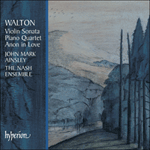 Walton: Chamber Music