
Welcome to Hyperion Records, a British classical label devoted to presenting high-quality recordings of music of all styles and from all periods from the twelfth century to the twenty-first.
Hyperion offers both CDs, and downloads in a number of formats. The site is also available in several languages.
Please use the dropdown buttons to set your preferred options, or use the checkbox to accept the defaults.



The Cello Sonata was the first of the sonatas to be finished, in the summer of 1915, and it was originally going to have a title: ‘Pierrot angry with the moon’. Although the work was written at great speed, Debussy was pleased with the result, telling Jacques Durand on 5 August 1915 that he liked ‘its proportions and form—almost classical in the good sense of the word’. As well as its links to a vanished past, the Cello Sonata has debts to more recent music, including the use of a cyclic theme. Debussy, who borrowed this device from César Franck, had already used it in his early String Quartet, but in the Cello Sonata there is greater refinement and delicacy in the way he handles the theme. The first movement opens with a gesture which introduces the motif that unites many of the musical ideas in the work (and which recalls Baroque ornamentation). The second movement is a ghostly serenade full of enigmatic harmonies, and this leads to a more flowing and animated finale that seems reluctant to settle until the closing D minor chords. The first known public performance of the work was given not in France, but at the Aeolian Hall in London on 4 March 1916, played by the cellist Charles Warwick Evans and pianist Ethel Hobday. The work was not heard in Paris until 24 March 1917, when the performers were Joseph Salmon and Debussy himself.
from notes by Nigel Simeone © 2025
La Sonate pour violoncelle et piano fut la première sonate terminée, au cours de l’été 1915, et, à l’origine, elle devait avoir un titre: «Pierrot fait fou avec la lune». Même si cette œuvre fut écrite très rapidement, Debussy fut satisfait du résultat et dit à Jacques Durand le 5 août 1915 qu’il en aimait «les proportions et la forme presque classique dans le bon sens du mot». Tout en ayant des liens avec un passé disparu, la Sonate pour violoncelle et piano montre l’influence d’une musique plus récente, notamment l’utilisation d’un thème cyclique. Debussy, qui emprunta ce procédé à César Franck, l’utilisa auparavant dans son Quatuor à cordes, mais dans la Sonate pour violoncelle et piano, il y a davantage de raffinement et de délicatesse dans la manière dont il manie le thème. Le premier mouvement commence avec un geste qui introduit le motif qui unit bon nombre d’idées musicales dans cette œuvre (et qui rappelle l’ornementation baroque). Le deuxième mouvement est une sérénade spectrale pleine d’harmonies énigmatiques, et cela mène à un finale plus fluide et animé qui semble peu disposé à s’apaiser jusqu’aux derniers accords de ré mineur. La première exécution publique connue de cette œuvre fut donnée non pas en France, mais à l’Aeolian Hall de Londres, le 4 mars 1916, interprétée par le violoncelliste Charles Warwick Evans et la pianiste Ethel Hobday. Elle ne fut pas jouée à Paris avant le 24 mars 1917, par Joseph Salmon et Debussy lui-même.
extrait des notes rédigées par Nigel Simeone © 2025
Français: Marie-Stella Pâris
Die Cellosonate war die erste der Sonaten, die im Sommer 1915 fertiggestellt wurde, und sie sollte ursprünglich den Titel „Pierrot zornig auf den Mond“ tragen. Obwohl das Werk in großer Eile geschrieben wurde, war Debussy mit dem Ergebnis zufrieden und erklärte Jacques Durand am 5. August 1915, dass ihm „die Proportionen und die Form“ gefielen, sie seien „fast klassisch, im guten Sinne des Wortes“. Die Cellosonate bezog sich nicht nur auf eine längst vergangene Zeit, sondern auf neuere Musik, unter anderem durch den Einsatz eines zyklischen Themas. Dieses Mittel stammte von César Franck und Debussy hatte es zunächst in seinem frühen Streichquartett verwendet, in der Cellosonate jedoch ist die Art und Weise, mit der er das Thema behandelt, raffinierter und feiner. Der erste Satz beginnt mit einer Geste, die das Motiv einleitet, das viele der musikalischen Ideen des Werks in sich vereint (und an barocke Ornamentik erinnert). Der zweite Satz ist eine geisterhafte Serenade voller rätselhafter Harmonien, die in ein fließenderes und lebhafteres Finale mündet, das bis zu den abschließenden d-Moll-Akkorden nur zögerlich zur Ruhe zu kommen scheint. Die erste bekannte öffentliche Aufführung des Werks fand nicht in Frankreich statt, sondern in der Londoner Aeolian Hall am 4. März 1916 und wurde von dem Cellisten Charles Warwick Evans und der Pianistin Ethel Hobday gegeben. In Paris war das Werk erst am 24. März 1917 zu hören, als Joseph Salmon und Debussy selbst auftraten.
aus dem Begleittext von Nigel Simeone © 2025
Deutsch: Viola Scheffel
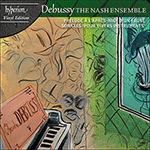 Debussy: Sonatas & Prélude à l'après-midi d'un faune - Vinyl Edition Debussy: Sonatas & Prélude à l'après-midi d'un faune - Vinyl EditionLPA68463  2025 marks The Nash Ensemble’s sixtieth anniversary: this all-Debussy programme of the three late sonatas plus an arrangement of the ‘Prélude à l’après-midi d’un faune’ proves that age ‘truly is just a number, and no barrier to probing, revelatory ...» More |