
Welcome to Hyperion Records, a British classical label devoted to presenting high-quality recordings of music of all styles and from all periods from the twelfth century to the twenty-first.

Hyperion offers both CDs, and downloads in a number of formats. The site is also available in several languages.

Please use the dropdown buttons to set your preferred options, or use the checkbox to accept the defaults.
Click cover art to view larger version
Track(s) taken from CDA68463

Sonata for flute, viola and harp, L145

composer
1916; No 2 of the (unfinished) set of six sonatas 'pour divers instruments'

The Nash Ensemble, Philippa Davies (flute), Lawrence Power (viola), Lucy Wakeford (harp)
Studio Master FLAC & ALAC downloads available
CD-Quality:
Studio Master:
Studio Master:
CD-Quality:
Studio Master:
Studio Master:
Recording details: December 2023
All Saints' Church, East Finchley, London, United Kingdom
Produced by Andrew Keener
Engineered by Oscar Torres
Release date: January 2025
Total duration: 17 minutes 12 seconds

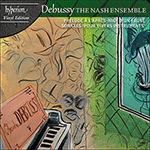
Cover artwork: Homage to Claude Debussy (1952) by Raoul Dufy (1877-1953)
Musée des Beaux-Arts de Nice / Manuel Cohen / akg-images
 

Reviews

‘In every respect, these are stronger readings than [The Nash Ensemble's earlier] Virgin Classics outing, not least due to the splendid recording in All Saints’ Church, East Finchley, a favoured Hyperion venue, produced by Andrew Keener. The sound is fuller and richer, the microphone placement closer, capturing more detail … I enjoy Gonley’s impetuosity in her finale and Brendel’s introspective brooding. Davies, Power and Wakeford are wonderfully animated in their sonata … aptly, Debussy’s Faune opens Hyperion’s programme in an exquisite arrangement by David Walter for wind quintet, string quartet, double bass, harp and crotales, which loses little from Debussy’s heady orchestral score … Debussy’s sole String Quartet ends the disc … the Nash’s fleet-footed reading is enormously enjoyable, as is this entire disc’ (Gramophone)

‘This recording demonstrates that age truly is just a number, and no barrier to probing, revelatory perspectives … the sound production throughout is impeccable: you can almost visualise the positioning of the players and the notes sailing upwards and hovering in languid circles above them. Musical lines pass in a single, continuous breath from one instrument to the next, and the sensual, dreamlike soundscapes are tinged with immaculately drawn moments of both despair and joy. An alluring and, in time, vintage recording’ (BBC Music Magazine)» More

‘The sensuous atmosphere of the mythical creature’s summer afternoon among nymphs and naiades [finds] new levels of intimacy in this arrangement by oboist and composer David Walter, and such a sensitive and deliciously coloured performance from The Nash Ensemble. Debussy’s String Quartet is here as well, but the other outstanding performances for me are the three sonatas, especially the contrast between Stephanie Gonley’s silvery sound in the Violin Sonata and the more muscular Adrian Brendel in the Cello Sonata … an excellent way to mark The Nash Ensemble’s sixtieth birthday’ (BBC Record Review)

‘The three sonatas out of a planned set of six that Debussy completed in the last years of his life are among the masterpieces of 20th-century chamber music, and it’s hard to think of a better way for the Nash Ensemble to mark their 60th anniversary than with a recording of these works, alongside Debussy’s String Quartet and an arrangement for 12 players of the Prélude à l’après-midi d’un faune … the performances of the three sonatas are all outstanding … great music played with all the warmth and understanding it needs’ (The Guardian)

‘Under the careful control of its co-founder, Amelia Freedman, the suave and buoyant Nash Ensemble has been enhancing our lives for so many years (60 to be exact) that it’s easy to take the group’s accomplishments for granted. This Debussy album sharply reminds us why we shouldn’t … sixty years have told us that with the Nash Ensemble’s musicians, whatever their repertoire, nothing can ever really go wrong’ (The Times)» More

‘Beautifully produced (Andrew Keener), beautifully recorded (Oscar Torres), beautifully composed (we knew that), beautifully played (we would expect nothing less from Nash Ensemble members) and beautifully presented (typical of this label), the performances are also penetrating and revealing as well as being the epitome of interactive music-making … from Faune to final track, this January release will be a New Year winner’ (colinscolumn.com)» More

‘For sixty years Amelia Freedman has been bringing together the finest musicians she can find in London to play chamber music as The Nash Ensemble and this superb album shows she has not lost her touch … one could not ask for a more integrated and accurate reading [of the String Quartet] than this—just listen to the pizzicato in the second movement or the veiled mistiness of the third. Can’t argue with this disc!’ (Eye On London)

‘Debussy’s String Quartet is a rather less volatile composition, though the Nash’s account here leans into the first movement’s pungent anticipations of Bartók-like dissonance and offers a nice foreshadowing of La mer’s billowing seascapes during the finale. In between come moments of whimsy—the second movement’s transformation of its opening theme charms the ear—and, in the Andantino, devotion. Filling out the album is David Walter’s arrangement of the Prélude à l’après-midi d’un faune. His is a lovely adaptation, though climaxes sometimes make it sound like Debussy’s faun has gone on a diet. Regardless, the Nash, here expanded to 12 players, does the transcription full, lush justice’ (The Arts Fuse, USA)
‘Where is French music? Where are the old harpsichordists who wrote so much true music?’ It was thoughts like these that prompted Claude Debussy to embark on a series of instrumental sonatas at the start of World War I. The teenage Poulenc, eager to acquire Debussy’s autograph, wrote to the composer in October 1915 (masquerading as a Belgian music critic) and Debussy replied: ‘This is a time when we should be trying to regain a hold on our ancient traditions: those whose beauty we have let slip from us, but which has not ceased to exist.’ It was in this frame of mind that Debussy set out to write a set of six sonatas. Weakened by cancer, he lived to complete only three of the planned set. According to his publisher Jacques Durand, it was hearing a performance of Saint-Saëns’s septet that inspired the composer to return to chamber music for the first time since the String Quartet. Debussy’s plans for the unwritten sonatas (Nos 4-6) are tantalizing: the fourth was to be for oboe, horn and harpsichord; the fifth for trumpet, clarinet, bassoon and piano; and the sixth combining all the instruments used in the previous sonatas, with the addition of a double bass.

Of the three completed sonatas, the only one scored for relatively unconventional forces is the Sonata for flute, viola and harp. Debussy toyed with the idea of scoring it for flute, oboe and harp but then decided to replace the oboe with the richer sonorities of a viola. The sonata is cast in three movements: a pastorale (marked ‘lento, dolce rubato’), an interlude (‘tempo di minuetto’) and a quick finale. In this astonishing work, the moods are often fleeting, the ideas quite fragmented, and the seemingly effortless exploration of instrumental colours gives the music a thrilling freshness. Its first performance was given at the New England Conservatory in Boston on 7 November 1916 and Debussy heard it at a private concert in Durand’s house on 10 December 1916. A performance in London (2 February 1917) was followed by the work’s French public premiere on 9 March 1917.

from notes by Nigel Simeone © 2025

«Où en est la musique française? Où sont nos vieux clavecinistes chez lesquels il y a tant de vraie musique?» Ce sont de telles réflexions qui poussèrent Claude Debussy à se lancer dans une série de sonates instrumentales au début de la Première Guerre mondiale. Dans son adolescence, Poulenc, qui voulait obtenir un autographe de Debussy, écrivit au compositeur en octobre 1915 (en se faisant passer pour un critique musical belge) et Debussy répondit: «En ce moment, nous devons tâcher à ressaisir nos vieilles traditions: celles-là dont nous avons laissé la beauté qu’elles n’ont cessé de contenir.» C’est dans cet état d’esprit que Debussy se mit à écrire un recueil de six sonates. Affaibli par le cancer, il ne put en achever que trois avant sa mort. Selon son éditeur Jacques Durand, c’est l’écoute d’une exécution du septuor de Saint-Saëns qui incita le compositeur à revenir à la musique de chambre pour la première fois depuis le Quatuor à cordes. Les projets de Debussy pour les sonates non écrites (nos 4-6) étaient séduisants: la quatrième était prévue pour hautbois, cor et clavecin; la cinquième pour trompette, clarinette, basson et piano; et la sixième alliant tous les instruments utilisés dans les sonates précédentes, avec l’ajout d’une contrebasse.

Des trois sonates achevées, la seule qui s’adresse à un effectif relativement peu conventionnel est la Sonate pour flûte, alto et harpe. Debussy caressa l’idée de l’écrire pour flûte, hautbois et harpe, mais décida ensuite de remplacer le hautbois par les sonorités plus riches de l’alto. Cette sonate s’inscrit dans un moule tripartite: une pastorale (marquée «lento, dolce rubato»), un interlude («tempo di minuetto») et un finale rapide. Dans cette œuvre étonnante, les atmosphères sont souvent fugaces, les idées très fragmentées et l’exploration apparemment aisée des couleurs instrumentales donne à la musique une fraîcheur exaltante. Sa création eut lieu au New England Conservatory de Boston, le 7 novembre 1916 et Debussy l’entendit lors d’un concert privé chez Durand, le 10 décembre 1916. Une exécution à Londres (2 février 1917) fut suivie de la première exécution publique française de l’œuvre le 9 mars 1917.

extrait des notes rédigées par Nigel Simeone © 2025
Français: Marie-Stella Pâris

„Wo ist die französische Musik? Wo sind die alten Cembalisten, die so viel wahre Musik geschrieben haben?“ Es waren Gedanken wie diese, die Claude Debussy zu Beginn des Ersten Weltkriegs veranlassten, eine Reihe von Instrumentalsonaten zu schreiben. Der junge Poulenc, der unbedingt ein Autogramm von Debussy haben wollte, schrieb dem Komponisten im Oktober 1915 (als belgischer Musikkritiker getarnt), und Debussy antwortete: „Dies ist eine Zeit, in der wir versuchen sollten, unsere alten Traditionen wiederzuerlangen: jene, deren Schönheit uns entglitten ist, die aber nicht aufgehört haben zu existieren.“ Mit dieser Prämisse machte sich Debussy daran, einen Zyklus von sechs Sonaten zu komponieren. Aufgrund einer Krebserkrankung war er jedoch geschwächt und schaffte es noch, drei der geplanten Sonaten vor seinem Tod zu vollenden. Laut seinem Verleger Jacques Durand war es eine Aufführung des Septetts von Saint-Saëns, die den Komponisten dazu inspirierte, zum ersten Mal seit dem Streichquartett wieder Kammermusik zu schreiben. Debussys Pläne für die ungeschriebenen Sonaten (Nr. 4-6) klingen vielversprechend: Nr. 4 sollte für Oboe, Horn und Cembalo sein, die fünfte für Trompete, Klarinette, Fagott und Klavier, und in der sechsten sollten alle in den vorangegangenen Sonaten verwendeten Instrumente zusammen erklingen und noch ein Kontrabass hinzugefügt werden.

Von den drei vollendeten Sonaten ist die Sonate für Flöte, Bratsche und Harfe die einzige, die für eine relativ unkonventionelle Besetzung entstand. Debussy spielte mit dem Gedanken, sie für Flöte, Oboe und Harfe zu komponieren, entschied sich dann aber dazu, die Oboe durch den volleren Klang der Bratsche zu ersetzen. Die Sonate besteht aus drei Sätzen: einem Pastorale (mit „Lento, dolce rubato“ bezeichnet), einem Zwischenspiel („Tempo di minuetto“) und einem schnellen Finale. In diesem erstaunlichen Werk werden die Stimmungslagen oft nur angedeutet, außerdem sind die Motive recht fragmentiert und die scheinbar mühelose Erkundung der instrumentalen Klangfarben verleiht der Musik eine aufregende Frische. Die Uraufführung fand am 7. November 1916 am New England Conservatory in Boston statt, und Debussy hörte sie am 10. Dezember 1916 bei einem Privatkonzert im Hause Durands. Nach einer Aufführung in London (2. Februar 1917) fand am 9. März 1917 die öffentliche französische Premiere statt.

aus dem Begleittext von Nigel Simeone © 2025
Deutsch: Viola Scheffel
Other albums featuring this work

Debussy: Sonatas & Prélude à l'après-midi d'un faune - Vinyl Edition
LPA68463
Waiting for content to load...