
Welcome to Hyperion Records, a British classical label devoted to presenting high-quality recordings of music of all styles and from all periods from the twelfth century to the twenty-first.

Hyperion offers both CDs, and downloads in a number of formats. The site is also available in several languages.

Please use the dropdown buttons to set your preferred options, or use the checkbox to accept the defaults.
Click cover art to view larger version
Track(s) taken from CDA68335

String Quartet in E flat major, Op 76 No 6

composer
1796/7; commissioned by and dedicated to Count Joseph Erdödy; published in Vienna and London in 1799/1800

The London Haydn Quartet
Studio Master FLAC & ALAC downloads available
CD-Quality:
Studio Master:
Studio Master:
CD-Quality:
Studio Master:
Studio Master:
Recording details: March 2020
Potton Hall, Dunwich, Suffolk, United Kingdom
Produced by Philip Hobbs
Engineered by Philip Hobbs
Release date: February 2021
Total duration: 25 minutes 15 seconds

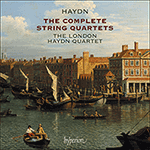
Cover artwork: View on the Thames with Westminster Bridge (c1743/44) by Samuel Scott (c1702-1772)
Yale Center for British Art, Paul Mellon Fund, USA / Bridgeman Images
 

Reviews

‘In Nos 5 and 6, Haydn even abandons the traditional sonata form for his opening allegros, shifting the expressive weight in each work to the slow second movement. It is in these—harmonically adventurous, formally ambiguous—that the London Haydn Quartet are often at their best, distilling an atmosphere of striking intensity in the ecstatic F sharp major Cantabile e mesto of No 5 and the resonant depths of the B major-ish Fantasia of No 6. The opening of the Sunrise (No 4) is similarly rich, leader Catherine Manson taking her time and unfurling the movement’s thematic material with improvisatory freedom … comparing these two period-instrument sets [the LHQ and Chiaroscuro Quartet] demonstrates once again that there is no single (or ‘right’) way to approach the infinitudes contained herein’ (Gramophone)

‘Here we have some of the greatest, most formally innovative, inventive and deeply felt string quartets ever composed, delivered by a quartet of players of faultless intonation, unanimity and blend, whose approach to Haydn has matured through eight much-praised previous albums of his quartets, and who have evidently prepared the present set with minute care’ (BBC Music Magazine)

‘Aristocrat or bumpkin? Joseph Haydn seems to be both at once, which is a large part of his appeal. His music effortlessly straddles the class divide, just as it straddles any number of other opposites: high and low, serious and comic, transcendent and everyday … this new recording of his radiant, wise and often mysterious set of six quartets Op 76 leans heavily towards the aristocratic … those minuets sidle into being with insinuating gracefulness, as if we’re in an aristocratic ballroom. It’s the same story in the spacious opening movements, the rapt hymn-like slow movements, and the helter-skelter finales … the London Haydn Quartet give those balanced phrases and sudden pauses a very different, tenderly expressive quality’ (The Daily Telegraph)

‘The performances of this glorious music—and there is so much more that could be said about it—are in general extremely rewarding … the playing is technically of a high order and the excellent balance also adds to the pleasures of a set that will delight anyone collecting a complete cycle now nearing completion’ (Early Music Review)

‘A particular triumph—of many—in this set is the rendition of Haydn’s sometimes achingly beautiful slow movements. I cannot recall performances more moving in their intensity and sensitivity. Even the most famous movement, the Kaiserlied, of Quartet No 3, becomes touchingly intense: to hear it in this performance is to encounter it as if for the first time … The London Haydn Quartet—in superior recording quality—give us so much rich treasure. These are special recordings of truly great music, and a more than worthy part of the marvellous ongoing series. Each time I have played them, I have found new insights’ (MusicWeb International)» More

„Fast anderthalb Jahrzehnte schon setzt sich das London Haydn Quartet mit den Werkes des Namensgebers auf Tonträger auseinander. Dies geschieht auf eine Weise, die immer wieder verblüfft: Statt das Bewährte auf die mit Darmsaiten bespannten Instrumente zu übertragen, werden die Originalitäten der Kompositionen hervorgeholt. Dabei mutet der Klang des Ensembles offener, aber eben weniger abgerundet an; gewonnen wird dadurch eine weitaus stärkere Charakterisierung des Individuellen … Emotionen werden hier dennoch nicht unter einer gepuderten Perücke versteckt; sie werden eben beherrscht und lassen dann auch Kontraste im Detail zu, bis hin zu nahe liegenden volksmusikalischen Allusionen (Nr. 3) oder eigenartigen Farbwirkungen unterschiedlicher Harmonien (Nr. 4)“ (HörBar, Germany)» More
At once retrospective and prophetic of the new century, the String Quartet in E flat major, Op 76 No 6, is in many ways the strangest of the Op 76 set, with none of the mellow lyricism that Haydn and Mozart habitually associated with the key of E flat. Its outer movements, with their faintly detached, even ascetic air, create wonders from minimal material. The opening allegretto unfolds as a set of variations on a bare, matter-of-fact theme. As with the ‘Emperor’s hymn’ in No 3, Haydn treats this as a cantus firmus against changing counter-melodies, with the second violin leading in variation one, and the cello in variation two. (Could Beethoven have had this skeletal tune at the back of his mind when he composed the finale of his ‘Harp’ Quartet, Op 74, in the same key?) Then Haydn springs a surprise. After variation three, where the theme migrates between instruments, the tempo increases to allegro (exactly as in No 5) for a double fugue that becomes less fugal towards the close: the upshot is the earliest example of the variation-and-fugue form cultivated by Beethoven (in his ‘Eroica’ and ‘Diabelli’ variations) and by many later nineteenth-century composers.

The first movement remains tied to E flat major and closely related keys. The adagio’s title ‘fantasia’ promises harmonic adventure, and Haydn does not disappoint. Its sole theme, reminiscent of the adagio of the ‘Sunrise’, wanders rhapsodically through such a maze of tonalities, linked by winding solos for first violin and cello, that there is initially no key signature. After eventually settling in B major (the key in which it had begun), the movement flowers into tranquil, rarefied polyphony that simultaneously looks back to the Baroque (the Haydn scholar H C Robbins Landon draws a parallel with Purcell’s string fantasias), and forward to late Beethoven.

Haydn marked the third movement ‘menuetto’, tongue firmly planted in cheek. With its wild leaps for first violin and impish play with a tiny two-note figure, this is a full-blown scherzo, the most manic—and most Beethovenian—in Op 76. In the trio—or, as Haydn dubs it, ‘alternativo’—a simple E flat major scale, first descending then ascending, is repeated in kaleidoscopically varied textures and harmonies. Here is the ancient cantus firmus principle at work again, with an effect both witty and oddly moving.

Descending scales also saturate the finale, another movement without a tune worth the name. Haydn had long enjoyed playing rhythmic games with his listeners. But he never did so with more gleeful elan than in this anarchic take on the triple-time dance finales of his late piano trios. Rhythmic confusion reigns from the outset, and reaches extremes of comic mayhem in the development. If you’re not fazed here, you haven’t been listening.

from notes by Richard Wigmore © 2021

À la fois rétrospectif et prophétique du nouveau siècle, le Quatuor à cordes en mi bémol majeur, op.76 nº 6, est à bien des égards le plus étrange du recueil op.76, sans le moindre lyrisme serein que Haydn et Mozart associaient habituellement à la tonalité de mi bémol majeur. Ses mouvements externes, avec leur air légèrement détaché, voire ascétique, créent des miracles à partir d’un matériel minime. L’allegretto initial se déroule comme des variations sur un simple thème prosaïque. Comme dans l’«hymne impérial» du nº 3, Haydn le traite en cantus firmus sur des contrechants changeants, avec le second violon qui mène la danse dans la première variation, et le violoncelle dans la deuxième. (Beethoven pensa-t-il à cet air squelettique lorsqu’il composa le finale de son Quatuor «les Harpes», op.74, dans la même tonalité?) Haydn crée ensuite la surprise. Après la troisième variation, où le thème migre entre les instruments, le tempo s’accélère en un allegro (exactement comme dans le cinquième quatuor de cet opus) pour une double fugue qui devient moins fuguée vers la fin: le résultat, c’est le premier exemple de la forme variation et fugue cultivée par Beethoven (dans ses variations «Eroïca» et «Diabelli») et plus tard par de nombreux compositeurs du XIXe siècle.

Le premier mouvement reste lié à mi bémol majeur et à des tonalités étroitement apparentées. Le titre «fantasia» de l’adagio promet une aventure harmonique et Haydn ne nous déçoit pas. Son seul et unique thème, qui fait penser à l’adagio du «Lever de soleil», vagabonde de manière rhapsodique dans un tel dédale de tonalités, relié par des solos sinueux du premier violon et du violoncelle, qu’il n’y a au départ aucune armature à la clef. Après s’être finalement installé en si majeur (la tonalité dans laquelle il avait commencé), ce mouvement s’épanouit dans une polyphonie paisible et raréfiée qui opère simultanément un retour au baroque (le spécialiste de Haydn H C Robbins Landon établit un parallèle avec les fantaisies pour cordes de Purcell) et anticipe les dernières œuvres de Beethoven.

Haydn a marqué le troisième mouvement «menuetto», d’un air résolument malicieux. Avec ses sauts délirants pour le premier violon et un jeu espiègle avec une minuscule figure de deux notes, c’est un scherzo dans le plus pur sens du terme, le plus frénétique—et le plus beethovenien—de l’op.76. Dans le trio ou, comme le qualifie Haydn, l’«alternativo», une simple gamme de mi bémol majeur, tout d’abord descendante, puis ascendante, est répétée dans des textures et des harmonies variées de manière kaléidoscopique. Ici, c’est l’ancien principe du cantus firmus qui est à nouveau à l’œuvre, avec un effet à la fois spirituel et étrangement émouvant.

Des gammes descendantes saturent aussi le finale, autre mouvement dépourvu d’un thème digne de ce nom. Haydn aimait depuis longtemps proposer des jeux rythmiques à ses auditeurs. Mais il ne l’avait jamais fait avec un allant plus jubilatoire que dans cette approche anarchique des finales de danse ternaire de ses derniers trios avec piano. La confusion rythmique règne dès le début et parvient à des extrêmes de chaos comique dans le développement. Si vous n’êtes pas dérouté ici, c’est que vous n’avez pas écouté.

extrait des notes rédigées par Richard Wigmore © 2021
Français: Marie-Stella Pâris

In die Vergangenheit und zugleich auf die Zukunft des neuen Jahrhunderts gerichtet ist das Streichquartett Es-Dur, op. 76 Nr. 6. In mancher Hinsicht ist es das eigenartigste im ganzen Opus 76; von der weichen Sanglichkeit, die Haydn und Mozart sonst mit der Tonart Es-Dur verbanden, zeigt dieses Werk nichts. Seine Ecksätze mit ihrer abgehobenen, ja asketischen Haltung bringen aus einem Minimum an Material wundersamen Reichtum hervor. Das Allegretto zu Beginn entfaltet sich als Variationenfolge über ein recht nüchternes Thema. Haydn behandelt es, wie die „Kaiserhymne“ des dritten Quartetts, als Cantus firmus über immer neuen Gegenmelodien; in Variation 1 erklingt es in der zweiten Geige, in Variation 2 im Cello. (Hatte Beethoven dieses rudimentäre Thema im Sinn, als er das Finale seines „Harfenquartetts“ op. 74 komponierte?) Dann überrascht uns Haydn: nach Variation 3, in der das Thema von Stimme zu Stimme wandert, beschleunigt er das Tempo auf Allegro zu einer Doppelfuge, die zum Ende hin immer weniger fugenmäßig daherkommt. Es handelt sich um das früheste Beispiel jener Kombination von Variationen und Fuge, die Beethoven etwa in seinen „Eroica“- und „Diabelli“-Variationen ausbaute und die später von vielen Komponisten des 19. Jahrhunderts aufgegriffen wurde.

Der erste Satz bleibt im engeren tonartlichen Umkreis von Es-Dur. Der Titel des zweiten dagegen, „Fantasia“, verheißt größeren harmonischen Wagemut, und Haydn enttäuscht uns nicht. Sein Thema—es erinnert an das Adagio des „Sonnenaufgang“-Quartetts—durchwandert rhapsodisch ein solches Labyrinth der Tonarten, vermittelt durch Soli von erster Geige und Cello, dass zu Beginn keine Tonart vorgezeichnet ist. Nachdem es sich wieder auf H-Dur eingefunden hat, der Tonart seines Beginns, erblüht der Satz zu kostbarer Polyphonie, die ebenso ins Barock zurückblickt (der Haydn-Forscher H. C. Robbins Landon zieht hier Parallelen zu Purcells Streicher-Fantasien), wie sie an den späten Beethoven denen lässt.

Als Haydn den dritten Satz „Menuetto“ überschrieb, dürfte er ziemlich sicher geschmunzelt haben. Mit den wilden Sprüngen der ersten Geige und dem schelmischen Spiel mit einer zweitönigen Figur bildet er ein ausgewachsenes Scherzo—das wildeste des Opus 76, zugleich jenes, das Beethoven am nächsten kommt. Im Trio—Haydn nennt es hier „Alternativo“—erscheint eine schlichte Es-Dur-Tonleiter, erst ab-, dann aufwärtsgerichtet, in kaleidoskopisch sich wandelnden Satz- und Harmoniebildungen. Auch hier begegnet uns das altertümliche Cantus-firmus-Prinzip, und es wirkt zugleich geistreich und seltsam anrührend.

Absteigende Skalen durchziehen auch das Finale—ein weiterer Satz, der nichts vorzuzeigen hat, was den Namen Melodie verdiente. Noch nie war sich Haydn zu schade gewesen, den Hörer in rhythmische Vexierspiele zu verwickeln. Doch tat er das kaum je mit solcher Wonne wie in dieser anarchischen Variante jener Finali im Dreiertakt, wie sie auch seine späten Klaviertrios prägen. Von Anfang an herrscht rhythmische Verwirrung, und in den komischen Verwicklungen der Durchführungen steigert sie sich zum Äußersten. Wer hier nicht aus dem Tritt gerät, der hat nicht richtig zugehört.

aus dem Begleittext von Richard Wigmore © 2021
Deutsch: Friedrich Sprondel
Other albums featuring this work

Haydn: The Complete String Quartets
CDS44651/7020CDs Boxed set (at a special price) Available Friday 5 June 2026
Higher-value orders will be automatically discounted at check-out
Waiting for content to load...