
Welcome to Hyperion Records, a British classical label devoted to presenting high-quality recordings of music of all styles and from all periods from the twelfth century to the twenty-first.

Hyperion offers both CDs, and downloads in a number of formats. The site is also available in several languages.

Please use the dropdown buttons to set your preferred options, or use the checkbox to accept the defaults.
Click cover art to view larger version
Track(s) taken from CDA68335

String Quartet in D minor 'Fifths', Op 76 No 2

composer
1796/7; commissioned by and dedicated to Count Joseph Erdödy; published in Vienna and London in 1799/1800

The London Haydn Quartet
Studio Master FLAC & ALAC downloads available
CD-Quality:
Studio Master:
Studio Master:
CD-Quality:
Studio Master:
Studio Master:
Recording details: March 2020
Potton Hall, Dunwich, Suffolk, United Kingdom
Produced by Philip Hobbs
Engineered by Philip Hobbs
Release date: February 2021
Total duration: 26 minutes 14 seconds

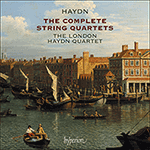
Cover artwork: View on the Thames with Westminster Bridge (c1743/44) by Samuel Scott (c1702-1772)
Yale Center for British Art, Paul Mellon Fund, USA / Bridgeman Images
 

Reviews

‘In Nos 5 and 6, Haydn even abandons the traditional sonata form for his opening allegros, shifting the expressive weight in each work to the slow second movement. It is in these—harmonically adventurous, formally ambiguous—that the London Haydn Quartet are often at their best, distilling an atmosphere of striking intensity in the ecstatic F sharp major Cantabile e mesto of No 5 and the resonant depths of the B major-ish Fantasia of No 6. The opening of the Sunrise (No 4) is similarly rich, leader Catherine Manson taking her time and unfurling the movement’s thematic material with improvisatory freedom … comparing these two period-instrument sets [the LHQ and Chiaroscuro Quartet] demonstrates once again that there is no single (or ‘right’) way to approach the infinitudes contained herein’ (Gramophone)

‘Here we have some of the greatest, most formally innovative, inventive and deeply felt string quartets ever composed, delivered by a quartet of players of faultless intonation, unanimity and blend, whose approach to Haydn has matured through eight much-praised previous albums of his quartets, and who have evidently prepared the present set with minute care’ (BBC Music Magazine)

‘Aristocrat or bumpkin? Joseph Haydn seems to be both at once, which is a large part of his appeal. His music effortlessly straddles the class divide, just as it straddles any number of other opposites: high and low, serious and comic, transcendent and everyday … this new recording of his radiant, wise and often mysterious set of six quartets Op 76 leans heavily towards the aristocratic … those minuets sidle into being with insinuating gracefulness, as if we’re in an aristocratic ballroom. It’s the same story in the spacious opening movements, the rapt hymn-like slow movements, and the helter-skelter finales … the London Haydn Quartet give those balanced phrases and sudden pauses a very different, tenderly expressive quality’ (The Daily Telegraph)

‘The performances of this glorious music—and there is so much more that could be said about it—are in general extremely rewarding … the playing is technically of a high order and the excellent balance also adds to the pleasures of a set that will delight anyone collecting a complete cycle now nearing completion’ (Early Music Review)

‘A particular triumph—of many—in this set is the rendition of Haydn’s sometimes achingly beautiful slow movements. I cannot recall performances more moving in their intensity and sensitivity. Even the most famous movement, the Kaiserlied, of Quartet No 3, becomes touchingly intense: to hear it in this performance is to encounter it as if for the first time … The London Haydn Quartet—in superior recording quality—give us so much rich treasure. These are special recordings of truly great music, and a more than worthy part of the marvellous ongoing series. Each time I have played them, I have found new insights’ (MusicWeb International)» More

„Fast anderthalb Jahrzehnte schon setzt sich das London Haydn Quartet mit den Werkes des Namensgebers auf Tonträger auseinander. Dies geschieht auf eine Weise, die immer wieder verblüfft: Statt das Bewährte auf die mit Darmsaiten bespannten Instrumente zu übertragen, werden die Originalitäten der Kompositionen hervorgeholt. Dabei mutet der Klang des Ensembles offener, aber eben weniger abgerundet an; gewonnen wird dadurch eine weitaus stärkere Charakterisierung des Individuellen … Emotionen werden hier dennoch nicht unter einer gepuderten Perücke versteckt; sie werden eben beherrscht und lassen dann auch Kontraste im Detail zu, bis hin zu nahe liegenden volksmusikalischen Allusionen (Nr. 3) oder eigenartigen Farbwirkungen unterschiedlicher Harmonien (Nr. 4)“ (HörBar, Germany)» More
In a published set of six quartets, one work in the minor key was de rigueur. The opening allegro of the String Quartet in D minor, Op 76 No 2, is Haydn at his grimmest and most obsessive, a world away from the amiable ‘Papa’ of popular myth. Haydn’s famed thematic economy here reaches its logical extreme. The initial pairs of falling fifths that spawned the German nickname ‘Quintenquartett’ permeate the textures like a cantus firmus, sometimes in shorter note values, sometimes inverted. The whole restlessly inventive movement teems with Haydnesque unpredictability—nowhere more so than towards the end of the development. Here the falling fifths hover on the brink of A minor for several bars, only to sink to a rich, deep C major: a tonal surprise out of all proportion to the means used. Another surprise—shock may be a better word—is the ferocious coda, beginning with hectic violin figuration over clashing syncopations for the lower strings.

After such concentrated intensity the ear craves respite. Haydn duly provides it in an easily flowing ‘andante o più tosto allegretto’, in the bright key of D major. At the opening, the first violin sings a lilting serenade over gently strumming pizzicatos—though, typically, Haydnesque innocence is compromised by the irregular phrasing (5+2+4 bars) of the theme’s second half. A ‘developing’ central episode, beginning in D minor, toys quizzically with a fragment of the theme before the serenade returns, now adorned with delicately skittish violin figuration.

Several of Haydn’s early quartets had included minuets featuring two-part canonic writing, with the upper and lower pairs of instruments playing in bare octaves. Some critics found this texture crude and tasteless. Haydn, as ever, went his own way. In the so-called ‘Witches’ minuet’ of Op 76 No 2, he pushed this harsh sonority, with viola and cello pursuing the violins at a bar’s distance, to remorseless, rebarbative extremes. Never had a minuet been further removed from its courtly origins. The trio is just as eccentric, a garish parody of a village dance in which D minor and D major collide head-on.

With its ‘exotic’ sharpened fourths and violin slides, the finale’s main theme has a Hungarian gypsy flavour—a reminder that from his boyhood Haydn had heard gypsy fiddling on the border of Austria and Hungary. The whole movement mingles Haydn’s typical restless energy (its comedy is distinctly edgy) with stylized rusticity, courtesy of bagpipe drones and hee-hawing donkey imitations that inevitably suggest the overture of Mendelssohn’s A Midsummer Night’s Dream. Near the start of the recapitulation, D minor resolves to D major, tentatively at first, in a pianissimo transformation of the main theme, then with increasing bravado.

from notes by Richard Wigmore © 2021

Dans un recueil publié de six quatuors, une œuvre de tonalité mineure était de rigueur. L’allegro initial du Quatuor à cordes en ré mineur, op.76 nº 2, est du Haydn très sombre et très obsédant, à mille lieux de l’aimable «Papa» du mythe populaire. La célèbre économie thématique de Haydn atteint ici son extrême logique. Les paires initiales de quintes descendantes qui sont à l’origine du surnom allemand «Quintenquartett» («les quintes») imprègnent les textures comme un cantus firmus, parfois en valeurs de notes plus courtes, parfois inversées. L’ensemble de ce mouvement nerveusement inventif fourmille de ce côté imprévisible typique de Haydn—surtout à la fin du développement. Là, les quintes descendantes planent à la limite de la mineur pendant plusieurs mesures, pour finalement s’enfoncer dans un profond ut majeur: une surprise tonale hors de proportion avec les moyens utilisés. Autre surprise—le mot «choc» serait peut-être plus approprié—la violente coda, qui commence par une figuration chargée de violon sur des syncopes des cordes graves qui s’entrechoquent.

Après une telle concentration d’intensité, l’oreille a besoin de répit. Haydn y pourvoit avec un «andante o più tosto allegretto» qui s’écoule tranquillement, dans la brillante tonalité de ré majeur. Au début, le premier violon chante une sérénade mélodieuse sur de délicats accords légers pizzicato—mais l’innocence typiquement haydnienne est remise en cause par le phrasé irrégulier (5+2+4 mesures) de la seconde moitié du thème. Un épisode central «de développement», qui commence en ré mineur, joue d’un air interrogateur avec un fragment du thème avant le retour de la sérénade, maintenant parée d’une figuration délicatement capricieuse du violon.

Plusieurs des premiers quatuors de Haydn comportaient des menuets dotés d’une écriture en canon à deux parties, les paires supérieure et inférieure d’instruments jouant en octaves à découvert. Certains critiques trouvèrent cette texture grossière et de mauvais goût. Comme toujours, Haydn suivait sa propre voie. Dans ce mouvement de l’op.76 nº 2 qu’on appelle «Menuet des sorcières», il poussa cette sonorité dure à des extrêmes impitoyables et rebutants, avec l’alto et le violoncelle à la suite des violons à une mesure d’intervalle. Un menuet n’avait jamais été aussi éloigné de ses origines courtoises. Le trio est tout aussi excentrique, une parodie tapageuse de danse villageoise où ré mineur et ré majeur se heurtent de front.

Avec ses quartes diésées «exotiques» et ses glissades de violon, le thème principal du finale a une saveur tzigane hongroise—qui nous rappelle que Haydn avait entendu jouer du violon tzigane dans son enfance à la frontière de l’Autriche et de la Hongrie. L’ensemble de ce mouvement mêle l’insatiable énergie typique de Haydn (son humour est vraiment crispé) à une rusticité stylisée, grâce à des bourdons de cornemuse et à des imitations du hi-han de l’âne qui évoquent inévitablement l’ouverture du Songe d’une nuit d’été de Mendelssohn. Au début de la réexposition, ré mineur bascule en ré majeur, tout d’abord avec hésitation, dans une transformation pianissimo du thème principal, puis avec une bravade croissante.

extrait des notes rédigées par Richard Wigmore © 2021
Français: Marie-Stella Pâris

In einer gedruckten Sammlung von sechs Quartetten musste, so verlangte es die Gepflogenheit, eines in Moll stehen. Der Allegro-Kopfsatz des Streichquartetts d-Moll, op. 76 Nr. 2, zeigt einen düsteren, verbissenen Komponisten, so ganz anders, als ihn das Klischee vom liebenswerten „Papa Haydn“ will. Haydn treibt hier seine berühmte thematische Ökonomie konsequent ins Extrem. Die beiden Quintfälle des Anfangs, denen das Stück seinen Spitznamen „Quintenquartett“ verdankt, ziehen sich durch die Komposition wie ein Cantus firmus, manchmal in verkürzten Notenwerten, manchmal in Umkehrung. In seinem ruhelosen Ideenreichtum strotzt der Satz von Haydn’schen Überraschungen, ganz besonders am Ende der Durchführung. Die Quintfälle scheinen einige Takte lang auf dem Weg nach a-Moll zu verharren, dann lassen sie sich in ein volltönendes, tiefes C-Dur fallen: ein harmonischer Handstreich, dessen Wirkung in keinem Verhältnis zu den eingesetzten Mitteln steht. Eine weitere Überraschung, ja Überrumpelung bildet die wildbewegte Coda, die mit hektischen Geigenfiguren über synkopischen Kollisionen der tiefen Streicher beginnt.

Nach so gedrängter Intensität sehnt sich das Ohr nach Erholung. So schreibt Haydn denn auch ein leicht dahinfließendes „Andante o più tosto allegretto“ in hellem D-Dur. Zu Anfang singt die erste Geige eine Serenade über zarten Pizzicati—wobei der Anschein Haydn’scher Unschuld charakteristisch unterlaufen wird, wenn die zweite Hälfte des Themas unregelmäßig phrasiert wird (5+2+4 Takte). Ein durchführungsartiger Mittelteil beginnt in d-Moll und spielt mit einem Bruchstück des Themas, dann kehrt die Serenade zurück, nun verziert mit übermütigen Figurationen der ersten Geige.

Manche der frühen Quartette Haydns enthielten Menuette in zweistimmigem Kanonsatz, der das tiefe und das hohe Streicherpaar in Oktaven führte—in den Ohren mancher Kritiker roh und geschmacklos. Doch Haydn störte das natürlich nicht. Im sogenannten „Hexenmenuett“ des op. 76 Nr. 2 treibt Haydn diese raue Klanglichkeit—Bratsche und Cello verfolgen die beiden Violinen mit einem Takt Abstand—ohne alle Bedenken ins bittere Extrem. Nie entfernte ein Menuett sich weiter von seinem höfischen Ursprung. Ebenso exzentrisch ist das Trio, die grelle Parodie eines Dorftanzes, in dem d-Moll und D-Dur ungebremst aufeinandertreffen.

Das Hauptthema des Finales ist mit seinen „exotischen“ übermäßigen Quarten und Geigenglissandi in der Art ungarischer Zigeunermusik gefärbt—was daran erinnert, dass Haydn in seiner Kindheit im ungarisch-österreichischen Grenzgebiet Zigeunergeiger erlebt hatte. Der Satz verquickt die für Haydn typische Ruhelosigkeit mit einem stilisiert-ländlichen Tonfall, etwa in den Dudelsack-Bordunen und Eselsrufen, die unausweichlich an Mendelssohns Sommernachtstraum-Musik denken lassen. Kurz nach Eintritt der Reprise wandelt d-Moll sich zu D-Dur—zunächst noch schüchtern in einer pianissimo-Version des Hauptthemas, dann aber immer selbstbewusster.

aus dem Begleittext von Richard Wigmore © 2021
Deutsch: Friedrich Sprondel
Other albums featuring this work

Haydn: The Complete String Quartets
CDS44651/7020CDs Boxed set (at a special price) Available Friday 5 June 2026
Higher-value orders will be automatically discounted at check-out
Waiting for content to load...