
Welcome to Hyperion Records, a British classical label devoted to presenting high-quality recordings of music of all styles and from all periods from the twelfth century to the twenty-first.

Hyperion offers both CDs, and downloads in a number of formats. The site is also available in several languages.

Please use the dropdown buttons to set your preferred options, or use the checkbox to accept the defaults.
Click cover art to view larger version
Track(s) taken from CDA68335

String Quartet in D major 'Largo', Op 76 No 5

composer
1796/7; commissioned by and dedicated to Count Joseph Erdödy; published in Vienna and London in 1799/1800

The London Haydn Quartet
Studio Master FLAC & ALAC downloads available
CD-Quality:
Studio Master:
Studio Master:
CD-Quality:
Studio Master:
Studio Master:
Recording details: March 2020
Potton Hall, Dunwich, Suffolk, United Kingdom
Produced by Philip Hobbs
Engineered by Philip Hobbs
Release date: February 2021
Total duration: 20 minutes 33 seconds

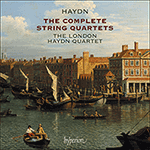
Cover artwork: View on the Thames with Westminster Bridge (c1743/44) by Samuel Scott (c1702-1772)
Yale Center for British Art, Paul Mellon Fund, USA / Bridgeman Images
 

Reviews

‘In Nos 5 and 6, Haydn even abandons the traditional sonata form for his opening allegros, shifting the expressive weight in each work to the slow second movement. It is in these—harmonically adventurous, formally ambiguous—that the London Haydn Quartet are often at their best, distilling an atmosphere of striking intensity in the ecstatic F sharp major Cantabile e mesto of No 5 and the resonant depths of the B major-ish Fantasia of No 6. The opening of the Sunrise (No 4) is similarly rich, leader Catherine Manson taking her time and unfurling the movement’s thematic material with improvisatory freedom … comparing these two period-instrument sets [the LHQ and Chiaroscuro Quartet] demonstrates once again that there is no single (or ‘right’) way to approach the infinitudes contained herein’ (Gramophone)

‘Here we have some of the greatest, most formally innovative, inventive and deeply felt string quartets ever composed, delivered by a quartet of players of faultless intonation, unanimity and blend, whose approach to Haydn has matured through eight much-praised previous albums of his quartets, and who have evidently prepared the present set with minute care’ (BBC Music Magazine)

‘Aristocrat or bumpkin? Joseph Haydn seems to be both at once, which is a large part of his appeal. His music effortlessly straddles the class divide, just as it straddles any number of other opposites: high and low, serious and comic, transcendent and everyday … this new recording of his radiant, wise and often mysterious set of six quartets Op 76 leans heavily towards the aristocratic … those minuets sidle into being with insinuating gracefulness, as if we’re in an aristocratic ballroom. It’s the same story in the spacious opening movements, the rapt hymn-like slow movements, and the helter-skelter finales … the London Haydn Quartet give those balanced phrases and sudden pauses a very different, tenderly expressive quality’ (The Daily Telegraph)

‘The performances of this glorious music—and there is so much more that could be said about it—are in general extremely rewarding … the playing is technically of a high order and the excellent balance also adds to the pleasures of a set that will delight anyone collecting a complete cycle now nearing completion’ (Early Music Review)

‘A particular triumph—of many—in this set is the rendition of Haydn’s sometimes achingly beautiful slow movements. I cannot recall performances more moving in their intensity and sensitivity. Even the most famous movement, the Kaiserlied, of Quartet No 3, becomes touchingly intense: to hear it in this performance is to encounter it as if for the first time … The London Haydn Quartet—in superior recording quality—give us so much rich treasure. These are special recordings of truly great music, and a more than worthy part of the marvellous ongoing series. Each time I have played them, I have found new insights’ (MusicWeb International)» More

„Fast anderthalb Jahrzehnte schon setzt sich das London Haydn Quartet mit den Werkes des Namensgebers auf Tonträger auseinander. Dies geschieht auf eine Weise, die immer wieder verblüfft: Statt das Bewährte auf die mit Darmsaiten bespannten Instrumente zu übertragen, werden die Originalitäten der Kompositionen hervorgeholt. Dabei mutet der Klang des Ensembles offener, aber eben weniger abgerundet an; gewonnen wird dadurch eine weitaus stärkere Charakterisierung des Individuellen … Emotionen werden hier dennoch nicht unter einer gepuderten Perücke versteckt; sie werden eben beherrscht und lassen dann auch Kontraste im Detail zu, bis hin zu nahe liegenden volksmusikalischen Allusionen (Nr. 3) oder eigenartigen Farbwirkungen unterschiedlicher Harmonien (Nr. 4)“ (HörBar, Germany)» More
After the elaborate sonata-form opening movements of the first four Op 76 quartets, Nos 5 and 6 break the mould with structures based on variations. The allegretto first movement of the String Quartet in D major ‘Largo’, Op 76 No 5, has a similar design to the finale of the ‘Sunrise’. It begins with a graceful 6/8 pastoral melody, akin to ‘With verdure clad’ in The Creation. Its innocence is then questioned in a D minor episode that treats the melody in grave contrapuntal imitation before launching into a bold new theme. After a return of the opening and a dramatic pause, Haydn quickens the tempo for a coda that both develops and resolves the material of the D minor section.

The heart of the quartet is the largo, marked ‘cantabile e mesto’ (mesto = ‘sad’), in the rare key of F sharp major, remote and otherworldly after the vernal brightness of D major. Extremes of key provoke extremes of feeling. Based, characteristically, on a single theme, the music mingles a Wordsworthian serenity with a visionary strangeness, above all in the labyrinthine harmonic explorations, viola and cello to the fore, at the movement’s centre. Like the adagio of Op 76 No 1, this sublime largo exerted a profound influence on Beethoven’s hymnic slow movements, not least the adagio of the ‘Razumovsky’ Quartet, Op 59 No 2.

Back in the broad daylight of D major, the minuet transforms the exalted largo theme into a convivial dance; though, true to form, Haydn has fun roughing up the regular minuet rhythm. The D minor trio is laconic and enigmatic, counterpointing a repeated two-note cadence with scurrying cello scales that later migrate to the upper instruments. The same cadence, now in D major, launches the finale—a favourite Haydnesque ending-as-beginning pun. This irresistible music is the composer at his most uninhibitedly rustic, using the skirls and scrapings of a village band as the basis for a riotous, endlessly unpredictable sonata structure. At the start of the recapitulation, Haydn enlivens the cadence with an out-of-the-blue burst of virtuosity for the second violin—a thrilling moment.

from notes by Richard Wigmore © 2021

Après les premiers mouvements élaborés en forme sonate des quatre premiers quatuors de l’op.76, le cinquième et le sixième s’écartent de la tradition avec des structures basées sur des variations. Le premier mouvement allegretto du Quatuor à cordes en ré majeur «Largo», op.76 nº 5, a un plan analogue à celui du finale du «Lever de soleil». Il commence par une gracieuse mélodie pastorale à 6/8, qui ressemble à «La flore enveloppée d’un frais manteau vert» dans La Création. Son innocence est ensuite mise en question dans un épisode en ré mineur qui traite la mélodie en une grave imitation contrapuntique avant de se lancer dans un nouveau thème audacieux. Après un retour du début et un point d’orgue dramatique, Haydn accélère le tempo pour une coda qui développe et résout à la fois le matériel de la section en ré mineur.

Le cœur de ce quatuor est le largo «cantabile e mesto» (mesto=«triste») dans la rare tonalité de fa dièse majeur, éloignée et venant de l’au-delà après l’éclat printanier de ré majeur. Les extrêmes de tonalité provoquent des extrêmes de sentiment. Basée, comme d’habitude, sur un seul thème, la musique mêle une sérénité wordsworthienne à une étrangeté visionnaire, surtout dans les explorations harmoniques labyrinthiques, alto et violoncelle au premier plan, au milieu du mouvement. Comme l’adagio de l’op.76 nº 1, ce sublime largo exerça une profonde influence sur les mouvements lents hymniques de Beethoven, notamment l’adagio du Quatuor «Razoumovski», op.59 nº 2.

De retour dans la pleine lumière de ré majeur, le menuet transforme le thème exalté du largo en une danse conviviale, quoique, fidèle à lui-même, Haydn s’amuse à malmener le rythme habituel du menuet. Le trio en ré mineur est laconique et énigmatique, avec en contrepoint une cadence de deux notes répétées sur des gammes très rapides du violoncelle qui migrent ensuite aux instruments aigus. La même cadence, maintenant en ré majeur, lance le finale—un calembour favori de Haydn consistant à terminer comme il a commencé. Cette musique irrésistible illustre le compositeur dans ses moments rustiques les moins refrénés, utilisant les sons aigus et les raclements d’une fanfare de village comme base d’une structure de sonate délirante sans cesse imprévisible. Au début de la réexposition, Haydn anime la cadence avec une explosion de virtuosité à l’improviste pour le second violon—un moment exaltant.

extrait des notes rédigées par Richard Wigmore © 2021
Français: Marie-Stella Pâris

Nach den in sorgfältig ausgearbeiteter Sonatenform gehaltenen Kopfsätzen der ersten vier Quartette des Opus 76 gehen die Nummern 5 und 6 neue Wege: sie beruhen auf dem Variationsprinzip. Der erste Satz des Streichquartetts D-Dur „Largo“, op. 76 Nr. 5, ist ähnlich aufgebaut wie das Finale des „Sonnenaufgang“-Quartetts. Er beginnt mit einer anmutigen 6/8-Melodie von pastoralem Charakter, nah verwandt der Arie „Nun beut die Flur“ aus Der Schöpfung. Diese Unschuld stört eine d-Moll-Episode, in der die Melodie strenger kontrapunktischer Imitation unterworfen wird und die sich dann einem kühnen neuen Thema öffnet. Nach der Rückkehr des Anfangs und einer dramatischen Pause beschleunigt Haydn das Tempo für die Coda, die das Material des d-Moll-Abschnitts durchführt und zugleich auflöst.

Herzstück des Quartetts ist das Largo „cantabile e mesto“ (mesto = „traurig“) in entlegenem Fis-Dur; neben dem frühlingshaft lichten D-Dur scheint es einer anderen Welt anzugehören. Extreme Tonarten verlangen nach extremen Emotionen. Die Musik beruht typischerweise auf einem einzigen Thema; sie verbindet poetische Gelassenheit mit einer visionär-fremdartigen Anmutung, besonders in den labyrinthischen harmonischen Verläufen im Mittelteil des Satzes, in dem Bratsche und Cello in den Vordergrund rücken. Wie das Adagio des Quartetts op. 76 Nr. 1 sollte dieses erhabene Largo starken Einfluss auf die hymnischen langsamen Sätze Beethovens ausüben, nicht zuletzt im Adagio des zweiten „Rasumowsky-Quartetts“ im Opus 59.

Das Menuett, zurück in hell strahlendem D-Dur, verwandelt das entrückte Largo-Thema in einen geselligen Tanz—wobei Haydn es abermals nicht lassen kann, das Regelmaß des Menuett-Rhythmus gegen den Strich zu bürsten. Knapp und rätselhaft wirkt das d-Moll-Trio, in dem eine wiederholte kurze Kadenzformel von eiligen Cello-Skalen kontrapunktiert wird, die später in die höheren Instrumente wandern. Dieselbe Kadenz, nun in D-Dur, gibt das Startsignal zum Finale—eine Scherzgeste, die Haydn liebte: die Schlussformel wird zum Neuanfang. Diese unwiderstehliche Musik zeigt ganz unverstellt die Vorliebe des Komponisten für das Rustikale. Das Geblase und Gekratze einer Dorfkapelle bildet den Ausgangspunkt für eine widerborstige, stets unvorhersehbare Sonatenform. Zu Beginn der Reprise reichert Haydn die Kadenzformel mit einem gänzlich unerwarteten virtuosen Ausscheren der zweiten Geige an—ein packender Einfall.

aus dem Begleittext von Richard Wigmore © 2021
Deutsch: Friedrich Sprondel
Other albums featuring this work

Haydn: The Complete String Quartets
CDS44651/7020CDs Boxed set (at a special price) Available Friday 5 June 2026
Higher-value orders will be automatically discounted at check-out
Waiting for content to load...