
Welcome to Hyperion Records, a British classical label devoted to presenting high-quality recordings of music of all styles and from all periods from the twelfth century to the twenty-first.
Hyperion offers both CDs, and downloads in a number of formats. The site is also available in several languages.
Please use the dropdown buttons to set your preferred options, or use the checkbox to accept the defaults.


Whereas Mozart’s greatest slow movements are operatically inspired, Haydn’s typically exude a hymn-like gravity that aligns them with his late Masses and oratorios. One of the noblest is the adagio sostenuto of Op 76 No 1. In an extreme contrast of textures, a deep-toned cantabile theme, with each instrument on its lowest string, alternates with sorrowful or agitated dialogues between cello and first violin.
The third movement’s heading ‘menuetto’ should fool no one. With its capering staccatos and explosive fortissimo outbursts, this is Haydn’s first presto scherzo. Could he have been influenced here by the scherzos in Beethoven’s Op 1 piano trios, which he had heard at Prince Lobkowitz’s palace in 1795? Although not marked in the score, the tempo slows for the rustic trio, where the first violin sings a yodelling serenade against a pizzicato accompaniment.
Early players and listeners would surely have been taken aback by the opening of the finale, in a tough, troubled G minor—a startling move in a work that had begun in the major (the only earlier instance in Haydn is his Symphony No 70 of 1779). Here, for the first time in his quartets, is a finale that surpasses the first movement in weight and expressive scope. The tense second theme, announced after an abrupt harmonic swerve, brings no respite; the development then takes fragments of the main theme through a mysterious sequence of modulations that touches the esoteric remoteness of D flat minor. In the recapitulation, the theme emerges, as if in a daze, into the light of G major, with magical effect. Haydn springs a final surprise in the coda, turning the once strenuous theme upside down and transmuting it into a rustic polka, complete with pizzicato accompaniment: a tongue-in-cheek reminder both of the scherzo’s trio and of the quartet’s bucolic opening.
from notes by Richard Wigmore © 2021
Alors que les plus grands mouvements lents de Mozart s’inspirent de l’opéra, il se dégage comme d’habitude de ceux de Haydn une gravité proche de celle des hymnes, ce qui les rapproche de ses dernières messes et oratorios. L’un des plus nobles est l’adagio sostenuto de l’op.76 nº 1. Dans un contraste extrême de textures, un thème cantabile à la sonorité profonde, où chaque instrument joue sur sa corde la plus grave, alterne avec des dialogues tristes ou agités entre le violoncelle et le premier violon.
Le titre «menuetto» du troisième mouvement ne doit tromper personne. Avec ses staccatos gambadants et ses éclats fortissimo explosifs, il s’agit du premier scherzo presto de Haydn. Aurait-il pu être influencé ici par les scherzos des trios avec piano op.1 de Beethoven, qu’il avait entendus au palais du prince Lobkowitz en 1795? Même si ce n’est pas marqué sur la partition, le tempo ralentit pour le trio rustique, où le premier violon chante une sérénade jodlante sur un accompagnement pizzicato.
Les premiers interprètes et auditeurs furent sûrement déconcertés par le début du finale, dans un sol mineur sévère et troublé: un changement saisissant dans une œuvre qui avait commencé en majeur (le seul exemple antérieur chez Haydn se trouve dans sa Symphonie nº 70 de 1779). Ici, pour la première fois dans ses quatuors, le finale surpasse le premier mouvement en poids et en portée expressive. Le second thème tendu, annoncé après un brusque écart harmonique, n’apporte aucun répit; et le développement fait passer des fragments du thème principal par une mystérieuse séquence de modulations qui atteint le lointain ré bémol mineur ésotérique. À la réexposition, le thème émerge, comme étourdi, dans la lumière de sol majeur, avec un effet magique. Haydn crée la surprise finale dans la coda, bouleversant le thème autrefois énergique qu’il transmue en polka rustique, avec accompagnement pizzicato: un rappel au second degré à la fois du trio du scherzo et du début bucolique du quatuor.
extrait des notes rédigées par Richard Wigmore © 2021
Français: Marie-Stella Pâris
Sind die bedeutendsten langsamen Sätze bei Mozart oft von der Oper inspiriert, so besitzen sie bei Haydn typischerweise einen hymnischen Ernst, der sie in die Nähe von dessen Messen und Oratorien rückt. Zu den edelsten Schöpfungen dieser Art zählt das Adagio sostenuto des Quartetts op. 76 Nr. 1. In überdeutlichem Kontrast der Satzarten alterniert ein tiefliegendes Cantabile—hier spielen alle Instrumente auf ihrer jeweils tiefsten Saite—mit trauervollen oder erregten Zwiegesprächen zwischen Cello und erster Geige.
Von der Überschrift „Menuetto“ für den dritten Satz lasse man sich nicht täuschen: mit seinen übermütigen Staccati und explosiven Fortissimo-Ausbrüchen ist es das erste Presto-Scherzo, das Haydn komponierte. Könnten ihn darin die Scherzi in Beethovens Klaviertrios op. 1 beeinflusst haben, die er 1795 im Palais des Fürsten Lobkowitz gehört hatte? Das ländlich wirkende Trio erklingt—obgleich das in der Partitur nicht vermerkt ist—etwas langsamer: über der Pizzicato-Begleitung singt die erste Geige eine jodelnde Serenade.
Das strenge und ernste g-Moll zu Beginn des Finales dürfte die ersten Spieler und Hörer des Quartetts befremdet haben—eine verblüffende Wendung in einem Werk, das in Dur anfängt (ähnliches kommt zuvor nur in Haydns Sinfonie Nr. 70 von 1779 vor). Zum ersten Mal in seinem Quartettschaffen schreibt Haydn hier ein Finale, das den ersten Satz an Gewicht und Ausdruckskraft übertrifft. Das angespannte zweite Thema, das sich nach einem plötzlichen harmonischen Umschwung meldet, bringt kaum Entspannung; und die Durchführung entführt Fragmente des Hauptthemas nach geheimnisvollen Modulationen bis in die entrückten Regionen von des-Moll. In der Reprise erscheint das Thema, wie in Trance, in lichtem G-Dur—ein zauberischer Effekt. Eine letzte Überraschung zieht Haydn in der Coda aus dem Ärmel: er kehrt das angespannte Thema um und verwandelt es in eine ländliche Polka mit Pizzicato-Begleitung. Mit hintersinnigem Humor erinnert er damit an das Trio des Scherzos und an den Werkbeginn.
aus dem Begleittext von Richard Wigmore © 2021
Deutsch: Friedrich Sprondel
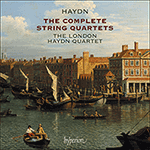 Haydn: The Complete String Quartets Haydn: The Complete String QuartetsCDS44651/7020CDs Boxed set (at a special price) Available Friday 5 June 2026 Higher-value orders will be automatically discounted at check-out  10x double-CD sets presented in strikingly handsome double wallets throughout, each featuring opulent paintings by Samuel Scott on front and back. Each wallet offers a track listing, with many presenting facsimiles of the original scores and front ...» More |