
Welcome to Hyperion Records, a British classical label devoted to presenting high-quality recordings of music of all styles and from all periods from the twelfth century to the twenty-first.
Hyperion offers both CDs, and downloads in a number of formats. The site is also available in several languages.
Please use the dropdown buttons to set your preferred options, or use the checkbox to accept the defaults.

| Alexandra Dariescu (piano), Philharmonia Orchestra, Tianyi Lu (conductor)» More |
 PERFORMANCE
Some listeners may feel, too, that it is the most successful of the three. The first movement, melodically somewhat under-nourished, is replete with the passagework and rhetorical gestures of those composers to whom, thanks to her father’s teaching regime, she was in thrall: Kalkbrenner, Hummel, Herz and the like. After a stormy octave passage in E major, via a single bar (marked ‘adagio’ and ‘a piacere senza tempo’), the second movement begins, without a break, in the key of A flat major. This Romanze (‘andante non troppo con grazia’) is to be played with ‘la melodia ben marcato e legato’—and indeed the principal ‘melodia’ is most appealing, especially when taken up by the solo cello later in the movement. Is it too fanciful to suppose that Brahms, who was to become so close to Clara and who later used the same unusual (for a piano concerto) device of a solo cello in the slow movement, might have got the idea from this work? Once again, the music subsides (poco a poco ritenuto) before linking, by means of a drum roll and trumpet fanfare, into the high spirits of the last movement.
Linking the three movements of a concerto was a novel idea in 1833, the most famous example being Mendelssohn’s Concerto No 1 in G minor, Op 25, premiered in Munich in 1831. He played it for the first time in Clara’s home city of Leipzig on 29 October 1835—and it was he who, just eleven days later, conducted the premiere of Clara’s concerto at the Gewandhaus with its young composer as soloist. (At the same concert she also played Mendelssohn’s Capriccio brillant, Op 22, and J S Bach’s Triple Concerto in D minor with Mendelssohn and Louis Rakemann as her co-soloists—remarkably, the first time that any of Bach’s music had ever been played in the Gewandhaus.) After some revision, the concerto, Clara Schumann’s only extant orchestral composition, was published in 1836 with a dedication to the illustrious violinist, composer and conductor Louis Spohr.
from notes by Jeremy Nicholas © 2019
Certains auditeurs trouveront peut-être aussi que c’est le plus réussi des trois mouvements. Le premier, légèrement sous-alimenté sur le plan mélodique, regorge de traits et de gestes rhétoriques propres aux compositeurs sous l’emprise desquels elle se trouvait en raison du régime d’enseignement de son père: Kalkbrenner, Hummel, Herz et d’autres musiciens du même genre. Après un passage tumultueux en octaves en mi majeur, et une simple mesure de transition (marquée «adagio» et «a piacere senza tempo»), le deuxième mouvement s’enchaîne, sans interruption, dans la tonalité de la bémol majeur. Cette Romanze («andante non troppo con grazia») doit être jouée avec «la melodia ben marcato e legato»—et, en fait, la principale «melodia» est très séduisante, surtout lorsque le violoncelle solo la reprend un peu plus loin dans le mouvement. Est-il trop illusoire de supposer que Brahms, qui allait devenir si proche de Clara et qui utilisa par la suite le même procédé inhabituel (pour un concerto pour piano) consistant à faire intervenir un violoncelle solo dans le mouvement lent, ait pu en puiser l’idée dans cette œuvre? Une fois encore, la musique s’apaise (poco a poco ritenuto) avant de se glisser, sur un roulement de tambour et un appel de trompettes, dans l’entrain du dernier mouvement.
Enchaîner les trois mouvements d’un concerto était une idée originale en 1833, l’exemple le plus célèbre étant le Concerto n° 1 en sol mineur, op.25, de Mendelssohn, créé à Munich en 1831. Il le joua pour la première fois chez Clara à Leipzig, le 29 octobre 1835—et c’est lui qui, seulement onze jours plus tard, dirigea la création du concerto de Clara au Gewandhaus avec sa jeune compositrice en soliste (au même concert, elle joua aussi le Capriccio brillant, op.22, de Mendelssohn et le Triple Concerto en ré mineur de J S Bach, Mendelssohn et Louis Rakemann tenant les autres parties de piano—fait étonnant, c’était la première fois qu’une œuvre de Bach était jouée au Gewandhaus). Après quelques révisions, ce concerto, la seule composition pour orchestre de Clara Schumann qui nous soit parvenue, fut publié en 1836 avec une dédicace à l’illustre violoniste, compositeur et chef d’orchestre Louis Spohr.
extrait des notes rédigées par Jeremy Nicholas © 2019
Français: Marie-Stella Pâris
Auf manche Hörer mag er auch als der gelungenste der drei Sätze wirken. Der erste, nicht eben reich an melodischer Entwicklung, weist reichlich Passagenwerk und virtuose Gesten auf, wie es typisch für jene Komponisten war, die sie in der Ausbildung bei ihrem Vater am intensivsten studiert hatte: Kalkbrenner, Hummel, Herz und ihresgleichen. Nach einem stürmischen Abschnitt in Oktaven in E-Dur und der Überleitung in einem einzigen Takt, bezeichnet „adagio“ und „a piacere senza tempo“, hebt ohne Pause der zweite Satz in As-Dur an. In dieser Romanze („andante non troppo con grazia“) soll „la melodia ben marcato e legato“ vorgetragen werden—und so ist die Hauptmelodie denn auch sehr ansprechend, besonders wenn im Verlauf des Satzes das Solocello sie übernimmt. Liegt es da so fern, sich zu fragen, ob nicht Brahms, der Clara so nahestand und später selber im langsamen Satz eines Klavierkonzerts ein Solocello einsetzte, hier die Anregung dazu gefunden hatte? Erneut verebbt die Musik („poco a poco ritenuto“), um dann mittels eines Paukenwirbels und einer Trompetenfanfare zum hochgestimmten Finale überzuleiten.
Die Sätze eines Solokonzerts ineinander übergehen zu lassen, war 1833 noch ein neuartiges Konzept; das berühmteste Beispiel dafür ist Mendelssohns Klavierkonzert Nr. 1 g-Moll, op. 25, das 1831 in München erstmals erklang. In Claras Heimatstadt Leipzig spielte er es erstmals am 29. Oktober 1835—und er war es auch, der nur elf Tage später die Uraufführung von Claras Klavierkonzert im Gewandhaus dirigierte, mit der jungen Komponistin am Klavier. (Im selben Konzert spielte sie auch Mendelssohns Capriccio brillant, op. 22, und Bachs Tripelkonzert d-Moll neben Mendelssohn selber und Louis Rakemann als weiteren Solisten—es war das erste Mal, dass im Gewandhaus überhaupt Musik von Bach erklang.) Nach einer Überarbeitung erschien das Konzert—das einzige Orchesterwerk, das sich von Clara Schumann erhalten hat—im Jahr 1836 mit einer Widmung an den berühmten Geiger, Komponisten und Dirigenten Louis Spohr.
aus dem Begleittext von Jeremy Nicholas © 2019
Deutsch: Friedrich Sprondel
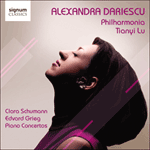 Grieg & Schumann (C): Piano Concertos Grieg & Schumann (C): Piano ConcertosStudio Master: SIGCD799Download onlyStudio Master FLAC & ALAC downloads available  Clara Schumann gave the first performance of her virtuosic piano concerto when still a teenager (the conductor on the occasion being no less a figure than Felix Mendelssohn); Edvard Grieg was only a few years older when he wrote his. Here young Ro ...» More |