Welcome to Hyperion Records, a British classical label devoted to presenting high-quality recordings of music of all styles and from all periods from the twelfth century to the twenty-first.
Hyperion offers both CDs, and downloads in a number of formats. The site is also available in several languages.
Please use the dropdown buttons to set your preferred options, or use the checkbox to accept the defaults.

| London Symphony Orchestra, Barry Tuckwell (conductor)» More |
 PERFORMANCE
 RECORDING
The choice of the collective title Pomp and Circumstance is in itself equivocal. It comes from Shakespeare: a renunciatory speech made by Othello who, imagining himself betrayed, angrily contemplates an end to military service with a farewell to ‘the royal banner, and all quality, Pride, pomp and circumstance of glorious war’. It is hardly celebratory. Nor is there obvious celebration in the prefatory poem Elgar appended to the score of the first March, which talks of ‘proud music that draws men on to die … in martial ecstasy’. It serves as a reminder that in 1901 Britain was still fighting the Boer Wars, with serious losses.
Nonetheless, the first performance of Marches 1 and 2, given together in October 1901, was the unequivocal success Elgar (now in his 40s) had been waiting for, and fixed a basic format for the Marches still to come—each of which would (curiously for such public music) be dedicated to personal friends, most of them cathedral organists.
March No 1 remains the best-known, thanks to the great tune in the Trio section that, as in all these Marches, supplies a more serene foil to the martial introduction. As originally conceived by Elgar, it was purely instrumental. But the following year it acquired a text by the Cambridge academic A C Benson—the deathless Land of Hope and Glory—with which it was then incorporated into an Ode for the coronation of King Edward VII. It also morphed into a stand-alone song for the soprano Clara Butt. And in 1905 it made its first appearance at the Proms, where it remains an annual Last Night fixture—irremovably, with all attempts to leave it out resisted vigorously by the public.
from notes by Michael White © 2023
Le choix du titre générique de Pomp and Circumstance est en lui-même équivoque. Il nous vient de Shakespeare: il renvoie à un discours de renoncement prononcé par Othello, lequel, s’imaginant trahi, envisage avec colère de mettre fin à son engagement militaire, en faisant ses adieux à «the royal banner, and all quality, Pride, pomp and circumstance of glorious war». Voilà qui n’est guère festif. Il n’est pas plus question de «célébration» dans le poème qui tient lieu de préface, qu’Elgar a joint à la partition de la première Marche, et qui parle de «la fière musique qui conduit les hommes à la mort … dans une extase martiale». Ce texte vient rappeler qu’en 1901, la Grande-Bretagne était encore engagée dans la guerre des Boers, avec de lourdes pertes à déplorer.
Néanmoins, la première exécution des Marches nº 1 et 2, données ensemble en octobre 1901, connaît ce succès sans équivoque qu’Elgar (alors âgé d’une quarantaine d’années) était en droit d’attendre, et arrête un format de base pour les Marches à venir—chacune d’entre elles étant (curieusement pour une musique aussi publique) dédiée à des amis personnels, pour la plupart des organistes de cathédrales.
La Marche nº 1 reste la plus connue de toutes, grâce au fameux air de la section correspondant au Trio, lequel, comme dans toutes ces Marches, fournit un contrepoids, plus serein, à l’introduction martiale. Telle que conçue à l’origine par Elgar, elle était purement instrumentale. Mais l’année suivante, elle reçoit un texte dû à un universitaire de Cambridge, du nom de A C Benson—l’immortel Land of Hope and Glory («Terre d’espoir et de gloire»)—avec lequel elle se trouve ensuite incorporée dans une Ode pour le couronnement du roi Édouard VII. Elle s’est également transformée en une pièce autonome chantée par la soprano Clara Butt. Et, en 1905, elle fait pour la première fois son apparition aux Proms, où elle reste un incontournable rendez-vous annuel de la Last Night («Dernière Soirée»)—de manière inamovible, toutes les tentatives visant à l’exclure ayant été vigoureusement combattues par le public.
extrait des notes rédigées par Michael White © 2023
Français: Pascal Bergerault
Die Wahl des übergeordneten Titels Pomp and Circumstance ist mehrdeutig und stammt aus Shakespeares Othello. Der Titelheld glaubt sich hintergangen, er erwägt zornig, sich aus dem Militärdienst zurückzuziehen und sich zu verabschieden von „königlich Panier und alle[m] Glanz, Pracht, Pomp und Rüstung des glorreichen Kriegs!“ Das kann man kaum eine Festrede nennen, und ebenso wenig festlich ist das einleitende Gedicht, das Elgar der Partitur des ersten Marschs beifügte; dort ist die Rede von „stolzer Musik, die Männer antreibt … in kriegerischer Ekstase zu sterben.“ Das dient eher der Erinnerung daran, dass Großbritannien im Jahr 1901 noch mit großen Verlusten den Burenkrieg führte.
Dennoch war die gemeinsame Premiere der Märsche 1 und 2, die im Oktober 1901 erfolgte, der eindeutige Erfolg, auf den Elgar (mittlerweile gut vierzig) gewartet hatte, und sie legten das grundlegende Format für die noch folgenden Märsche fest—von denen jeder einem persönlichen Freund gewidmet sein würde (was für derart öffentliche Musik recht ungewöhnlich ist), zumeist Domorganisten.
March Nr. 1 ist nach wie vor der bekannteste wegen der großartigen Weise im Trio-Abschnitt, der, wie bei all diesen Märschen, einen abgeklärten Kontrast zur martialischen Einleitung bildet. Von Elgar war er ausschließlich instrumental konzipiert, doch im darauffolgenden Jahr erhielt er einen Text von dem in Cambridge wirkenden Gelehrten und Dichter A.C. Benson—Land of Hope and Glory, dem Land der Hoffnung und des Ruhms, in dem es keinen Tod gibt—und wurde damit in eine Ode anlässlich der Krönung König Edwards VII aufgenommen. Zudem wurde die Nummer zu einem in sich abgeschlossenen Lied für die Sopranistin Clara Butt. 1905 dann erklang die Musik erstmals bei den Proms, wo sie nach wie vor alljährlich ein fester Bestandteil der Last Night bildet—alle Versuche, daran etwas zu ändern, scheitern am heftigen Widerspruch der Öffentlichkeit.
aus dem Begleittext von Michael White © 2023
Deutsch: Ursula Wulfekamp
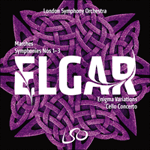 Elgar: Symphonies, Marches, Enigma Variations & Cello Concerto Elgar: Symphonies, Marches, Enigma Variations & Cello ConcertoLSO0572-D4CDs Download only  Over five hours of sumptuous orchestral grandeur in a bargain new set of classic Elgar recordings from the London Symphony Orchestra.» More |