Welcome to Hyperion Records, a British classical label devoted to presenting high-quality recordings of music of all styles and from all periods from the twelfth century to the twenty-first.

Hyperion offers both CDs, and downloads in a number of formats. The site is also available in several languages.

Please use the dropdown buttons to set your preferred options, or use the checkbox to accept the defaults.

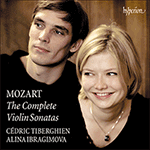
Click cover art to view larger version
Track(s) taken from CDA68092

Violin Sonata in G major, K9

composer
No 4; published as part of Sonates pour le Clavecin Qui peuvent se jouer avec l'Accompagnement de Violon, Op 1 & 2, dedicated to Princess Victoire, daughter of Louis XV

Alina Ibragimova (violin), Cédric Tiberghien (piano)
Studio Master FLAC & ALAC downloads available
CD-Quality:
Studio Master:
CD-Quality:
Studio Master:
Recording details: January 2015
Concert Hall, Wyastone Estate, Monmouth, United Kingdom
Produced by Andrew Keener
Engineered by Simon Eadon
Release date: October 2016
Total duration: 15 minutes 2 seconds
 

Reviews

‘Balancing what the 18th century dubbed ‘taste’ with vivid moment-by-moment characterisation, Tiberghien and Ibragimova strike me as nigh-on ideal … this ongoing series from the symbiotic partnership of Tiberghien and Ibragimova will be hard to beat’ (Gramophone)

‘Tiberghien's limpid phrasing, radiant cantabile and velvety, cushioned tone proves a continual source of pleasure, complemented ideally by Ibragimova's silvery-toned exploratory zeal, as she delights in Mozart's gentle textural interplay’ (BBC Music Magazine)
PERFORMANCE
RECORDING

‘Alina Ibragimova is, in many ways, an ideal interpreter … her sense of period taste conforms very much to current expectations of Mozart performance—the sound, delivered with immaculate cleanliness, is well-balanced and translucent, with sparing vibrato, intelligent, small-scale phrasing’ (The Strad)» More

«À cette rencontre entre deux instruments répond celle entre deux artistes, qui confirme ici un partenariat des plus accomplis» (Radio Classique, France)» More

«En complicité, le pianiste Cédric Tiberghien et la violoniste Alina Ibragimova dessinent l'émancipation d'un génie et subliment ses plus belles pages par un sens éprouvé de la narration» (24 heures, Switzerland)» More

„Vor allem aber beweist Alina Ibragimova bei Mozart ihre Fähigkeit, vermeintlich Bekanntes erfrischend neu klingen zu lassen, ohne dass sie dabei in die Gefahr gerät, bemüht originell klingen zu wollen … im reaktionsschnellen Zusammenspiel mit Cédric Tiberghien … bringt sie Mozarts Musik zum Singen, gibt den melodischen Linien klare Kontur, ohne sie vorsätzlich aufzurauen“ (Coburger Tageblatt, Germany)» More

„Ibragimova und Tiberghien … eröffnen den Reigen mit der F-Dur-Sonate KV 376—und zeigen hier und da den verschmitzten Mozart, immer aber sind sie auf Noblesse und Ausgewogenheit bedacht, dynamisch scheinen sie sich viel lieber im piano und pianissimo aufzuhalten als im forte“ (NDR Kultur, Germany)» More

„Diese musiziert diskret, zart, unaufdringlich, als hätte sie die klassische Terminologie—'Sonate für Klavier und Violine'—als Aufforderung gesehen, sich zurückzunehmen. Doch gerade die Diskretion ihres Spiels macht es so kostbar: Mozarts Musik ist absolut nichts für Selbstdarsteller“ (Ö1, Austria)» More

„Man darf gespannt sein, wann sich die beiden nun an die ‚großen‘ späten Sonaten wagen. Ihr Konzept geht jedenfalls immer noch auf und macht die zweite Folge abwechslungsreich“ (Klassik.com, Germany)» More
PERFORMANCE
RECORDING
The Sonata in G major, K9, begins with a piece on an ambitious scale for a composer of such tender age. The latter half of its opening subject is made up of an expansive, chromatically rising sequence of mounting tension, and the central development section unfolds for the greater part in the minor. The opening subject of the slow movement is given out in caressing thirds, while the second subject consists largely of a series of ascending scales. Given the modest scope of the exposition—a mere two-dozen bars—the central development section is surprisingly broad. Here, Mozart explores both the main subject’s rhythm and its melodic shape, bringing its parallel thirds into play. The first in the pair of minuets that concludes the sonata features an intermittent figure in flowing triplets. The triplets spill over into the second minuet, in the minor, which is written in triplet motion throughout.

from notes by Misha Donat © 2016

La Sonate en sol majeur, K 9, commence par une pièce d’une ampleur ambitieuse pour un compositeur dans l’âge tendre. La seconde moitié de son sujet initial se compose d’une séquence étendue à la tension croissante et qui monte chromatiquement; le développement central se déroule en majeure partie dans le mode mineur. Le premier sujet du mouvement lent est exposé en tierces caressantes, tandis que le second consiste largement en une série de gammes ascendantes. Par rapport aux dimensions modestes de l’exposition—juste deux douzaines de mesures—le développement central est d’une longueur étonnante. Mozart y explore à la fois le rythme du sujet principal et sa forme mélodique, faisant entrer en jeu ses tierces parallèles. Le premier des deux menuets qui conclut la sonate présente une figure intermittente en triolets fluides. Les triolets s’étendent au second menuet, en mineur, qui est écrit en triolets du début à la fin.

extrait des notes rédigées par Misha Donat © 2016
Français: Marie-Stella Pâris

Die Sonate G-Dur, KV 9 beginnt mit einem Stück, das von beträchtlichen Ehrgeiz für einen so jungen Komponisten zeugt. Die zweite Hälfte des Anfangsthemas besteht aus einer ausgedehnten chromatischen Sequenz von zunehmender Spannung, und die zentrale Durchführung entfaltet sich zum größeren Teil in Moll. Das erste Thema des langsamen Satzes erscheint zunächst in zärtlichen Terzparallelen, während das zweite größenteils aus ansteigenden Tonleitern besteht. Gemessen an der knappen Exposition—die gerade einmal 24 Takte hat—erreicht die Durchführung überraschende Ausdehnung. Hier verarbeitet Mozart sowohl den Rhythmus des Hauptthemas als auch dessen Melodik, wobei er die Terzparallelen ins Spiel bringt. Das erste der beiden Menuette, die die Sonate beschließen, enthält eine Figur in fließenden Triolen. Sie führen weiter ins zweite, in Moll gehaltene Menuett, das ganz in Triolenbewegung komponiert ist.

aus dem Begleittext von Misha Donat © 2016
Deutsch: Friedrich Sprondel
Other albums featuring this work

Mozart: The Complete Violin Sonatas
CDS44751/6010CDs Boxed set (at a special price) — To be issued soon Available Friday 11 September 2026
Waiting for content to load...