Welcome to Hyperion Records, a British classical label devoted to presenting high-quality recordings of music of all styles and from all periods from the twelfth century to the twenty-first.

Hyperion offers both CDs, and downloads in a number of formats. The site is also available in several languages.

Please use the dropdown buttons to set your preferred options, or use the checkbox to accept the defaults.
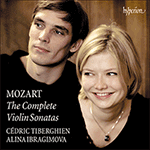
Click cover art to view larger version
Track(s) taken from CDA68091

Violin Sonata in E minor, K304

composer
No 21; Paris 1777/8

Alina Ibragimova (violin), Cédric Tiberghien (piano)
Studio Master FLAC & ALAC downloads available
CD-Quality:
Studio Master:
CD-Quality:
Studio Master:
Recording details: October 2014
Concert Hall, Wyastone Estate, Monmouth, United Kingdom
Produced by Andrew Keener
Engineered by Simon Eadon
Release date: May 2016
Total duration: 15 minutes 24 seconds
 

Reviews

‘[I] hope that these delightful, inventive performances presage a complete series of Mozart’s mature violin sonatas, with or without a smattering of childhood works’ (Gramophone)

‘Alina Ibragimova and Cédric Tiberghien … clearly relish their sense of innocent contentment and exhilaration in Mozart's burgeoning creative powers. Tiberghien's limpid phrasing, radiant cantabile and velvety, cushioned tone combine exquisitely, captured to perfection by production dream-team Andrew Keener and Simon Eadon’ (BBC Music Magazine)» More
PERFORMANCE
RECORDING

‘The balance between pianist Cédric Tiberghien and violinist Alina Ibragimova on this recording is as beautifully calibrated as always in this long-standing partnership’ (The Guardian)» More

‘Cédric Tiberghien takes the lead here, as he should, since the violin parts are written to be optional, but the partnership is full of entertaining touches … all the playing here shows an understanding of period practice’ (The Strad)» More

‘The set has been brightly recorded and Mozartians are in for a treat’ (Limelight, Australia)» More

‘Ibragimova sounds, perhaps, surprisingly mystical by virtue of the studied musical presence she evinces in her readings. But the very directness and clarity of Mozart’s style defies an attempt at any definitive execution and this set is as captivating as any, and true to Mozart’s spirit’ (MusicWeb International)

‘This brings out the best in both players (including piano playing of incredible softness), and the unresolved harmonic tensions of the close will surely tempt listeners to hope for more Mozart from the same team very soon’ (The Europadisc Review)» More

‘Tiberghien and Ibragimova scale their sound down effectively for these early works, and Hyperion's engineering work at the Wyastone Estate concert hall catches all the details. Recommended for those intrigued by Mozart's childhood’ (AllMusic, USA)» More

‘The fluidity of the partnership between Ibragimova and Tiberghien is key to the success of this album … the result is simply effortless listening, with the two musical roles complementing each other perfectly’ (Presto Classical)» More

‘A very desirable release’ (The Federation of Recorded Music News)» More

«Le piano de Cédric Tiberghien … se montre tour à tour impérial et voluptueux» (Diapason, France)» More

«Les deux musiciens jouent régulièrement ensemble, ce qui leur confère inévitablement un naturel et une complicité qui se ressentent dans leurs interprétations» (Radio Classique, France)» More

„Deliziös“ (Aachener Zeitung, Germany)» More

„Vor allem aber beweist Alina Ibragimova bei Mozart ihre Fähigkeit, vermeintlich Bekanntes erfrischend neu klingen zu lassen, ohne dass sie dabei in die Gefahr gerät, bemüht originell klingen zu wollen … im reaktionsschnellen Zusammenspiel mit Cédric Tiberghien … bringt sie Mozarts Musik zum Singen, gibt den melodischen Linien klare Kontur, ohne sie vorsätzlich aufzurauen“ (Coburger Tageblatt, Germany)» More

„Insbesondere hier fasziniert, wie eingespielt das Duo Ibragimova/Tiberghien ist, wie feinfühlig beider Spiel aufeinander reagiert und für Überraschungen sorgt, wenn Ibragimova mit ihrem eher historisch informierten Spielansatz und Tiberghien mit seinem kultivierten, poetischen Anschlag den mozartschen Impetus widerzugeben vermögen“ (MDR Kultur, Germany)» More

„Bei Mozart lässt sich die Entwicklung der Violinsonate von der Klaviersonate mit Begleitung der Violine bis hin zur Sonate mit zwei gleichberechtigten Partnern wunderbar nachvollziehen“ (Badisches Tagblatt, Germany)» More

'De Brits-Russische violiste Alina Ibragimova en pianist Cédric Tiberghien bundelen in een album van twee cd’s enkele schitterende stukken van Wolfgang Amadeus Mozart' (Kerk & Leven, Belgium)» More
Among the six violin sonatas of 1778, it is the quietly tragic Sonata in E minor, K304—Mozart’s only composition in this key—that leaves the deepest impression. Both the austere character of its opening movement and the haunting nostalgia of its minuet-style finale place it apart from its companions.

When Mozart begins a work with a theme in subdued bare octaves, as he does here, that beginning more often than not presages an unexpected harmonization of the same theme at a later stage. In this case, the harmonized version occurs at the start of the recapitulation. It is, indeed, so intensely chromatic that it momentarily gives the impression that the preceding development section is continuing.

The sotto voce minuet theme of the second movement, with its descending bass line (chromatically intensified in the melody’s second half), is one that carries an infinite feeling of melancholy. Even so, the theme is surpassed in expressive intensity by the movement’s major-mode middle section. The return to the minor brings with it a new accompanimental figure in smooth triplets, though its more flowing motion serves only to set in relief a coda whose halting phrases seem stricken with grief.

from notes by Misha Donat © 2016

Parmi les six sonates pour violon et piano de 1778, c’est la Sonate en mi mineur, K 304, doucement tragique—la seule composition de Mozart dans cette tonalité—qui laisse la plus profonde impression. Le caractère austère du mouvement initial comme la nostalgie lancinante de son finale dans le style d’un menuet la différencient de ses compagnes.

Lorsque Mozart commence une œuvre avec un thème en octaves contenues à découvert, comme il le fait ici, un tel début présage plus souvent qu’à son tour une harmonisation inattendue du même thème à une phase ultérieure. Dans le cas présent, cette version harmonisée survient au début de la réexposition. Elle est en fait si intensément chromatique qu’elle donne momentanément l’impression que le développement précédent se poursuit.

Le thème du menuet sotto voce du second mouvement, avec sa basse descendante (intensifiée de manière chromatique dans la seconde moitié de la mélodie) traduit une impression infinie de mélancolie. Le thème est quand même surpassé en intensité expressive par la section centrale du mouvement en majeur. Le retour au mineur amène une nouvelle figure d’accompagnement en triolets fluides, même si son mouvement plus coulant ne sert qu’à mettre en relief une coda dont les phrases hésitantes semblent accablées de douleur.

extrait des notes rédigées par Misha Donat © 2016
Français: Marie-Stella Pâris

Von den sechs Violinsonaten des Jahren 1778 hinterlässt die verhalten-tragische e-Moll-Sonate KV 304, die einzige Komposition Mozarts in dieser Tonart, den stärksten Eindruck. Sowohl die Strenge des Kopfsatzes als auch die Melancholie des Menuett-Finales zeichnen sie vor ihren Schwesterwerken aus.

Wenn Mozart ein Stück mit einem Thema in halblautem Unisono beginnt, so ist meistens zu einem späteren Zeitpunkt eine überraschende Harmonisierung zu erwarten. Hier erscheint sie zu Beginn der Reprise. Sie ist dabei so stark chromatisiert, dass der Eindruck entsteht, die Durchführung ginge einfach weiter.

Das sotto-voce-Thema des zweiten Satzes mit seiner absteigenden, in der zweiten Themenhälfte chromatisch intensivierten Basslinie scheint von grenzenloser Melancholie erfüllt. Gesteigert wird dieser Charakter noch vom Dur-Mittelteil des Satzes. Die Rückkehr nach Moll führt eine neue Begleitfigur aus Triolen und damit eine weicher fließende Bewegung ein—freilich nur, um in die Coda mit ihren trauervoll-stockenden Phrasen überzuleiten.

aus dem Begleittext von Misha Donat © 2016
Deutsch: Friedrich Sprondel
Waiting for content to load...