
Welcome to Hyperion Records, a British classical label devoted to presenting high-quality recordings of music of all styles and from all periods from the twelfth century to the twenty-first.
Hyperion offers both CDs, and downloads in a number of formats. The site is also available in several languages.
Please use the dropdown buttons to set your preferred options, or use the checkbox to accept the defaults.

| Llŷr Williams (piano)» More |
 PERFORMANCE
 RECORDING
The E major Sonata was probably begun in 1798, though it could have been earlier. It was published, along with its companion piece, in December of the following year. Did Beethoven originally plan to publish these two works together with his Sonata Op 13, the ‘Grande Sonate Pathétique’, thus completing a set of three to match his Op 2 and Op 10? It is possible, but he perhaps changed his mind when the ‘Pathétique’ turned out to be on a completely different scale.
The E major Sonata looks easier than most, but when you start to go beyond the notes you realize how many interpretative decisions there are to take. The opening four notes are the same (albeit transposed) as the first four notes of the fugue subject Beethoven was to use in the Sonata Op 110, which is purely coincidence. Some of the hopefulness of that ascending fugue subject is also felt here, above a simple, throbbing accompaniment. If this Allegro is started too fast things will get very scrambled in the fifth bar (a finger-twister if ever there was one). In the quartet version, Beethoven cautiously revised the tempo to Allegro moderato.
Small hands will have difficulty with bars 17–20 and breaking the chords is musically not very satisfying. The tender second subject brings out the ‘serene and noble’ character referred to by Czerny, who also tells us not to drag. The sforzando alternations between G natural and G sharp in bars 46–49 must be brought out while the inner part remains piano, and the bass a determined forte. The notes aren’t complicated, but their characterization is.
In a sketch for this movement, Beethoven wrote a note to himself not to develop the theme (‘ohne das Thema durchzuführen’), and he stuck to that. The development section commences with the rising fourths of the opening, but then begins a swirling theme, passionately disrupting what has come before. The momentum continues in the recapitulation where upward scales (both upwards and downwards in the case of the quartet version) accompany the theme. A drop to C major at the bottom of the keyboard adds a different colour. The coda is not easy to bring off. Again you need a large hand, great control of touch at softer dynamics, and the sensitivity to make the last few bars sound like an ending rather than just an abrupt stop.
Unlike Op 13, there is no slow movement, but rather an Allegretto in E minor that Czerny describes as a scherzo with a kind of ‘sad humour’ (‘unmuthiger Laune’). Schubert doesn’t seem far off at all. The tempo is perhaps more easily chosen from the maggiore middle section whose long lines seem happier if not dragging.
Allegro comodo (‘at a convenient pace’) is the marking for the final rondo, which is also alla breve. In other words, don’t rush: character before brilliant display. The sudden piano in bar 4 is not a mistake and must be observed. A good exercise in developing finger staccato in both loud and soft dynamics is found in the G major episode. The two variants on the rondo theme that end this work are marvellous: the first with its syncopations becoming more and more insistent; the second, with its gliding passing notes, pianissimo—leading us into the sudden but brilliant ending.
from notes by Angela Hewitt © 2016
La Sonate en mi majeur fut probablement commencée en 1798, mais peut-être plus tôt. Elle fut publiée, avec celle qui l’accompagne, en décembre de l’année suivante. À l’origine, Beethoven avait-il projeté de publier ces deux œuvres avec sa Sonate, op.13, la «Grande Sonate pathétique», complétant ainsi un cycle de trois sonates correspondant à son op.2 et à son op.10? C’est possible, mais il changea peut-être d’avis lorsque la «Pathétique» se révéla être d’une ampleur totalement différente.
La Sonate en mi majeur paraît plus facile que la plupart des autres, mais lorsque l’on commence à dépasser les notes, on se rend compte du nombre de décisions qu’il faut prendre en matière d’interprétation. Les quatre premières notes sont les mêmes (quoique transposées) que les quatre premières notes du sujet de fugue que Beethoven utilisa dans la Sonate, op.110, ce qui est pure coïncidence. Une part de l’optimisme de ce sujet fugué ascendant se retrouve aussi ici, au-dessus d’un simple accompagnement lancinant. Si cet Allegro commence trop vite, les choses se bousculeront beaucoup à la cinquième mesure (un entortillement des doigts ou je ne m’y connais pas). Dans la version pour quatuor, Beethoven révisa prudemment le tempo en Allegro moderato.
Les petites mains auront des difficultés avec les mesures 17–20 et sur le plan musical ce n’est pas très satisfaisant d’arpéger les accords. Le tendre second sujet fait ressortir le caractère «serein et noble» auquel faisait allusion Czerny, qui nous dit aussi de ne pas traîner. Les sforzando alternés entre sol naturel et sol dièse aux mesures 46–49 doivent ressortir tandis que la partie interne reste piano sur une basse résolument forte. Les notes ne sont pas compliquées, mais c’est leur interprétation qui l’est.
Dans une esquisse de ce mouvement, Beethoven a noté à son intention de ne pas développer le thème («ohne das Thema durchzuführen») et il s’y est tenu. Le développement commence avec ces quartes ascendantes, mais commence alors un thème tourbillonnant, qui interrompt avec passion ce qui a précédé. L’élan persiste dans la réexposition où des gammes ascendantes (ascendantes et descendantes dans le cas de la version pour quatuor) accompagnent le thème. Un passage en ut majeur en bas du clavier ajoute une couleur différente. La coda n’est pas facile à réussir. Il faut à nouveau avoir une grande main, une grande maîtrise du toucher dans les nuances plus douces et de la sensibilité pour que les dernières mesures aient l’air d’une fin plutôt que d’un arrêt abrupt.
Contrairement à l’op.13, il n’y a pas de mouvement lent, mais plutôt un Allegretto en mi mineur que Czerny décrit comme un scherzo avec une sorte d’humour triste («unmuthiger Laune»). Schubert ne semble pas très loin. Le tempo est peut-être plus facile à déterminer en partant de la section médiane maggiore dont les longues lignes semblent plus heureuses si on ne traîne pas.
Le rondo final, qui est aussi alla breve, est marqué Allegro comodo («à une allure convenable»). Autrement dit, ne vous précipitez pas: du caractère avant toute démonstration brillante. Le piano soudain à la mesure 4 n’est pas une erreur et doit être observé. L’épisode en sol majeur constitue un bon exercice pour développer le staccato des doigts dans les nuances fortes et douces. Les deux variantes sur le thème du rondo qui terminent cette œuvre sont merveilleuses: la première avec ses syncopes qui deviennent de plus en plus insistantes; la seconde, avec ses notes de passage qui planent, pianissimo—nous menant à la conclusion soudaine mais brillante.
extrait des notes rédigées par Angela Hewitt © 2016
Français: Marie-Stella Pâris
Beethoven begann wahrscheinlich 1798 mit der Arbeit an der E-Dur-Sonate, möglicherweise auch schon früher. Sie wurde im Dezember des folgenden Jahres zusammen mit ihrem Pendant herausgegeben. Hatte er ursprünglich geplant, diese beiden Werke mit seiner Sonate op. 13—die „Grande Sonate Pathétique“—zu kombinieren, und damit einen weiteren Dreierzyklus, entsprechend seines op. 2 und op. 10, herauszugeben? Möglich ist es, doch änderte er vielleicht sein Vorhaben, als die „Pathétique“ sich als ein Werk von ganz anderen Dimensionen entpuppte.
Die E-Dur-Sonate wirkt zunächst einfacher als viele andere, wenn man jedoch über den Notentext hinausgeht, wird deutlich, wie viele interpretatorische Entscheidungen zu treffen sind. Die vier Anfangstöne gleichen (wenn auch in transponierter Form) den vier Anfangstönen des Fugenthemas, welches Beethoven in der Sonate op. 110 verwendete, was allerdings reiner Zufall ist. Die Hoffnung jenes aufsteigenden Fugenthemas macht sich auch hier in gewisser Weise bemerkbar und erklingt über einer schlichten, pulsierenden Begleitung. Wenn man dieses Allegro zu schnell beginnt, wird es im fünften Takt (sozusagen ein Fingerbrecher) etwas chaotisch. In der Version für Quartett änderte Beethoven das Tempo vorsichtshalber zu Allegro moderato um.
Mit kleinen Händen hat man in den Takten 17–20 seine Mühe, und die Akkorde gebrochen zu spielen, ist musikalisch gesehen nicht besonders befriedigend. Das zarte zweite Thema bringt den „heiter’n, edlen Charakter“ zum Ausdruck, auf den Czerny hinweist, welcher zudem mahnt, das man nicht schleppen solle. Die Sforzando-Wechsel zwischen G und Gis in den Takten 46–49 müssen betont werden, während die Mittelstimme im Piano bleibt und die Basslinie ein entschiedenes Forte spielt. Die Töne selbst sind nicht kompliziert, ihre Darstellung hingegen durchaus.
In einer Skizze zu diesem Satz notierte Beethoven sich: „ohne das Thema durchzuführen“, und daran hielt er sich auch. Der Durchführungsteil beginnt mit jenen aufsteigenden Quarten, doch erklingt dann ein umherwirbelndes Thema, welches das zuvor Erklungene temperamentvoll unterbricht. Dieser Impuls hält sich bis in die Reprise, wo aufwärts gerichtete Tonleitern (in der Quartettversion verlaufen sie sowohl aufwärts als auch abwärts) das Thema begleiten. Ein Abfallen nach C-Dur am unteren Ende der Klaviatur sorgt für eine neue Klangfarbe. Die Coda ist nicht leicht zu bewältigen. Auch hier sind große Hände sowie besondere Anschlagsbeherrschung bei der leiseren Dynamik und Feingefühl vonnöten, dass die letzten Takte wie ein Ende und nicht ein abruptes Innehalten klingen.
Anders als in op. 13 gibt es hier keinen langsamen Satz, sondern stattdessen ein Allegretto in e-Moll, das Czerny als ein Scherzo von „unmuthiger Laune“ beschreibt. Schubert scheint nicht weit entfernt zu sein. Das Tempo lässt sich vielleicht am besten aus dem mit „Maggiore“ bezeichneten Mittelteil entnehmen, dessen lange Linien glücklicher wirken, wenn sie nicht schleppen.
Allegro comodo (laut Czerny: „sehr lebhaft und munter, aber mit einer gewissen leichtfertigen Bequemlichkeit“) lautet die Bezeichnung für das Schlussrondo, welches zudem ein Alla breve ist. Mit anderen Worten: Nicht hetzen, Charakter geht vor brillanter Zurschaustellung. Das plötzliche Piano in Takt 4 ist kein Fehler und sollte beachtet werden. Eine gute Übung zum Entwickeln eines Fingerstaccatos sowohl im Forte als auch Piano findet sich in der G-Dur-Episode. Die beiden Varianten des Rondo-Themas, mit denen dieses Werk endet, sind herrlich—in der ersten werden die Synkopen immer nachdrücklicher, und in der zweiten erklingen gleitende Durchgangstöne im Pianissimo, die zu dem plötzlichen, aber brillanten Schluss führen.
aus dem Begleittext von Angela Hewitt © 2016
Deutsch: Viola Scheffel
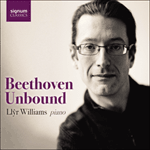 Beethoven: Beethoven Unbound Beethoven: Beethoven UnboundStudio Master: SIGCD52712CDs Download onlyStudio Master FLAC & ALAC downloads available  A comprehensive new cycle of the Beethoven sonatas recorded live at London's Wigmore Hall during the pianist's epic fourth rendition of these masterpieces .» More |