
Welcome to Hyperion Records, a British classical label devoted to presenting high-quality recordings of music of all styles and from all periods from the twelfth century to the twenty-first.
Hyperion offers both CDs, and downloads in a number of formats. The site is also available in several languages.
Please use the dropdown buttons to set your preferred options, or use the checkbox to accept the defaults.


| Eileen Joyce (piano)» More |

Grieg never performed the Ballade in public, but in 1876 gave a private performance for Dr Max Abraham, director of Peters the music publishers. According to witnesses, when he was finished, Grieg was ‘completely exhausted, and so agitated and shaken that he could not say a word for a long time afterwards’. It was clearly a work that had a strong emotional meaning for him, with the composer describing it as having been ‘written with my life’s blood in days of sorrow and despair’. It was composed in the aftermath of the death of his parents in 1875, a period of depression also linked to problems in his relationship with his wife.
The Ballade’s sombre sixteen-bar theme was taken by Grieg from Ludvig Mathias Lindeman’s collection Ældre og nyere Norske fjeldmelodier (‘Norwegian mountain tunes new and old’), published in 1840, though the melody is several hundred years older than that. The fourteen variations range from simple elaborations to ornate metamorphoses in wildly different characters and styles. There are canons, recitative-like passages, a melancholy lento, witty scherzando episodes, Schumannesque pages and virtuosic Lisztian outbursts. The first eight variations preserve the theme almost intact both harmonically and melodically. The ninth variation is more elaborate and could almost stand as an independent piece of music, while the remaining variations form one continuous stream of music.
The writer Gregory Martin has commented that ‘Grieg’s engagement with his material may be seen as something analogous to the oral poet, illuminating aspects of storytelling sometimes unfamiliar in the Western tradition’—an echo of Shaw’s characterization of Grieg as a ‘rhapsode’. Here, Greek epic poems are exchanged for Norwegian Eddic ones.
Leopold Godowsky made the first disc recording of the work in 1929. We can take this as an authoritative interpretation, for back in 1907 when the two met in Berlin the composer himself had expressed a hope that such a recording might take place, Grieg having been told of Godowsky’s masterly interpretation of his Ballade (shortly after he did indeed make an early piano roll of it for Hupfeld). It was also in the repertoire of Rachmaninov, Josef Hofmann and Percy Grainger, but after Godowsky, apart from four in the 1940s, no further recordings were made until the advent of the LP, the most delightful being in 1953 from Arthur Rubinstein who had been introduced to Grieg briefly in 1902.
from notes by Jeremy Nicholas © 2024
Grieg ne joua jamais la Ballade en public, mais, en 1876, il en donna une exécution privée pour le Dr Max Abraham, directeur de la maison d’édition Peters. Selon des témoins, lorsqu’il eut terminé, Grieg était «complètement épuisé, et si agité et secoué qu’il ne put pas prononcer un seul mot pendant un bon moment». C’était clairement une œuvre qui avait une forte signification émotionnelle pour lui, le compositeur la décrivant comme ayant été «écrite avec mon âme à une époque de chagrin et de désespoir». Elle fut composée après la mort de ses parents en 1875, une période de dépression également liée à des problèmes dans ses relations conjugales.
Grieg tira le thème sombre de seize mesures de sa Ballade du recueil de Ludvig Mathias Lindeman Ældre og nyere Norske fjeldmelodier («Airs montagnards norvégiens nouveaux et anciens»), publié en 1840, bien que la mélodie remonte à plusieurs centaines d’années en arrière. Les quatorze variations vont de simples élaborations à des métamorphoses richement ornées, de caractères et de styles très différents. Il y a des canons, des passages en forme de récitatifs, un lento mélancolique, des épisodes scherzando spirituels, des pages dans le style de Schumann et des accès de virtuosité lisztiens. Les huit premières variations conservent le thème presque intact à la fois sur le plan harmonique et sur le plan mélodique. La neuvième variation est plus élaborée et pourrait presque être jouée seule, alors que les variations suivantes forment un flot continu de musique.
L’écrivain Gregory Martin a noté que «l’engagement de Grieg à l’égard de son matériel peut être considéré comme quelque chose d’analogue au poète oral, illuminant des aspects de la narration parfois inhabituels dans la tradition occidentale»—un écho de Shaw qualifiant Grieg de «rhapsode». Ici, la poésie épique grecque est remplacée par des poèmes eddiques norvégiens.
Leopold Godowsky fit le premier enregistrement discographique de cette œuvre en 1929. On peut le prendre comme une interprétation de référence, car, en 1907, lorsque Grieg et Godowsky se rencontrèrent à Berlin, le compositeur lui-même exprima l’espoir qu’un tel enregistrement puisse avoir lieu, Grieg ayant entendu parlé de l’interprétation magistrale de sa Ballade par Godowsky (peu après il en fit en effet une première bande perforée pour piano mécanique pour Hupfeld). Elle était aussi au répertoire de Rachmaninov, Josef Hofmann et Percy Grainger, mais après Godowsky, à l’exception de quatre enregistrements dans les années 1940, il n’y en eut aucun autre jusqu’à l’apparition du 33 tours, le plus beau étant dû, en 1953, à Arthur Rubinstein qui avait rencontré brièvement Grieg en 1902.
extrait des notes rédigées par Jeremy Nicholas © 2024
Français: Marie-Stella Pâris
Grieg bot die Ballade nie öffentlich dar, doch gab er 1876 eine Privataufführung für den Direktor des Musikverlags Peters, Dr. Max Abraham. Zeugenaussagen zufolge war Grieg danach „völlig erschöpft und derartig aufgewühlt, dass er danach lange Zeit kein Wort sagen konnte“. Das Werk hatte für ihn offensichtlich eine starke emotionale Bedeutung—er erklärte, er habe es „mit meinem Lebensblut in Tagen des Kummers und der Verzweiflung geschrieben“. Es entstand nach dem Tod seiner Eltern im Jahr 1875, einer Zeit der Depression, die auch mit Problemen in seiner Beziehung zu seiner Frau zusammenhing.
Das düstere 16-taktige Thema der Ballade stammte aus Ludvig Mathias Lindemans 1840 veröffentlichter Sammlung Ældre og nyere Norske fjeldmelodier („Ältere und neuere norwegische Gebirgsmelodien“), obwohl die Melodie mehrere hundert Jahre älter ist. Die 14 Variationen reichen von einfachen Ausarbeitungen bis hin zu kunstvollen Metamorphosen mit diversen Charakteristika und in sehr unterschiedlichen Stilen. Es gibt Kanons, rezitativartige Passagen, ein melancholisches Lento, witzige Scherzando-Episoden, Schumanneske Passagen und virtuose Liszt’sche Ausbrüche. In den ersten acht Variationen bleibt das Thema sowohl harmonisch als auch melodisch fast unangetastet. Die neunte Variation ist aufwändiger und könnte fast als eigenständiges Musikstück stehen, während die übrigen Variationen einen kontinuierlichen Musikstrom bilden.
Dem Schriftsteller Gregory Martin zufolge könne „Griegs Auseinandersetzung mit seinem Material als eine Art Analogie zum mündlichen Dichter gesehen werden, der Aspekte des Geschichtenerzählens beleuchtet, die in der westlichen Tradition manchmal ungewohnt sind“, womit er Shaws Charakterisierung von Grieg als „Rhapsoden“ unterstreicht. Hier wird griechische Epik gegen norwegische eddische Dichtung ausgetauscht.
Leopold Godowsky spielte das Werk 1929 erstmals auf Schallplatte ein. Man kann durchaus davon ausgehen, dass dies eine maßgebliche Interpretation war, denn bereits 1907, als die beiden sich in Berlin trafen, hatte der Komponist selbst die Hoffnung geäußert, dass eine solche Aufnahme zustande kommen möge, da Grieg von Godowskys meisterhafter Interpretation seiner Ballade gehört hatte (kurz darauf spielte er tatsächlich eine frühe Notenrolle davon für Hupfeld ein). Auch Rachmaninow, Josef Hofmann und Percy Grainger hatten sie im Repertoire, aber nach Godowsky wurden, abgesehen von vier Aufnahmen in den 1940er Jahren, bis zum Aufkommen der Schallplatte keine weiteren Aufnahmen mehr gemacht, wobei Arthur Rubinstein, der Grieg 1902 kurz kennengelernt hatte, 1953 die schönste einspielte.
aus dem Begleittext von Jeremy Nicholas © 2024
Deutsch: Viola Scheffel
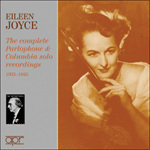 Eileen Joyce - The complete Parlophone & Columbia solo recordings Eileen Joyce - The complete Parlophone & Columbia solo recordingsAPR75025CDs Download only  ‘Listening to Joyce is strangely addictive. One cannot wait, as it were, to read the next chapter. She shares with Kreisler and Tauber the same unteac ... ‘The quality that comes across in these performances is the sheer joy of playing. Joyce possessed a formidable technique and an interpretative mind th ...» More |